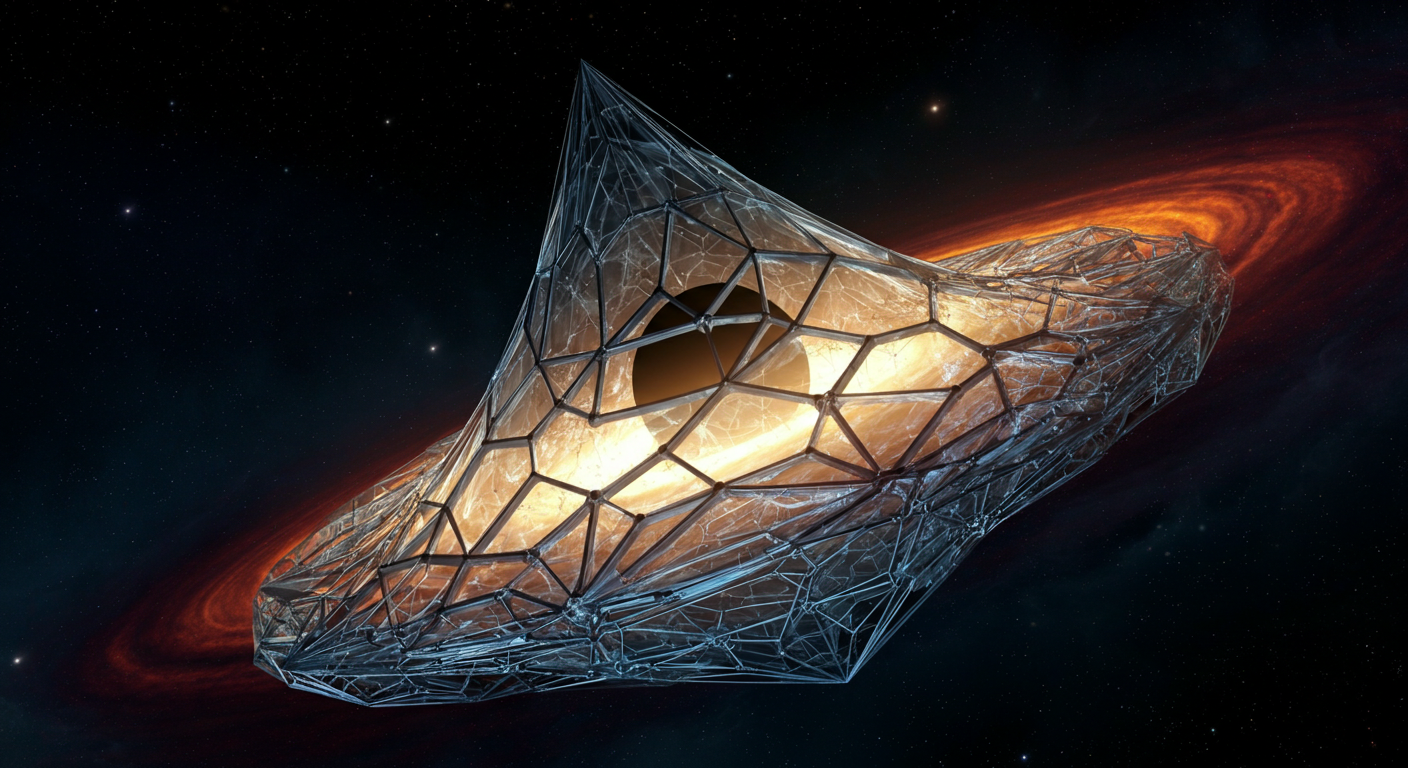
Astronomers are celebrating a "breakthrough" that isn't one. The pop-sci media machine is churning out headlines claiming we have finally cracked the 30-year-old mystery of how supermassive black holes formed in the early universe without relying on dying stars. They are pointing to new cosmological simulations of "direct collapse" as if someone just handed them a smoking gun.
They are celebrating a mathematical ghost. Discover more on a similar subject: this related article.
The mainstream narrative is neat, tidy, and utterly flawed. It tells you that pristine gas clouds in the early universe, devoid of heavy elements to cool them down, collapsed under their own gravity straight into massive black holes. This supposedly solves the "impossible early black hole" problem—the fact that we see monstrous black holes just a few hundred million years after the Big Bang that shouldn't have had time to grow.
The lazy consensus has bought into a pristine, idealized simulation that reality completely rejects. If you spend your career looking at raw observational data rather than polished code visualizations, you know the truth: direct collapse is a theoretical band-aid for a gaping wound in standard cosmological models. We are inventing physics to save our assumptions. More journalism by Mashable highlights comparable perspectives on the subject.
The Mathematical Mirage of Pristine Clouds
To make a direct collapse black hole work on paper, you need conditions so hyper-specific they border on the miraculous. You need a massive cloud of hydrogen and helium. You need it to be completely isolated from metals—astronomy shorthand for anything heavier than helium. And critically, you need a nearby, massive star-forming galaxy to flood that cloud with a precise dose of Lyman-Werner radiation.
This radiation is supposed to destroy molecular hydrogen ($H_2$), preventing the cloud from fragmenting into a cluster of normal, small stars. The idea is that without molecular hydrogen to cool the gas to low temperatures, the cloud stays hot, stays bloated, and then collapses en masse into a single singularity of $10^4$ to $10^6$ solar masses.
Here is what the textbook cheerleaders omit: the required intensity of that radiation field is absurdly high.
Imagine trying to keep a block of ice from melting while blasting it with a hairdryer from five miles away, except the hairdryer has to be exactly the right wattage or the ice turns into steam instantly. If the radiation field is too weak, the cloud fragments, and you get a boring old star cluster. If it is too strong, you ionize the gas entirely, blow it away, and get absolutely nothing.
Simulations can tune these knobs to perfection. The universe cannot.
When we look at the actual topology of the early universe through instruments like the James Webb Space Telescope, we do not see pristine, isolated pockets waiting to be perfectly illuminated. We see a chaotic, highly turbulent environment. Heavy elements from the very first population of stars (Pop III) polluted the interstellar medium far faster and far more thoroughly than early models predicted. The moment you introduce a fraction of a percent of carbon or oxygen, the direct collapse channel shuts down permanently. The gas cools, fragments, and the "mystery-solving" shortcut vanishes.
The Scale Problem We Refuse to Admit
Let us look at the raw mechanics. The standard model of accretion—the Eddington limit—dictates how fast a black hole can eat. It balances the inward pull of gravity against the outward pressure of the radiation generated by the falling matter.
$$M_{\text{dot}} = \frac{4\pi G M m_p}{\epsilon c \sigma_T}$$
If a black hole feeds above this limit, the radiation blows the food supply away. To get the supermassive black holes we observe at a redshift of $z > 7$, a stellar-mass seed (born from a dying star) would have to feed at hyper-Eddington rates continuously for hundreds of millions of years without a break. Because that violates conventional astrophysics, theorists invented direct collapse to give the black holes a massive head start.
But replacing stellar seeds with direct collapse seeds does not fix the underlying structural issue; it just kicks the can down the road.
A $10^5$ solar mass seed is still tiny compared to the $10^9$ solar mass monsters we are detecting. It still requires sustained, uninterrupted, highly efficient accretion in an early universe that was characterized by violent feedback, supernovae explosions, and intense stellar winds that routinely cleared out gas reservoirs.
I have spent years analyzing spectral data, and if there is one thing nature loves, it is messy, inefficient feedback loops. The idea that a massive gas cloud smoothly channels its entire mass into a central point without blowing itself apart via angular momentum is a fantasy. As gas collapses, it spins faster. Spin creates centrifugal barriers. To get the gas into the center, you must shed angular momentum at an impossible rate. Standard magnetic braking mechanisms in primordial gas are simply not strong enough to handle this on the scales required for direct collapse.
The Flawed Premise of Your Questions
When people ask, "How did black holes grow so fast?" they are operating under a flawed premise. They assume our understanding of time, accretion limits, and early star formation is a solved puzzle, meaning the seed mass must be the variable we tweak.
Instead of inventing pristine clouds that defy thermodynamic realities, we should look at what we are actually miscalculating:
- The Eddington Limit is Not a Hard Ceiling: We treat the Eddington limit as an absolute physical law. It is not. It assumes spherical symmetry and steady-state accretion. Real accretion is asymmetric, chaotic, and occurs via dense disks or cold streams. Super-Eddington accretion is not just possible; it is likely the dominant mode of growth in the early universe.
- Primordial Black Holes Are Ignored: We are looking for answers in gas clouds because we can simulate them easily. We completely ignore the possibility of Primordial Black Holes (PBHs) formed during cosmic inflation, fractions of a second after the Big Bang. These seeds would require no gas dynamics, no radiation fields, and no heavy-element constraints to exist.
The Risk of Our Theoretical Echo Chamber
The danger of the current enthusiasm around these new simulations is that it stalls genuine discovery. When a high-profile paper claims to have solved a 30-year-old mystery, funding shifts, telescope time gets allocated to confirm the bias, and alternative theories are pushed to the fringe.
Admitting that direct collapse is highly improbable forces us to confront uncomfortable gaps in fundamental physics. It means acknowledging that our models of how gas behaves under extreme gravitational fields in the early universe are inadequate. It means admitting that the early universe was far more efficient at moving matter than our current equations allow.
We have substituted observational proof with beautiful code. A simulation showing a cloud collapsing into a black hole is not evidence that it happened; it is merely proof that a programmer wrote a set of rules that allowed it to happen.
Stop looking for the magic seed that skipped the line. The universe did not cheat the clock with immaculate gas clouds. Our understanding of how matter feeds is what is broken. Fix the accretion physics, stop treating limits as laws, and the impossible early black holes suddenly become inevitable.