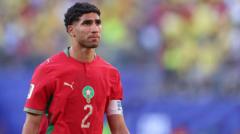
A French appeals court confirmed that Morocco captain and Paris Saint-Germain star Achraf Hakimi will stand trial for rape, a decision delivered just hours before his national team took the pitch at the World Cup. The ruling by the Versailles appeals court solidifies a multi-year legal process that men’s professional football has spent millions trying to outrun. While Hakimi prepares to face Scotland in Group C following a hard-fought draw against Brazil, his legal reality has caught up with his sporting ascendancy. This development cuts through the carefully manicured public relations imagery of modern football, exposing the friction between elite athletic systems and judicial scrutiny.
The international sporting industry has built a modern architecture designed to insulate its most valuable human assets from external legal turbulence. When the Nanterre prosecutor’s office first opened its investigation in March 2023 after a twenty-four-year-old woman alleged she was assaulted at Hakimi’s suburban Paris home, the institutional machinery immediately pivoted toward preservation. Contracts remained untouched. Corporate sponsors maintained their silence. The player continued to start, eventually helping Paris Saint-Germain secure a consecutive Champions League trophy in May 2026 against Arsenal. If you found value in this piece, you might want to look at: this related article.
The Mechanics of Institutional Inaction
Super-clubs operate less like traditional sports teams and more like sovereign corporations with private interests to defend. When an asset worth tens of millions of euros faces severe criminal allegations, the default corporate posture is to defer to the slow grind of the judicial process while extracting maximum on-field utility from the employee. Paris Saint-Germain head coach Luis Enrique encapsulated this institutional detachment when pressed on the matter, dryly stating that the issue resides entirely within the hands of the authorities. This calculated neutrality allows clubs to bypass moral obligations under the guise of legal prudence.
The economic reality of modern football dictates that benching a player of Hakimi's caliber without a definitive verdict represents a massive hit to capital. He remains arguably the finest right-back in the global game, an indispensable piece of both his club’s tactical framework and Morocco’s golden generation. To bench him is to diminish the value of a multi-million-euro investment. Consequently, the industry chose to normalize his presence on the pitch, allowing him to collect an Olympic bronze medal in 2024 and lift European trophies while the criminal investigation quietly intensified behind closed doors. For another perspective on this event, check out the latest coverage from NBC Sports.
The criminal justice system in France operates under specific structural mechanisms that contrast sharply with the swift public judgments of the internet era. The investigative judge’s decision in February to send the case to trial, now ratified by the appeals court, indicates that the state believes there is a serious, credible case to answer. It is not a declaration of guilt. It is, however, an acknowledgement that the evidence compiled over three years cannot simply be dismissed as a minor dispute or a malicious fabrication.
The Strategy of Aggressive Defense
Fanny Colin, the attorney spearheading Hakimi’s legal defense, has adopted a strategy centered on aggressive counter-accusations and systemic bias. The defense maintains that the case against the defender is a product of high-profile opportunism. Colin has publicly asserted that the standard investigation would have been thrown out if the defendant were an ordinary citizen rather than a globally recognized sports icon. Hakimi echoed this sentiment on social media, claiming that justice officials admitted to him that his fame was the sole reason the prosecution persisted.
The defense team has explicitly targeted the credibility of the plaintiff, highlighting her refusal to undergo certain medical examinations, DNA testing, or full forensic analysis of her mobile device. According to Colin, two separate psychological assessments of the complainant noted inconsistencies in her narrative and a distinct absence of post-traumatic symptoms. The defense has gone so far as to claim that the police files contain evidence of an attempted extortion plot against the Moroccan international. By framing the player as a victim of celebrity racketeering, the defense seeks to shift the spotlight from the alleged assault to the financial motives of the accuser.
This legal maneuvering represents a standard blueprint in high-stakes sports litigation. When the physical evidence is contested or obscured by delays, the battleground shifts entirely to narrative control and psychological undermining. The defense aims to establish a pattern of non-cooperation by the plaintiff to create reasonable doubt before a judge ever seats a trial.
The Sound Barrier of Sport
Rachel-Flore Pardo, the attorney representing the plaintiff, views the appeals court decision as a historical rupture in an industry notorious for silencing accusers. Pardo stated that her client experienced years of public defamation and systemic intimidation by the player’s extensive legal apparatus. The decision to move forward to a full criminal trial offers a rare moment of institutional validation for an individual challenging a multi-billion-euro sporting enterprise.
Pardo noted that while social movements have altered accountability metrics across the entertainment and corporate sectors, men’s professional football remains an insulated enclave where alternative rules apply. The sport operates as a private economy with its own internal governance, its own billionaire owners, and a fan base that often prioritizes weekend results over systemic ethics. This environment creates a protective bubble where athletes are insulated from the social transformations affecting the broader cultural world.
The legal journey of this case highlights the immense personal and financial cost borne by individuals who bring allegations against elite figures. For more than three years, the plaintiff has had to watch her alleged abuser celebrated on television screens, lifting domestic titles and leading his country on the world stage. The psychological weight of this disparity is immense. The upcoming trial threatens to dismantle the structural impunity that has historically characterized European football clubs when managing the off-field conduct of their superstar assets.
The World Cup Context and Corporate Exposure
The timing of the court’s decision introduces an unprecedented logistical and reputational challenge for FIFA and the tournament organizers in North America. Having the captain of the Moroccan national team actively competing in the group stage of a World Cup while being officially ordered to stand trial for a violent crime creates a public relations nightmare. Corporate sponsors who spend hundreds of millions to attach their brands to the tournament are suddenly forced to navigate a toxic intersection of sports entertainment and criminal prosecution.
Morocco’s spectacular run in recent tournaments turned players like Hakimi into national icons and symbols of regional pride across Africa and the Arab world. The national federation has chosen to back its captain entirely, viewing him as essential to their competitive survival in a group that demands flawless performances. This unwavering athletic backing demonstrates that within the calculus of international sports, competitive survival almost always supersedes ethical consistency.
The trial date remains unannounced, leaving a cloud of uncertainty hanging over both Paris Saint-Germain’s upcoming season and Hakimi's long-term career prospects. If convicted, the defender faces a substantial prison sentence under French law, a result that would abruptly terminate his career at its absolute physical peak. If acquitted, the verdict will be weaponized by the football establishment to justify their continued employment of contested assets and to discredit future allegations brought against high-earning players.
The upcoming proceedings will force a public accounting of events that took place away from the stadium lights, under the strict evaluation of criminal law rather than the lenient internal codes of a football club. The sport will be watching, not for the tactical brilliance of a right-back, but to see if its financial power can influence the statutory mechanisms of a European state. The fortress of football governance is about to face its most direct judicial challenge.