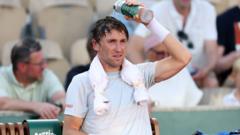
Five match points. You're up two sets to love, leading 5-3, and holding a triple match point at 40-0 on Court Simonne-Mathieu. Your ticket to the second round of the French Open is basically punched. Then, the air turns to soup, your vision blurs, and your own body becomes your worst enemy.
That's the nightmare Casper Ruud lived through in Paris. The Norwegian clay-court specialist didn't just survive a tennis match against Roman Safiullin; he survived a medical emergency. By the time he scraped through with a 6-2, 7-6 (7-5), 5-7, 0-6, 6-2 victory, he wasn't thinking about tactics or ranking points. He was just trying not to faint.
The Anatomy of a Physical Collapse
Tennis fans love a good comeback story, but what happened to Ruud in the third and fourth sets wasn't a standard choke. It was a complete biological shutdown. Leading 5-3 in the third set, Ruud missed five opportunities to close the match. Safiullin, displaying the kind of resilience you need to survive Grand Slam tennis, broke back and took the set 7-5.
That's when the wheels came off entirely.
The heat in Paris crossed the 90-degree mark, but on the enclosed, sunken clay courts of Roland Garros, the humidity and trapped air make it feel significantly hotter. Ruud's core temperature spiked. He couldn't get it back down.
"I felt quite horrible and dizzy. It was really hard to see the ball," Ruud admitted after the match. "I think my body temperature was too high."
What followed was hard to watch. Ruud lost 11 out of 12 games. In the fourth set, he looked like a ghost wandering around the baseline, completely unable to track Safiullin's shots. He took two separate medical timeouts so doctors could check his vitals. He was tracking toward a heatstroke. The fourth set was a brutal, swift 0-6 blowout. He was effectively out on his feet.
Tanking a Set to Save a Match
This is where veteran instinct replaces raw athleticism. When you're redlining from heat exhaustion, you can't fight the weather and a professional tennis player at the same time. Ruud made a conscious decision during that ugly fourth set. He stopped running. He gave himself time to breathe.
It looked like a tank to the casual observer. In reality, it was a calculated risk to lower his heart rate and let the worst of the full-body cramps pass.
A long bathroom break before the fifth set saved his tournament. Getting out of the sun, dumping ice water on his neck, and resetting mentally allowed him to stop the bleeding. When he walked back onto the court for the decider, the "zombie" version of Ruud was gone. The clay champion was back. He broke Safiullin early, reasserted his heavy topspin dominance, and closed it out 6-2.
Why the French Open Heat Hits Differently
People look at summer tournaments like the Australian Open or the US Open and assume Paris is a breeze by comparison. They're wrong. Roland Garros presents a unique physical challenge when the temperature surges.
Clay courts require continuous sliding, grinding, and extended rallies. You don't get free points on serve the way you do on grass or fast hard courts. Every single point is a physical negotiation. When you add high humidity to the equation, sweat stops evaporating efficiently. Your body loses its primary mechanism for cooling itself down.
Ruud is famously fit. He trains in grueling conditions and just came off a deep run to the final at the Italian Open in Rome. If a player with his aerobic base can look like a zombie after three hours in the sun, it means the conditions are borderline unsafe.
What This Means for the Rest of the Tournament
Ruud got away with one. You rarely get to blow five match points, lose a set 0-6, and still advance at a Grand Slam. But the physical toll of a 3-hour and 55-minute rollercoaster will linger.
Recovery is now the only thing that matters. Ruud faces Hamad Medjedovic in the second round, and his coaching staff will be focusing on aggressive hydration, ice baths, and regulatory sleep to fix the internal damage caused by the heat stress.
If you want to survive a two-week Grand Slam, you have to know how to win when your body fails you. Ruud proved he has the tactical IQ to manage a physical crisis on the big stage. He won't want to play another match like a zombie, but knowing he can pull himself back from the brink of collapse might just be the psychological edge he needs for the rest of his Paris campaign.