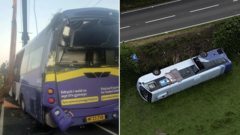
When a commuter bus collided with a freight truck on Route 9 last Tuesday, the official emergency response timeline missed the most critical window of survival. It took seventeen minutes for the first hydraulic extraction tools to arrive on the scene. During those seventeen minutes, trapped passengers survived only because a pair of local commercial plumbers pulled over, grabbed heavy-duty reciprocating saws and demolition bars from their work van, and cut through the twisted aluminum framing of the vehicle chassis themselves.
We call these incidents miracles. We praise the civilian heroes who act when adrenaline kicks in. But relying on civilian adrenaline is a terrifying structural failure masquerading as a feel-good news story.
The reality of modern transit safety is that our first responders are increasingly outpaced by the sheer scale of modern traffic gridlock and the evolving engineering of heavy passenger vehicles. When a mass casualty transit incident occurs, the first people on the scene are almost never paramedics or firefighters. They are ordinary drivers, construction workers, and tradespeople who happen to be in the adjacent lane. If they do not have the raw materials or the immediate instinct to intervene, people die waiting for a siren.
The Illusion of the Seventeen Minute Response
Municipalities frequently brag about response times that average under six minutes. What they omit is that these averages are heavily weighted by urban medical calls or minor residential alarms. For a major highway transit disaster, that metric disintegrates completely.
Traffic gridlock instantly locks down the very arterial roads emergency vehicles must use to reach the crash site. When a bus flips or jackknifes, it creates a localized kinetic bottleneck. The resulting backup can extend for miles within minutes, effectively barricading the scene from incoming fire trucks and heavy rescue squads.
Furthermore, standard emergency service protocols require a sequence of staging, size-up, and stabilization before extraction can even begin. This is a logical approach designed to protect responders from secondary hazards like fuel fires or unstable vehicle structures. However, for a passenger pinned beneath a collapsed row of seats, bleeding out from a ruptured femoral artery, this calculated delay is fatal.
Civilians do not wait for a size-up. They act on raw proximity. In the Route 9 incident, the tradespeople bypassed the traditional perimeter because they could hear the screams inside the cabin. They utilized commercial-grade cordless tools—devices that now possess the lithium-ion power to match older hydraulic machinery—to create makeshift exit portals through the shattered safety glass and reinforced side panels.
The Mechanics of Mechanical Advantage
To understand why civilian tools succeeded where standard emergency logic stumbled, one must look at the evolution of construction equipment. Over the past decade, high-torque cordless tools have quietly achieved parity with industrial rescue gear.
- Reciprocating saws equipped with carbide-tipped demolition blades can cut through high-strength alloy steels just as effectively as pneumatic shears, without requiring a heavy generator setup.
- Heavy-duty rotary hammers can fracture reinforced concrete barriers or floor panels in seconds.
- High-tensile ratcheting straps found in any standard commercial utility truck can stabilize a shifting vehicle frame faster than a specialized rescue cribbing kit can be deployed from a distant support unit.
This technological democratization means that a standard plumber's van or a contractor's flatbed is essentially a decentralized mobile rescue unit. The problem is that we treat these interventions as happy accidents rather than a predictable, necessary tier of emergency response.
The Lethal Cost of Bystander Hesitation
Every minute a trauma patient spends trapped inside a crushed cabin increases their mortality rate exponentially. Medical professionals refer to the Golden Hour—the window of time where prompt systemic intervention can prevent irreversible shock. Within that hour, the first fifteen minutes are the most volatile.
When civilians hesitate, it is rarely due to a lack of empathy. It is driven by fear. The modern legal environment has conditioned people to worry about liability, causing them to question whether moving an injured person will worsen a spinal injury or invite a catastrophic lawsuit.
While Good Samaritan laws technically protect individuals who provide amateur aid in good faith, the psychological barrier remains high. Most people see a twisted mass of metal and assume they lack the authority or the competence to touch it. They stand on the asphalt, pull out their smartphones, and record video while waiting for professional help that is stuck two miles back in traffic.
The tradespeople who intervened on Route 9 did not hesitate because their daily labor involves managing immediate, physical risk. They deal with high-pressure water systems, volatile gas lines, and unstable structural elements as a matter of course. Their comfort with physical chaos allowed them to override the natural instinct to stand back and wait.
The Risk of Amateur Extraction
It would be dishonest to suggest that civilian intervention is without severe danger. It is incredibly risky.
An untrained individual using a reciprocating saw can easily puncture a pressurized fuel line or sever an overlooked electrical conduit, triggering an explosion or electrocuting the victims. Commercial tools lack the spark-resistant coatings found on specialized fire rescue gear. Cutting through aluminum and steel produces a shower of white-hot sparks that can instantly ignite atomized gasoline or hydraulic fluid pooling beneath the wreckage.
[Crash Impact] -> [Local Gridlock Forms] -> [EMS Delayed in Traffic]
                                                    |
                                     +--------------+--------------+
                                     |                             |
                       [Option A: Civilian Action]    [Option B: Passive Waiting]
                                     |                             |
                      [Risk of Spark / Success]       [Exceeding Golden Hour]
                                     |                             |
                             (Rapid Extraction)              (Systemic Fatality)
There is also the problem of structural integrity. A vehicle cabin that has undergone severe kinetic deformation is often held in a state of precarious equilibrium. Cutting the wrong support pillar can cause the roof to collapse entirely under its own weight, crushing the occupants who were previously protected by the deformed metal. Professional rescue crews spend hundreds of hours learning how to read these structural stresses before they ever touch a tool to a vehicle. Civilians operate completely blind to these mechanics.
Redesigning the First Responder Hierarchy
If we accept that professional emergency services cannot always beat the clock on our crumbling, congested highway systems, we have to change how we view public transit security. We cannot keep relying on random acts of bravery to patch the holes in our civil infrastructure.
The first step requires a total shift in how commercial drivers and transit staff are trained. Long-haul truckers, delivery drivers, and municipal transit workers should not just be trained in basic first aid. They need to understand the fundamental principles of rapid vehicle stabilization and kinetic triage.
Our current system treats the public as passive cargo that must be preserved until a uniform arrives. That model is dead. It died the moment our suburban highways became permanent, slow-moving parking lots.
Decentralized Rescue Networks
Instead of concentrating all extraction capabilities in a few centralized fire stations, municipalities should incentivize the placement of heavy rescue kits inside standard commercial fleets.
Imagine a system where commercial transport vehicles are equipped with standardized, easily accessible exterior tool lockers containing heavy-duty glass breakers, reinforced cutting blades, and high-capacity tourniquets. If a major incident occurs, any qualified worker in the immediate vicinity can access the tools needed to initiate a life-saving intervention before the first fire engine even clears its station doors.
This requires zero abstract philosophy. It is a concrete logistical adjustment. We already do this with Automated External Defibrillators (AEDs) in office buildings and airports. We recognized that a heart attack will kill someone before an ambulance arrives, so we put the medical technology directly into the hands of whoever is standing nearby. A major highway collision is no different; it is simply a structural heart attack on a massive public scale.
The lesson of the Route 9 crash is not that we have great heroes among us. The lesson is that our centralized emergency systems failed to reach a high-casualty zone in time, and we got lucky that two men with a van full of pipe cutters and demo saws happened to have enough grit to step into the gap. Relying on luck is a terrible way to run a society. The next time a commuter bus folds inward on a congested highway, the plumbers might be three exits away, and the people inside will pay the price for our collective refusal to adapt.