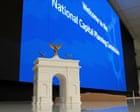
The National Capital Planning Commission just handed the White House a massive victory by advancing a 250-foot triumphal arch over intense public outcry. By an eight-to-one vote, the federal planning body granted preliminary approval for the gargantuan monument slated to sit at the Virginia end of the Memorial Bridge. The decision does not just threaten the iconic, flat skyline of Washington. It lays bare a calculated effort to dismantle a century of federal planning laws by declaring that the executive branch answers to no local height restrictions.
Bureaucrats did not just blink. They actively deferred the single most explosive legal question hanging over the project.
The core of the strategy relies on a quiet legal maneuver engineered by the Interior Department and backed by the commission’s chair, Will Scharf. Rather than settling whether the landmark Height of Buildings Act of 1910 applies to this massive monument, the commission chose to advance the project while kicking the legal question down the road. The administration argues that the federal government is simply not bound by the historic legislation that keeps the nation’s capital from looking like Houston or Dubai.
The Quiet Gutting of the Height Act
For over a century, the Height of Buildings Act has served as Washington’s architectural anchor. It was passed by Congress after the construction of the Cairo Apartment House in the 1890s, a 164-foot residential tower that terrified neighbors and sparked fears of uncontrollable urban firestorms. The law tied building heights strictly to the width of adjacent streets. This created the open, horizontal vistas that define the capital city.
The newly advanced arch shatters that convention entirely. At 250 feet tall, the monument will stand more than twice as high as the nearby Lincoln Memorial. It will reach nearly half the height of the Washington Monument.
The National Capital Planning Commission staff tried to offer a middle ground. In a dense 185-page report, the professional planning staff recommended that the administration redistribute the height of the arch, its habitable roof, and the three gilded statues topping the structure to mimic compliance with the spirit of the law. The commissioners ignored the warning. They chose instead to accept the Interior Department's legal memorandum, which claims total immunity from local zoning and height caps.
If this legal theory holds, the consequences stretch far beyond a single monument. Any administration could theoretically build high-rise structures on any patch of federal land within the city limits. This changes the entire philosophy of Washington’s urban core from a carefully curated democratic space to a playground for executive whim.
Twenty Hours of Daily Thunder Near Arlington
The physical reality of building this structure is equally grim. A preliminary assessment by the National Park Service reveals an aggressive, relentless construction plan designed to finish the project before the current presidential term ends.
Contractors intend to run two ten-hour shifts per day, working year-round for up to three years. Tower cranes reaching up to 320 feet into the air will dominate the sky. Heavy concrete pump systems, forklifts, and industrial machinery will operate for 20 hours out of every 24.
This breakneck schedule will take place directly on Memorial Circle, a traffic roundabout meant to serve as a quiet, symbolic transition between the capital's core and the sacred grounds of Arlington National Cemetery. The choice of location has drawn fierce resistance from veterans groups and historians alike. The continuous roar of heavy diesel engines and the clanging of iron will inevitably echo across the Potomac, bleeding into the solemn funeral services held daily at Arlington.
The visual connection between the Lincoln Memorial and Arlington National Cemetery was designed intentionally after the Civil War. It represents the literal and metaphorical healing of a fractured nation. Planners placed the bridge and the circle to create an unbroken line of sight. Wedging a massive, 250-foot granite arch into the middle of this axis effectively severs that historic connection.
The Mystery of the Funding Streams
No official cost estimate for the arch has been released to the public. The White House has consistently deflected questions regarding the total price tag of the monument, asserting instead that private donations would cover the bills.
The math does not add up. The administration previously claimed that hundreds of millions of dollars raised from wealthy donors and corporate interests for a new White House ballroom would leave a massive surplus. That surplus was supposed to fund the arch entirely.
Recent disclosures tell a very different story. Public tax dollars are already being funneled into the ballroom project, and federal documents confirm that public money will be used to subsidize the arch as well. The lack of transparency around these parallel mega-projects suggests a total evasion of typical congressional oversight.
Monuments in Washington usually require explicit statutory approval from Congress. The Commemorative Works Act mandates a long, arduous process of reviews, site selections, and funding verifications designed to prevent the capital from becoming crowded with hasty political statements. By routing the project through the Interior Department as a standard piece of park infrastructure rather than a traditional memorial, the administration has successfully sidestepped the legislative branch entirely.
A Fast Tracked Timeline and Future Flight Paths
The speed of the approval process is unprecedented for a project of this scale. The U.S. Commission of Fine Arts, an agency currently staffed with presidential allies, rubber-stamped the design in May. The National Capital Planning Commission followed suit with its preliminary approval just weeks later.
Urban planners who have worked under multiple administrations note that past proposals, even small plaques or minor statuary adjustments, routinely take years of deliberation. This project is moving at warp speed despite serious, unresolved safety concerns.
The Federal Aviation Administration is still investigating whether the 250-foot structure poses a danger to commercial aviation. The planned site sits directly beneath the busy flight path for Ronald Reagan Washington National Airport. Pilots landing and taking off from the airport rely on clear, predictable approaches over the Potomac River corridor. Introducing a 320-foot crane and a permanent 250-foot stone obstruction into this tight airspace presents a clear physical variable that aviation officials have not yet signed off on.
Local officials find themselves entirely sidelined. The lone vote against the project on Thursday came from Evan Cash, representing the D.C. Council. Three other local representatives voted present, reflecting a deep sense of helplessness against the federal government's raw exercise of authority. Cash pointed out that the city's unique skyline did not happen by accident. It is the result of a deliberate balance between federal ambition and local preservation.
The final showdown is set for September, when the commission will meet to consider final approval. By then, the administration expects to have its construction crews fully mobilized, turning a massive legal loophole into a permanent, unyielding feature of the American landscape.