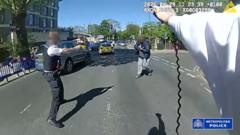
The release of body-worn camera footage by the Metropolitan Police following a violent arrest in Golders Green has done more than just document a single encounter. It has exposed the widening chasm between the tactical realities of modern policing and the public’s expectation of de-escalation. While the video provides a first-person perspective of the struggle, it fails to answer the fundamental question of how a routine interaction spiraled into a chaotic scene that left bystanders horrified. This wasn't just a physical struggle on a North London pavement. It was a failure of the systems designed to keep both the public and the officers safe.
The incident in question involved a man being restrained by multiple officers, an event captured from several angles by witnesses and eventually the police themselves. To understand why this specific arrest ignited such a firestorm, one must look past the grainy footage and examine the specific protocols of the Met’s territorial support groups. The footage shows a rapid transition from verbal instruction to physical force.
The Anatomy of a Confrontation
In the high-stakes environment of London policing, the first thirty seconds of an encounter usually dictate the outcome. The Golders Green footage reveals a textbook example of "pressure cooker" policing. When officers arrive on a scene with a high state of alert, their physiological response—elevated heart rates, tunnel vision, and adrenaline—can sometimes outpace their verbal communication strategies.
Critics of the arrest point to the immediate use of overwhelming force. The officers involved would argue that compliance was not forthcoming and that the risk of a suspect reaching for a concealed weapon or fleeing into traffic necessitated a rapid takedown. This is the gray area where policy meets the pavement. The Met’s use-of-force guidelines require that any physical intervention be "proportionate, legal, and necessary."
However, "necessary" is a subjective term when viewed through the lens of a body-worn camera. These devices, while marketed as tools for transparency, often provide a distorted view. They are mounted on the chest, meaning they miss the subtle cues an officer sees with their eyes—the shifting of weight, the clenching of a fist, or the wandering gaze of a suspect looking for an escape route.
The Problem with Perspective
Body-worn video is often treated as an objective truth. It is anything but. The camera captures the chaos but rarely the context. In Golders Green, the footage starts well after the initial suspicion was formed. We see the struggle, but we do not see the three minutes of dialogue that might have preceded it. This creates a vacuum of information that the public fills with their own biases.
If you see a man being pinned to the ground by four officers, your instinct is to feel empathy for the individual. If you are an officer who has been assaulted on duty, your instinct is to look for the moment the suspect resisted. Neither side is entirely wrong, which is precisely why these videos rarely settle disputes. They instead provide fuel for existing grievances.
Why De-escalation Often Fails in Practice
We hear the word "de-escalation" thrown around by politicians and activists as if it were a magic spell. In reality, de-escalation requires two willing participants. The Golders Green arrest highlights the specific difficulty of policing neighborhoods with high levels of communal anxiety. When an arrest happens in a crowded area like Golders Green, the presence of a "hostile" or merely filming crowd changes the officer's tactical calculus.
Officers are trained to "win" the encounter quickly to prevent the crowd from intervening. This leads to a paradoxical result: the faster the police move to secure a suspect, the more aggressive they appear to the public, which in turn makes the crowd more likely to react.
Tactical Withdrawal vs. Physical Dominance
There is a school of thought in modern policing that suggests officers should "tactically withdraw" if an arrest is likely to spark a riot or significant public disorder, provided the suspect does not pose an immediate threat to life. But the Met has traditionally favored a policy of "assertive policing."
This creates a friction point. On one hand, the public demands that criminals be caught. On the other, they are increasingly unwilling to witness the physical violence required to subdue someone who does not want to be caught. The Golders Green footage is a visceral reminder that the state’s monopoly on violence is messy, loud, and frequently ugly.
The Mental Health Component
While the specific medical history of the individual in the Golders Green arrest is protected by privacy laws, the broader trend in London is undeniable. A staggering percentage of use-of-force incidents involve individuals experiencing a mental health crisis or the effects of neurodivergence.
Police officers are not mental health professionals. They are given a few days of training to handle situations that clinical psychologists spend years mastering. When an officer encounters someone who is not responding to "loud and clear" commands, the default assumption is often non-compliance or "active resistance" rather than a sensory processing issue or a psychotic break.
The Cost of the Wrong Tool
When the only tool you have is a set of handcuffs and a canister of PAVA spray, every problem starts to look like a physical threat. If the Met wants to avoid more Golders Green-style PR disasters, they must address the fact that they are being used as a frontline mental health service.
The Accountability Gap
The Independent Office for Police Conduct (IOPC) will eventually weigh in on this case. They will spend months, perhaps years, dissecting every frame of that video. They will look at the angle of the officers’ limbs and the duration of the pressure applied to the suspect’s torso.
But for the community in Golders Green, the verdict has already been rendered. Trust isn't built in a courtroom; it’s built on the street. Every time a video like this goes viral, the "consent" part of "policing by consent" erodes a little further.
The Met Police often claim that body-worn video protects officers from false accusations. This is true. But it also holds a mirror up to the force, showing them how they appear to the people they serve. In the Golders Green footage, the image reflected is one of a force that is efficient at subduing, but struggling to communicate.
Moving Beyond the Footage
Fixing this isn't about more cameras. It’s about changing the incentive structures within the police force. Currently, officers are praised for "good arrests." They are rarely praised for the arrests they didn't make because they spent forty minutes talking someone down.
Until the metrics of success change, we will continue to see these explosive encounters. The Golders Green arrest is a symptom of a police force that is physically present but emotionally disconnected from the nuances of the communities it patrols.
The next time a video like this surfaces, don't just look at the struggle. Look at the lead-up. Look at the faces of the bystanders. Look at the sheer exhaustion on the faces of the officers after the cuffs are on. That exhaustion is the sound of a system hitting its breaking point.
Demand a policing model that values the quiet resolution over the televised takedown.