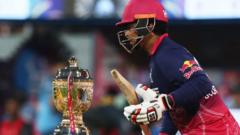
Cricket has a dangerous habit of turning children into gladiators before they have even mastered the art of being a teenager. The recent spectacle of a young talent like Ayush Sooryavanshi taking a sickening blow to the head only to remain at the crease is being hailed as a triumph of the human spirit. It isn't. It is a stark reminder of the immense pressure placed on "wonderkids" to perform at any cost, often ignoring the long-term neurological risks that come with a 5.5-ounce leather ball traveling at high speeds.
While the headlines focus on the grit of a 96-run innings, the real story lies in the silence of the medical tent and the culture of the dressing room. In a sport where a single failure can derail a career path carefully curated since the age of six, the choice to walk off the field isn't really a choice at all. It is a perceived admission of weakness in an environment that demands absolute stoicism.
The Myth of the Unstoppable Teenager
The narrative surrounding Sooryavanshi follows a predictable, tired script. A boy is hit. A boy shakes it off. A boy dominates the opposition. We see this repeated across the maidans of Mumbai and the academy grounds of London. We call it "mental toughness." We tell ourselves that this is how champions are forged.
However, the physics of a head injury do not care about a player's career trajectory. When a cricket ball strikes the helmet, the energy transfer is immense. Even with the advancements in concussion-protection technology and the introduction of "stem guards," the brain still rattles within the skull. To celebrate a player staying on the field immediately after such an impact is to celebrate a gamble where the stakes are life-altering.
The Psychology of the Prodigy Trap
Why do they stay? For a player labeled a "wonderkid," the weight of expectation is a physical burden. These athletes are products of an ecosystem that invests heavily in their success. Coaches, parents, and sponsors are often all pulling in the same direction, creating a tunnel-vision effect where the next match is the only thing that matters.
In this pressure cooker, a player learns early on that availability is the most important ability. If you leave the field for a concussion test, you are giving someone else a chance to take your spot. In the cutthroat world of age-group cricket, that spot might never be returned. The result is a generation of players who have become experts at hiding symptoms from team doctors.
The Failures of Modern Concussion Protocols
Despite the introduction of concussion substitutes in 2019, the implementation at the grassroots and intermediate levels remains inconsistent. The professional game has the luxury of independent doctors and multiple camera angles. The junior levels, where the most vulnerable brains are competing, often rely on a coach’s "eye test."
- Delayed Symptom Onset: A player might feel fine five minutes after a blow, only to experience cognitive decline hours later.
- The Adrenaline Mask: Intense competition floods the body with neurochemicals that can temporarily hide the disorientation of a mild traumatic brain injury.
- Institutional Pressure: There is an unspoken rule that you don't "soften up" the star player by pulling them out during a big knock.
The data suggests that second-impact syndrome—where a second head injury occurs before the first has healed—is rare but often fatal or permanently disabling. By encouraging Sooryavanshi and others like him to continue their innings, the sport is playing a game of Russian roulette with its most valuable assets.
Beyond the Scorecard
We look at a score of 96 and see success. We should be looking at the recovery time. A century is a fleeting statistic; cognitive health is a lifetime requirement. The obsession with the "warrior" archetype in cricket ignores the reality that these are developing bodies. A 16-year-old’s brain is not the same as a 30-year-old’s. The neural pathways are still forming, making them more susceptible to the long-term effects of repeated sub-concussive impacts.
A Systemic Overhaul of Player Welfare
If cricket wants to protect its future, it needs to stop romanticizing the injury. The applause for a player returning to the crease after a medical timeout should be replaced by a mandatory, non-negotiable stand-down period for any significant head strike.
We need to remove the "bravery" element from the equation entirely. If a player is hit on the helmet, they are removed from the game. Period. No evaluation in the middle. No "how many fingers am I holding up?" No input from the player who is, by definition, the least qualified person to judge their own mental state at that moment.
The Role of the Coach and Parent
The culture change must start at the top, but it has to be enforced at the bottom. Coaches who encourage players to "tough it out" after a head blow should face disciplinary action. Parents need to be educated that a missed innings at age 15 is a small price to pay for a functioning brain at age 50.
We often talk about the "purity" of the game, but there is nothing pure about risking a child's health for a regional trophy or a mention in a digital tabloid. The talent pipeline is currently built on the backs of those willing to ignore their own physical limits.
The Economic Engine of the Wonderkid Phenomenon
There is a financial incentive to keep these stories alive. The "comeback kid" narrative sells. It attracts scouts, it generates clicks, and it builds a brand for a player before they can even drive a car. When we celebrate Sooryavanshi’s 96, we are feeding a machine that requires a constant stream of heroic narratives to stay profitable.
Sponsors want athletes who are "built different." They want the story of the kid who took the hit and kept swinging. This commercialization of resilience creates a feedback loop where the players feel they must perform these acts of "heroism" to maintain their marketability.
- Marketability over Health: The pressure to maintain a "tough" brand image.
- The Scout's Ledger: Resilience is often rated as highly as technical skill.
- Media Amplification: Outlets prioritize the "bravery" angle because it drives engagement more than a sober report on medical safety.
Redefining Greatness in the Modern Game
True greatness should not be measured by how much punishment a player can take. It should be measured by the longevity and sustainability of their career. We have seen too many "wonderkids" burn out or fade away due to injuries that were preventable.
The case of Ayush Sooryavanshi isn't an isolated incident of grit; it’s a symptom of a systemic failure to prioritize the person over the performer. Until the cricketing world stops valuing a scoreboard more than a CT scan, we will continue to see young men and women risked for the sake of a headline.
We must demand a shift where the bravest thing a player can do is walk off the field. The sport needs to protect its players from their own ambition and from a public that hungers for a spectacle at the expense of safety. Anything less is a betrayal of the next generation.
The glory of a 96-run innings fades by the next season. The consequences of a mismanaged brain injury last forever. If we continue to applaud the dangerous "recovery" of youth players, we aren't fans of the game; we are accomplices in its most preventable tragedy. The bat belongs in the hands of the healthy, and the injured belong in the care of doctors, not under the heat of the midday sun trying to prove a point that shouldn't need proving.