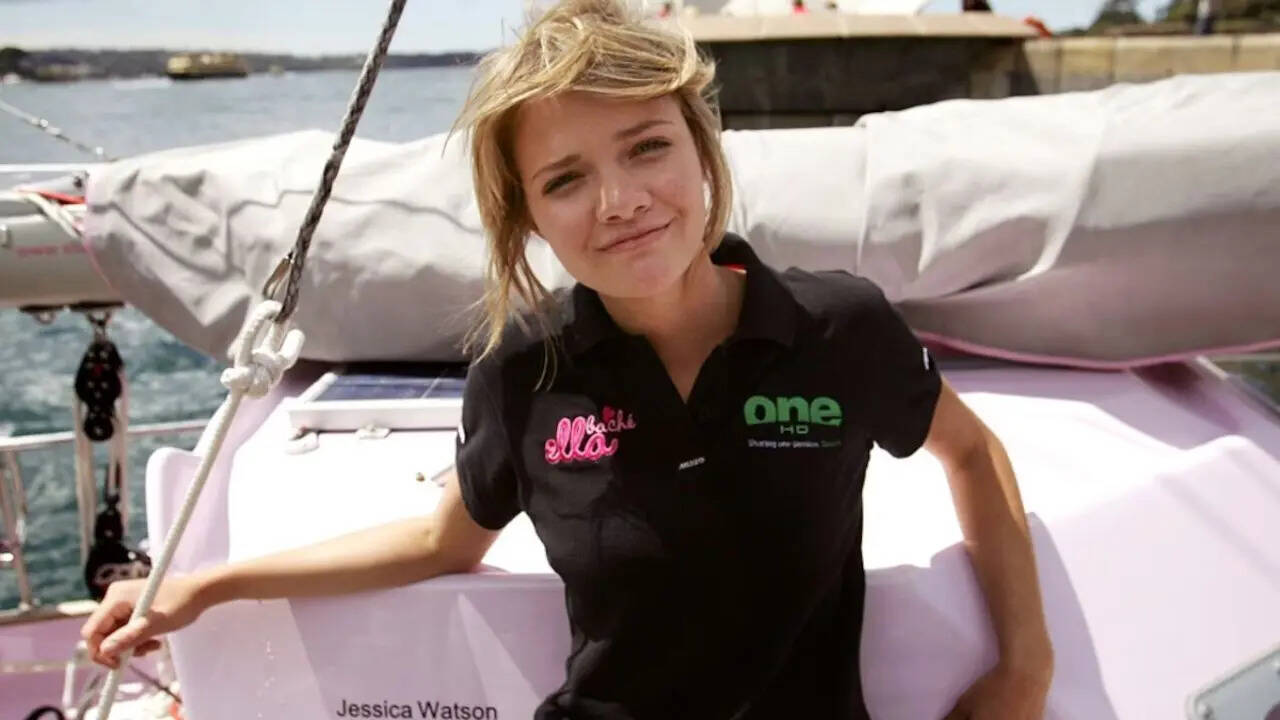
On the morning of September 9, 2009, a 16-year-old girl named Jessica Watson steered her 34-foot pink yacht, Ella’s Pink Lady, directly into the side of a 63,000-tonne bulk carrier. The collision off the coast of Queensland happened during a trial run, just weeks before she intended to become the youngest person to sail solo, non-stop, and unassisted around the world. The mast snapped like a toothpick. The hull was shredded. For the Australian public and maritime authorities, this wasn’t just an accident; it was a flashing red light.
Watson survived that night and eventually completed her 210-day odyssey, arriving back in Sydney Harbor to a crowd of 75,000 people and a hero's welcome from the Prime Minister. But the glossy retrospective often ignores the cold, mechanical reality of what she actually did. To understand Watson’s journey is to look past the "inspiring teen" narrative and analyze the physics of isolation, the engineering of a Sparkman & Stephens 34, and the disturbing ethics of high-stakes records involving minors. For a deeper dive into similar topics, we suggest: this related article.
The Physics of a Near Death Sentence
Sailing around the world via the Southern Ocean isn't a hobby. It is a sustained battle against the "Roaring Forties" and "Furious Fifties," latitudes where the wind has no landmass to break its momentum. Watson wasn't just steering a boat; she was managing a fragile ecosystem.
The Ella’s Pink Lady was a S&S 34, a design legendary for its ability to track straight in heavy seas and, crucially, to right itself after a knockdown. This was not a luxury choice. It was a survival requirement. During her 18,000-nautical-mile journey, Watson faced four major knockdowns—instances where the mast hit the water or the boat rolled nearly 180 degrees. For additional background on this topic, detailed coverage can also be found at NBC Sports.
When a boat rolls in the Southern Ocean, the interior becomes a centrifuge. Heavy cans of food, navigation equipment, and the sailor themselves become projectiles. Watson’s survival depended entirely on the structural integrity of the companionway hatches and the fact that her boat was effectively a sealed bubble. If a single hatch had failed during those rolls, the boat would have filled with water in seconds. She would have gone down in waters where the temperature averages 5 degrees Celsius, far beyond the reach of any rescue vessel.
The Logistics of 210 Days of Solitude
Most people focus on the loneliness, but the real enemy is maintenance. A solo sailor is a 24-hour-a-day mechanic, meteorologist, and medic.
Watson had to carry every calorie she would consume for seven months. This meant roughly 500 kilograms of food, mostly freeze-dried or canned, stored in every available crevice of the bilge to keep the center of gravity low. Water was another math problem. While she had a desalinator, those machines are notoriously prone to mechanical failure due to salt crystallization. She had to carry manual backups and pray the seals didn't perish.
The mental load is where the "why" becomes complicated. Sleep deprivation is the primary cause of maritime accidents. Watson utilized polyphasic sleep—napping in 20-minute bursts to ensure she could check the horizon and the radar for ships or ice. This leads to a state of permanent cognitive impairment. When you are 16 and operating on three hours of broken sleep while 40-foot waves are slamming into your carbon-fiber mast, the margin for error evaporates.
The Route and the Controversy
The path Watson took followed the classic clipper route:
- Departing Sydney, heading East across the Pacific.
- Rounding Cape Horn, the "Mount Everest" of sailing.
- Crossing the Atlantic toward the African coast.
- Rounding the Cape of Good Hope and crossing the Indian Ocean.
Critics, including the World Sailing Speed Record Council (WSSRC), eventually refused to recognize her record. They argued her route didn't head far enough north of the equator to meet the official 21,600-nautical-mile requirement for a true circumnavigation. While the technicality felt like a slight to her fans, it highlighted a deeper rift between the pursuit of "adventure" and the rigid standards of professional record-breaking.
The Ethics of the Southern Ocean
We have to talk about the parents. When Watson announced her intent, the backlash was vitriolic. Child protection advocates and veteran sailors alike called the voyage "state-sanctioned child abuse."
The debate centers on whether a teenager can truly consent to a 210-day period of near-constant mortal peril. Unlike a mountain climber who can turn back if the weather turns, once a sailor is in the heart of the Southern Ocean, there is often no turning back. The currents and winds dictate the path. You are committed to the circle.
However, Watson’s team argued that she was better prepared than most adults. She had logged over 6,000 miles of ocean sailing before she even left Sydney. She had undergone intensive sea survival courses. They viewed her age as an incidental factor, while the rest of the world viewed it as the only factor. This tension created a media circus that likely added more pressure than the waves themselves. If she failed, she wasn't just a sailor who lost a boat; she was a cautionary tale for an entire generation.
The Mechanical Toll of the Indian Ocean
By the time Watson reached the Indian Ocean, the final leg of her journey, both she and the boat were fraying. The rigging—the wires holding up the mast—stretches under constant load. The sails develop "creep," losing their aerodynamic shape and making it harder to point the boat toward the wind.
In May 2010, she encountered a storm that produced waves the size of apartment buildings. This is where the "unassisted" part of the record becomes a psychological weight. She could talk to her team via satellite phone, but they couldn't tell her how to fix a broken rudder or how to stitch a torn mainsail in a gale. They could only watch the GPS coordinates and wait.
The reality of solo sailing is that for 90% of the time, you are bored, damp, and tired. The other 10% is spent in a state of autonomic nervous system hijack, where your body is flooded with cortisol as you try to prevent a 10-tonne object from disintegrating beneath you.
The Commercialization of the Horizon
There is a cynical side to these records that rarely makes the documentary cut. High-profile solo voyages are expensive. They require corporate sponsorships, media rights deals, and a polished public image. Ella’s Pink Lady wasn't pink because Watson liked the color; it was part of a branding strategy that made the voyage marketable to a global audience.
This commercial pressure creates a dangerous incentive structure. When a voyage is sponsored by major brands, the pressure to "push through" a dangerous storm rather than seeking port can be overwhelming. Watson’s team insisted they never put the record above her safety, but the sheer momentum of a multi-million dollar media campaign is its own kind of weather system. It’s a system that doesn't allow for second thoughts.
Beyond the Pink Hull
When Jessica Watson sailed back into Sydney, she famously disagreed with the Prime Minister's assessment that she was a hero. She called herself an "ordinary person who had a dream."
That statement is a nice sentiment, but it’s factually incorrect. Ordinary people do not survive four knockdowns in the Southern Ocean. Ordinary people do not have the discipline to maintain a diesel engine while seasick and sleep-deprived. What Watson possessed was a specific, terrifyingly narrow focus that is usually reserved for elite athletes or special operations personnel.
The legacy of her voyage isn't just a trophy or a book deal. It is a data point in the ongoing discussion about human limits. She proved that the barrier to these feats isn't physical strength—it’s the ability to endure a relentless, grinding psychological assault.
The Ella’s Pink Lady now sits in the Queensland Maritime Museum. It is a small, scarred vessel that looks entirely too fragile for what it accomplished. Looking at the scratches on the hull, you realize that Watson didn't "conquer" the ocean. She negotiated with it, and she happened to survive the terms of the agreement.
The ocean doesn't care about records, age, or pink paint. It only responds to displacement and gravity. Watson’s success was a masterclass in managing those two forces until the land finally rose to meet her.


