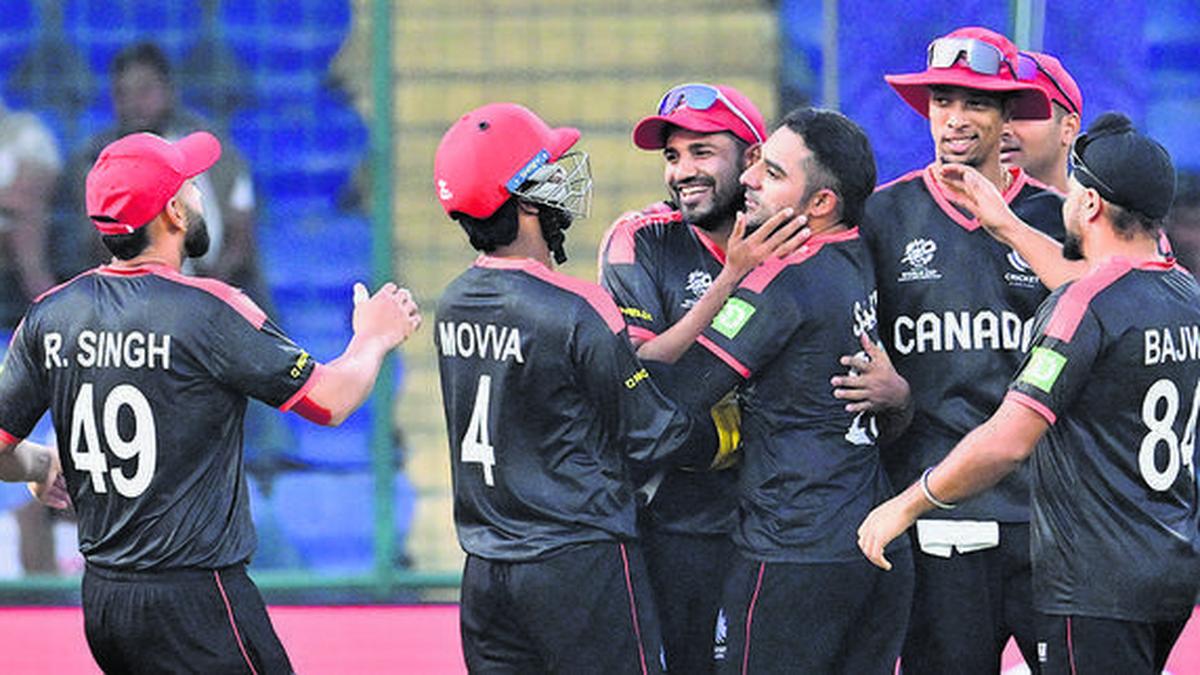
The leather ball hits the center of the willow bat with a sound like a sharp pistol shot. On a Tuesday afternoon in Toronto, that sound is everything. It represents thousands of miles traveled, cold mornings spent in indoor training facilities waiting for the snow to melt, and the fierce, quiet ambition of athletes who choose to play a global game in a hockey country.
For a brief moment, the sound makes you forget the email.
The notification arrived without fanfare, a cold digital sledgehammer from Dubai. The International Cricket Council (ICC) had suspended Cricket Canada. Just like that, the institutional scaffolding supporting every boundary hit, every youth clinic, and every dream of the World Cup was knocked loose. To the casual observer tracking sports headlines, it read like a routine administrative hiccup—a governing body reprimanding a member state over constitutional compliance.
But administration is never just administrative. It has a human cost.
When a national sporting organization loses its standing, the ripples do not stop at the boardroom door. They travel down to the teenager who just bought his first pair of proper spikes, wondering if his national team will even exist by the time he is old enough to try out. They land heavily on the shoulders of the veterans who have spent a lifetime putting Canadian cricket on the map, only to watch the map get redrawn by bureaucrats.
The Weight of the Sudden Freeze
The suspension caught almost everyone off guard. Rashpal Bajwa, the president of Cricket Canada, openly admitted the decision felt unexpected. The organization believed it was moving in the right direction, ticking boxes, and steadying a ship that had weathered turbulent waters before. Then came the ICC’s verdict: non-compliance with membership criteria, specifically regarding governance and administrative structures.
To understand why this hurts, you have to look past the spreadsheets and the legal jargon of sports governance.
Imagine dedicated administrators working late into the night in modest offices, trying to balance the ledger for a sport that does not enjoy corporate sponsorships or massive government handouts. In Canada, cricket is a passion project powered by immigrants, diaspora communities, and purists who love the game enough to fight for it against the cultural monopoly of ice and pucks.
When the ICC pulls the plug on full compliance, it is not just a slap on the wrist. It freezes funding. It introduces an agonizing layer of doubt into every negotiation with sponsors, every venue booking, and every high-performance training camp.
Consider the immediate reality of a national team player. Your life is a dizzying circuit of airports, hotel rooms, and intense physical conditioning. You sacrifice birthdays, stable career progression, and time with family. You do it because wearing the maple leaf on your chest means something. When the governing body above you is sanctioned, your professional world destabilizes. The pitch becomes uneven before you even step onto it. You find yourself answering questions about board compliance in press conferences when you should be discussing your batting average.
The suspension stems from a strict mandate by the ICC to ensure that national boards operate with absolute transparency, democratic stability, and free from internal political deadlock. When a board fails to meet these rigorous institutional benchmarks, the global body steps in to protect the integrity of the sport. But the medicine can feel incredibly bitter to those on the ground.
Reconstruction in the Shadow of Doubt
The reaction from Cricket Canada was not one of defiance, but of immediate, urgent course correction. There is an old saying in the sport that you cannot control the weather or the pitch, but you can control your footwork.
The leadership quickly pivoted to address the ICC's concerns, fast-tracking constitutional amendments and structural overhauls designed to satisfy the global governing body. The objective is simple: regain full compliance before the next major competitive cycle.
But fixing a sports federation is not like repairing a mechanical engine. You cannot just swap out a broken part and turn the key. It requires rebuilding trust.
Trust is a fragile commodity in amateur sports. Parents look at a suspended national body and wonder if they should enroll their children in soccer or basketball instead. Private donors look at the headlines and tighten their purse strings. The invisible stakes are far higher than a mere compliance certificate; the real gamble is the retention of the next generation of Canadian talent.
Let us look at a hypothetical scenario to ground this reality. Picture a fourteen-year-old girl in Vancouver. She possesses a natural, lethal bowling action that can decimate local batting lineups. Her coach tells her she has the raw ability to play internationally. Her parents, working hard to support her athletic dreams, read about organizational suspensions and financial uncertainty. They begin to look at university scholarships in track and field instead. The talent pipeline dries up not because the talent vanished, but because the institution holding the pipeline flickered out of focus for a moment.
This is the vulnerability that sports administrators live with every day. They know that a single administrative failure can echo through a decade of athletic development.
The True North Cricket Culture
Despite the institutional vertigo, the heartbeat of Canadian cricket remains stubborn. Go to any park in the Greater Toronto Area or Metro Vancouver on a weekend morning. You will see makeshift pitches, milk crates used as wickets, and players competing with an intensity that rivals the ashes.
The game thrives because it represents home to millions of Canadians. It connects them to their heritages in the Caribbean, South Asia, the United Kingdom, and Africa, while simultaneously forging a uniquely Canadian sporting subculture. This grassroots devotion is the real shield against institutional collapse.
The ICC suspension is a massive hurdle, but it is ultimately a chapter in a much longer, more resilient story. The corrective measures currently underway within Cricket Canada are not just about satisfying the legal teams in Dubai. They are about honoring the people who show up to the parks at 6:00 AM to roll the pitch. They are about ensuring that when a young player hits that perfect shot, the sound echoes all the way to the international stage, clear and uninterrupted.
The work happening now behind closed doors—the rewriting of bylaws, the restructuring of committees, the quiet diplomatic negotiations—is unglamorous. It will not make the highlight reels. Yet, every line of policy corrected is a step toward stability.
The sun begins to dip below the horizon at the Toronto cricket ground, casting long shadows across the grass. The players pack their gear into heavy canvas bags, chatting about a missed catch or a brilliant run-out. They are blissfully insulated from the corporate politics for at least a few hours. They know the board will sort itself out, because it has to. The game is too big to fail the people who love it.
A solitary figure walks out to the center square, checking the condition of the turf before the evening dew sets in. The grass is green, the pitch is hard, and the game waits patiently for the architects to finish fixing the house.