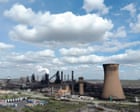
The British government is preparing to take a historic leap backward into state ownership to prevent the total collapse of the domestic steel industry. As the King prepares to outline the legislative agenda, the inclusion of a plan for British Steel signals the end of a decades-long experiment with private equity and foreign conglomerate management. This isn't just a bailout. It is a desperate attempt to salvage what remains of a foundational industry that has been hollowed out by high energy costs, cheap imports, and a global shift toward green technology that the UK was ill-prepared to meet.
For years, the Scunthorpe-based steelmaker has teetered on the edge of insolvency, kept on life support by a revolving door of owners and emergency government loans. The current owners, Jingye Group, have struggled to reconcile the massive costs of decarbonisation with the reality of running aging, coal-fired blast furnaces in a high-tax environment. Now, Whitehall has decided that the cost of inaction—thousands of job losses and the loss of sovereign manufacturing capability—outweighs the ideological distaste for nationalisation.
The Scunthorpe Standoff
The narrative surrounding British Steel often focuses on the immediate threat to 4,500 jobs, but the rot goes much deeper. To understand why nationalisation is the only remaining card on the table, one has to look at the divergence between government environmental targets and the financial reality of heavy industry. The UK has committed to some of the most aggressive carbon reduction goals in the developed world. While noble in a vacuum, these targets have acted as a slow-motion execution for traditional blast furnace operations.
Blast furnaces are the heart of primary steelmaking. They are also massive emitters of carbon dioxide. Replacing them with Electric Arc Furnaces (EAFs) is the industry standard for "going green." However, EAFs primarily recycle scrap steel rather than making virgin steel from iron ore. This transition changes the very nature of the product the UK can produce. Jingye and the government have been locked in a stalemate over who pays the £1.25 billion bill for this conversion. By taking the company into public hands, the taxpayer essentially agrees to foot the entire bill, assuming all the risk that a private Chinese firm was no longer willing to carry.
The Sovereign Capability Argument
Critics of the move argue that nationalisation is a nostalgic vanity project. They point to the fact that the UK can simply import steel from India, China, or Turkey at a lower cost. This view, however, ignores the geopolitical shifts of the last decade. The pandemic and the war in Ukraine proved that global supply chains are fragile. If the UK loses the ability to produce its own primary steel, it becomes entirely dependent on foreign powers for the materials needed for its own defense infrastructure, railways, and energy grid.
There is also the matter of quality. High-grade steel used in specialized engineering and aerospace often requires specific chemical compositions that are easier to control in a blast furnace environment. Moving entirely to recycled scrap steel via EAFs puts that niche at risk. The government’s gamble is that by owning the assets, they can direct the transition to green steel in a way that preserves these high-value capabilities, rather than letting a private owner cherry-pick the most profitable, low-effort parts of the business while shuttering the rest.
The Cost of Electricity
No amount of state ownership will fix the fundamental problem plaguing British heavy industry: the price of power. UK steelmakers pay significantly more for electricity than their competitors in France or Germany. This is largely due to the way network charges and green levies are structured in the British market.
If the government nationalises British Steel but fails to reform the industrial energy market, they will simply be subsidising a loss-making entity indefinitely. It becomes a black hole for public funds. To make the "Nationalised British Steel" model work, the Department for Business and Trade must find a way to offer industrial electricity prices that are competitive on a global scale. Without that, the new state-owned entity will be dead on arrival, regardless of how much capital is injected into new machinery.
Lessons from the British Leyland Ghost
Veterans of the 1970s will hear the word "nationalisation" and immediately think of British Leyland. The spectre of state-managed inefficiency looms large over this proposal. There is a very real danger that a public British Steel becomes a political football, where decisions are made based on election cycles rather than market demand.
To avoid the terminal decline seen in previous eras of state ownership, the new structure must be insulated from the Treasury's whims. It requires an independent board with the authority to make brutal commercial decisions. This includes the possibility of further headcount reductions as the transition to more automated EAF technology progresses. If the government tries to use the company as a job-guarantee program rather than a competitive manufacturer, the project will fail.
The primary goal must be a lean, high-tech operation that can eventually be returned to the private sector in a decade as a functional, carbon-neutral asset.
The Scrap Steel Paradox
The UK is one of the world's largest exporters of scrap steel. We ship millions of tonnes of high-quality waste metal abroad, only to buy it back later as finished products. This is an economic absurdity that the nationalisation plan aims to correct. By investing in EAFs, the state can create a "circular" steel economy where British scrap is processed in British furnaces powered by British wind and nuclear energy.
This sounds perfect in a manifesto, but the technical challenges are immense. Not all scrap is created equal. Removing impurities from recycled steel to meet the standards required for a car chassis or a bridge girder is a complex metallurgical feat. The government will need to invest not just in furnaces, but in the advanced sorting and processing facilities required to clean the UK’s scrap stream. This is an overlooked part of the "why" behind the King's Speech announcement; it is an attempt to finally build a domestic supply chain that isn't at the mercy of international shipping rates.
Comparing the European Model
The UK is not alone in this struggle, but it is the most vulnerable. Germany and France have already funneled billions in state aid into their steel giants like Thyssenkrupp and ArcelorMittal. The difference is that those countries have used "contracts for difference" and direct carbon subsidies to bridge the gap. The UK, having left the EU, has more freedom to nationalise but less of an established framework for industrial strategy.
We are seeing a return to "interventionist" economics that would have been unthinkable twenty years ago. The move toward nationalisation is an admission that the free market has no interest in maintaining a low-margin, high-capital-intensity industry in a country with high labour and energy costs. If the state wants steel, the state must own the means of production.
The Workforce and the Scunthorpe Community
For the town of Scunthorpe, this is about survival. The steelworks is the lifeblood of the local economy. A total closure would be a catastrophic blow, creating a "rust belt" effect that would take generations to fix. Nationalisation provides a temporary shield for these workers, but they are not out of the woods.
The shift to Electric Arc Furnaces requires fewer workers than traditional blast furnace operations. This is the hard truth that politicians rarely mention. Even under state ownership, the workforce of the future British Steel will likely be smaller. The "success" of this nationalisation will be measured by whether the government can facilitate a "just transition"—re-training older furnace operators to work in high-tech recycling and specialized finishing plants.
Strategic Infrastructure and the Grid
The final hurdle is the National Grid. EAFs require massive amounts of instantaneous power. In many parts of the country, the grid is already at capacity. To bring Scunthorpe and potentially Port Talbot (if the contagion spreads) into a new era of electric steelmaking, the government must fast-track massive infrastructure upgrades. You cannot run a modern steel industry on a Victorian-era grid.
This brings the entire "Green Steel" dream back to the same bottleneck: infrastructure. Nationalising the steelworks is the easy part. The hard part is the decades of neglected investment in the pipes, wires, and power plants that make heavy industry possible.
British Steel's return to the public fold is a high-stakes gamble on the future of manufacturing. It is an acknowledgment that in an age of protectionism and climate crisis, the old rules of neoliberal economics no longer apply to essential industries. The success of this move will depend entirely on whether the government treats it as a temporary rescue mission or a long-term strategic investment. If they choose the former, we are simply delaying the inevitable. If they choose the latter, they must be prepared for a long, expensive, and technically grueling journey that far outlasts any single parliament.
The first step is securing the legislation in the King’s Speech. The real work begins when the first state-funded furnace is switched on and the taxpayer becomes the ultimate guarantor of every ton of metal that leaves the yard. Stop treating steel as a commodity and start treating it as a sovereign utility. That is the only way this ends in anything other than a fire sale a decade from now.