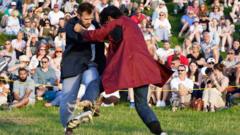
The scent of crushed damp grass mixes with the sharp, metallic tang of sweat and liniment. It is a smell that has drifted over the Cotswold hills every summer for more than four hundred years. A crowd forms a tight, roaring ring on the hillside, their breath hanging faintly in the cool evening air. In the center of this human circle stand two men. They are not titans of modern athletics. They do not have multi-million-dollar sponsorships, nor do they wear aerodynamic polymers. They wear white lab coats, their hands gripped tightly onto each other’s lapels like two drowning men trying to pull each other out of a turbulent sea.
Then, the kicking begins.
To the uninitiated, the Cotswold Olimpick Games look like a fever dream born of isolation and local ale. Held annually on Dover’s Hill, just above the idyllic market town of Chipping Campden, these games reject the sanitized, hyper-commercialized reality of modern sports. There are no digital scoreboards here. No slow-motion replay cameras to dissect the exact millimeter of a foul. Instead, there is the brutal, agonizingly simple art of shin-kicking.
Most people read about this and laugh. They see a quirky snippet on a slow news day, a brief broadcast tucked between the weather report and a human-interest story about a skateboarding dog. They chuckle at the thought of grown men stuffing their trousers with straw and hacking at each other’s lower legs until someone collapses.
They are missing the entire point.
Behind the novelty lies a fierce, unbroken thread of human endurance, local pride, and a strange, stoic beauty that modern life has largely scrubbed away. To understand the shin-kicking championship is to understand why humans have always gathered in the dirt to test the limits of their pain.
The Anatomy of the Strike
Consider a hypothetical contender. Let us call him Thomas. Thomas is a twenty-eight-year-old stonemason from Gloucestershire. His hands are calloused, his shoulders broad from lifting limestone. He has spent the last six months running up steep hills and enduring the mocking laughter of his friends as he practiced kicking fence posts to harden his shins.
Now, he is staring into the eyes of a rival from a neighboring village. The referee, known traditionally as the Stickman, stands between them holding a wooden staff.
The rules are deceptively simple. You must hold your opponent by the collar with both hands. You may not lift your foot higher than the knee. You cannot trip, wrestle, or gouge. You can only kick. You kick with the hard inside edge of your shoe, aiming directly for the unprotected bone between the ankle and the knee. You keep kicking until your opponent gives up, falls down, or cries out the word that ends it all: "Sufficient."
Thomas feels the first blow land.
It is not a dull throb. It is a blinding, white-hot flash of agony that radiates from his tibia straight up to his teeth. The human shin is a design flaw of evolutionary biology; a major bone protected by nothing more than a thin layer of skin and a few nerve endings that seem engineered specifically to register maximum torment.
When that boot connects, Thomas’s brain screams at him to let go, to step back, to protect himself. That is the instinct of survival. But the crowd is chanting, the drums are beating, and the collar of his opponent’s coat is slippery beneath his white-knuckled grip. Thomas does not step back. He digs his heels into the mud, absorbs the shock, and drives his own boot forward in retaliation.
This is the hidden crucible of the sport. It is not actually a test of who can kick the hardest. It is an audit of who can endure the most suffering while maintaining a smile.
A Rebellion in the Mud
To truly grasp why men still subject themselves to this voluntary torture, you have to look backward. We live in an era where risk is managed, mitigated, and insured against. We sign waivers, wear helmets, and look at the world through the safe, glowing glass of our smartphones. We have sanitized our leisure.
But it was not always this way.
In 1612, a lawyer named Robert Dover established these games as a direct protest against the rising tide of Puritanism. The Puritans wanted to ban Sunday sports, dance, and merrymaking. They viewed physical exuberance as a sin. Dover saw it as essential to the human spirit. He wanted a festival where the gentry and the peasantry could mix, where the rigid class structures of Jacobean England could be temporarily forgotten in a blur of wrestling, leaping, and shin-kicking.
King James I even gave the games his blessing. For a few decades, Dover’s Hill was a sanctuary of wild, unbridled humanity.
Then history intervened. The English Civil War broke out. The Puritans gained power and shut the games down. Yet, like a stubborn weed pushing through concrete, the festival returned after the Restoration. It was banned again in the nineteenth century because the Victorian authorities grew terrified of the gambling, the drunkenness, and the sheer, uncontrollable energy of thousands of working-class people gathering in one place.
Every time authority tried to kill the shin-kicking, the community brought it back.
When you watch a champion crowned today, you are not just watching a sporting event. You are watching a historical resurrection. You are witnessing a four-hundred-year-old act of defiance against the idea that life should be entirely safe, predictable, and polite.
The Currency of Pain
There is a moment in every championship match where the strategy evaporates.
In the early rounds, fighters use technique. They attempt to unbalance their opponent, waiting for a momentary lapse in concentration to deliver a swift, sweeping blow to the side of the calf. They use the straw stuffed down their trousers to absorb the worst of the impact, though everyone knows the straw is a psychological shield rather than a physical one. It compresses to nothing after the first three hits.
But by the final round, the straw is ruined. The trousers are stained with mud and tiny, blooming circles of dark blood. The technique is gone.
What remains is pure psychology.
The two finalists are exhausted. Their shins are already swelling, turning deep shades of purple and black beneath their clothes. They are leaning into each other, practically embracing, their chests heaving in unison.
The crowd falls strangely quiet. The superficial novelty of the event has burned away, replaced by the heavy, solemn realization of what these two men are doing to themselves for nothing more than a silver trophy and the fleeting adulation of a hillside.
Consider what happens next: the champion delivers a strike that sounds like a wet branch snapping. His opponent’s eyes widen. For a fraction of a second, the loser tries to maintain his grip. Then, his knees simply buckle. He doesn’t fall because he is weak; he falls because his nervous system has staged a coup against his willpower.
The Stickman lowers his staff. The match is over.
The Long Walk Down the Hill
The transformation of the winner is immediate. The agony doesn't vanish, but it is instantly transmuted into something else. Glory? Perhaps. But it is a deeply localized, intimate kind of glory.
There are no television cameras from major sports networks waiting for him. There is no press conference with microphoned journalists asking him how he plans to spend his winnings. The prize is a modest cup, a handshake from an organizer dressed in seventeenth-century garb, and the right to walk into the local pub with his head held high.
The real magic happens an hour later.
Go into any tavern in Chipping Campden on the night of the games. You will find the champion sitting at a wooden table. His leg will be propped up on a stool, a bag of crushed ice melting through a towel onto his ruined shin. Beside him, nursing a pint of bitter, will be the man he defeated in the final.
They are not enemies. They are bound by an intimacy that only people who have shared a specific, intense threshold of pain can understand. They will recount every kick, laughing at the moments where their vision went blurry, comparing the size and color of their respective bruises like badges of honor.
We spend so much of our lives trying to avoid discomfort. We seek comfort in every purchase, every app, every lifestyle upgrade. Yet, the enduring popularity of the Cotswold Olimpick Games suggests that we are missing something vital in our climate-controlled existence. We need to know what we are made of. We need to test our edges, even if those edges are the sharp bones of our legs.
As the lanterns flicker out on Dover’s Hill and the mist settles over the vales, the shouting dies down. The grass will grow back over the trampled mud. The bruises will fade over the coming weeks, turning from purple to green to yellow before disappearing entirely. But the memory of the night they stood their ground, anchored to another human being by nothing but pride and a white linen collar, will remain etched into their skin forever.