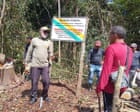
The physical demarcation of the Kawahiva do Rio Pardo indigenous territory in the Brazilian state of Mato Grosso is not merely a bureaucratic milestone. It is a desperate, late-stage intervention in a slow-motion genocide. After nearly three decades of legal paralysis, government teams have finally begun placing the physical markers that define the boundaries of this protected land. This action theoretically secures 412,000 hectares for a group of uncontacted people who have spent generations fleeing the sound of chainsaws and the stench of diesel. However, the ceremony of driving stakes into the ground hides a grimmer reality of political sabotage and entrenched economic interests that still threaten to render these boundaries meaningless.
A Ghost People Defined by Flight
The Kawahiva are survivors of a persistent, violent history of encroachment. Unlike the larger, contacted tribes of the Amazon, the Kawahiva exist as a group of nomadic hunters and gatherers who have consciously chosen isolation. Their existence is confirmed by the physical evidence they leave behind—abandoned campsites, intricate tapir traps, and bows carved from hardwood. They are often called the "People of the Rainbow," a name given by neighboring tribes, but to the illegal loggers and cattle ranchers of the Colniza region, they are a nuisance that stands in the way of a billion-dollar timber industry.
For twenty-seven years, the Brazilian state acknowledged their presence while simultaneously failing to protect their perimeter. The process began in 1999, yet the definitive decree to mark the land only arrived in 2016. Even then, the political climate under the previous administration effectively froze all land protection efforts. The Kawahiva became a "ghost people" in more ways than one; they were legally recognized but physically ignored, left to navigate a forest that was shrinking by several square miles every season.
The wait was never about a lack of evidence. It was about the power of the "Bancada Ruralista," the powerful agribusiness lobby in Brazil’s Congress. By delaying the physical demarcation, the state allowed "good faith" settlers and bad faith land grabbers to establish facts on the ground. When a fence goes up or a pasture is cleared, it becomes exponentially harder—politically and legally—to evict the occupants, even if the land belongs to an uncontacted tribe.
The Colniza Meat Grinder
The Kawahiva territory sits in the municipality of Colniza, which has long held a reputation as one of the most violent regions in Brazil. This is the "Arc of Deforestation," a frontier where the rule of law is often dictated by the caliber of a rifle. For a journalist or an activist, entering these zones means navigating a network of clandestine roads built by loggers to extract high-value timber like Mahogany and Ipê.
The stakes of the demarcation are exceptionally high because the Kawahiva land acts as a biological shield. If this territory falls, it opens a corridor for further destruction into the heart of the Amazon. The loggers aren't just taking trees; they are destroying the delicate ecosystem the Kawahiva rely on for survival. When the canopy is opened, the forest floor dries out. Game animals flee. The noise of industrial activity forces the Kawahiva into smaller and smaller pockets of land, leading to internal conflict and a collapse of their traditional social structures.
The violence is not always direct. While there are documented cases of "clearing" crews being sent to hunt indigenous people, the more common killer is disease. For a population with no previous exposure to common pathogens, a discarded soda can or a tool left behind by a logger can be as lethal as a bullet. Flu, measles, and even the common cold can wipe out an entire lineage in weeks. By finally marking the borders, the National Foundation for Indigenous Peoples (FUNAI) is attempting to create a sanitary and physical barrier against this invisible threat.
The Architecture of Delay
Why did it take twenty-seven years? To understand the failure of the Brazilian state, one must look at the legal hurdles intentionally built into the demarcation process. The path to securing indigenous land is a gauntlet of administrative challenges, environmental impact studies, and municipal appeals.
- Identification: FUNAI must prove the land is traditionally occupied.
- Approval: The Ministry of Justice must issue a declaratory decree.
- Demarcation: Physical markers are placed on the ground.
- Ratification: The President signs the final deed into law.
- Registration: The land is recorded in the national property registry.
The Kawahiva have been stuck between steps two and three for nearly a decade. During this interval, the Brazilian government faced immense pressure from local politicians in Mato Grosso who argued that the 412,000 hectares were "too much land for too few Indians." This argument purposefully ignores the nomadic nature of the Kawahiva. They do not live in a single village; they move across a massive range to allow the forest to regenerate and to follow the seasonal migrations of their prey.
The physical marking that is happening now is a victory for FUNAI’s "Ethno-environmental Protection Teams." These are the specialists who live in remote outposts, often under threat of death, to monitor the borders. Their work is a delicate balance of surveillance and non-interference. They must stop the loggers without accidentally making contact with the Kawahiva, as any contact could be the catalyst for the tribe's demise.
The Economics of Incursion
The driving force behind the opposition is the price of land. Once forest is converted to pasture, its value skyrockets. In the Mato Grosso interior, land speculation is a primary driver of the local economy. Illegal land grabbers, known as grileiros, use a technique of "aging" fraudulent documents to claim ownership of public lands. They then sell these tracts to unsuspecting or complicit ranchers.
The Kawahiva territory is a prime target for this because it contains some of the last stands of primary forest in the region. The timber alone is worth millions on the international market, often laundered through "legal" sawmills and shipped to Europe and the United States. When the physical markers go up, that "asset" becomes a liability. The presence of the federal police and FUNAI teams makes it harder to transport stolen wood, which is why the demarcation teams are often met with blocked roads and burnt bridges.
The Problem with Physical Borders
Placing a concrete pillar in the middle of the jungle is a symbolic act, but it is not a force field. The history of the Amazon is littered with "paper parks"—protected areas that exist on a map but are ravaged in reality. For the Kawahiva, the markers are only as strong as the enforcement behind them.
The current administration has significantly increased the budget for environmental protection, but the damage done during the previous four years was profound. Surveillance infrastructure was dismantled, and the rhetoric from the capital emboldened the grileiros. Rebuilding that enforcement capacity takes time—time the Kawahiva might not have. The demarcation must be followed by permanent, well-funded patrols. Without them, the markers will simply be pulled out of the ground the moment the government helicopters fly away.
The Counter-Argument of Development
Local leaders in Colniza frequently argue that indigenous protections stifle the economic growth of the region. They point to the need for infrastructure—roads, power lines, and bridges—that are often blocked by indigenous land claims. This is a classic "clash of civilizations" narrative used to justify the erasure of the Kawahiva.
However, this "development" is almost always extractive and short-term. It enriches a handful of large-scale landowners and logging magnates while leaving the local population with depleted soil and a ruined climate. The Kawahiva, in their isolation, provide a service that the local economy cannot: they maintain the hydrological cycle. The "flying rivers" of the Amazon, which provide rainfall for the very soy and cattle farms that threaten the forest, depend on the integrity of large, unbroken tracts of jungle like the Rio Pardo territory.
The Looming Threat of the Time Limit Trick
Even as the markers are placed, a greater legal threat looms: the "Marco Temporal" or Time Limit Trick. This legal theory, pushed by the agribusiness lobby, suggests that indigenous peoples are only entitled to land they were physically occupying on the day the Brazilian Constitution was signed—October 5, 1988.
For a group like the Kawahiva, this is a death sentence. By their very nature as a nomadic, uncontacted group fleeing for their lives, proving their exact physical location on a specific day in 1988 is a near-impossible task. While the Brazilian Supreme Court has ruled against this theory, the Congress has attempted to revive it through legislative maneuvers. If the Time Limit Trick becomes law, the physical markers currently being placed could be torn up by judicial order, returning the Kawahiva to a state of permanent dispossession.
The demarcation of the Kawahiva territory is a race against both the chainsaw and the gavel. It represents a rare moment where the state has prioritized the survival of a unique human culture over the immediate profits of the commodity market. But we must be clear-eyed about the fragility of this win. A marker in the mud is not a guarantee of peace; it is merely a line in the sand.
The Kawahiva remain in the shadows, unaware that their fate is being debated in the sterile halls of Brasília or the lawless streets of Colniza. They continue to move through the forest, looking for the next camp, listening for the next tree to fall. The success of this demarcation will not be measured by the number of markers placed, but by the silence that remains in the forest. If the Kawahiva can continue to live without ever knowing the name of the President or the price of beef, then the state has finally done its job.
The next phase requires more than just cement and surveyors. It requires a sustained, multi-decade commitment to excluding the global market from a few hundred thousand hectares of the Earth. It is an expensive, difficult, and politically unpopular task. But for the Kawahiva, it is the difference between existence and extinction. The world is watching to see if Brazil can protect those who cannot speak for themselves, or if the "People of the Rainbow" will finally vanish into the smoke of a clearing fire.


.png?width=1200&auto=webp&trim=36%2C0%2C37%2C0)