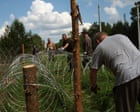
The mud in northern Ukraine does not care about geopolitics. It is a thick, dark, suffocating clay that clings to the boots of teenagers and veterans alike, pulling them down into the earth. For generations, this borderland—where Ukraine meets Belarus—was defined by nothing more than quiet forests, shared rivers, and families who walked across an invisible line to visit cousins for Sunday dinner.
Now, that line is a fortress. If you enjoyed this post, you might want to look at: this related article.
Consider Serhiy. He is forty-two, a former high school geography teacher who now wears the digital camouflage of the Ukrainian Territorial Defense Forces. Before the escalation, his biggest daily stress was convincing teenagers to memorize the tributaries of the Dnieper River. Today, he stands in a hand-dug trench lined with pine logs, staring north through a pair of scratched binoculars. The air smells of damp pine needles, diesel exhaust, and the sharp, metallic tang of wet iron.
Serhiy is a hypothetical composite of the men holding this line, but his reality is entirely factual. He represents thousands of citizens who have been pulled from their civilian lives to fortify a frontier that most of the world forgot about when the fighting shifted to the south and east. For another angle on this story, check out the latest update from Al Jazeera.
To understand why Serhiy is shivering in a ditch, one must look at the map of Ukraine’s northern underbelly. The border with Belarus stretches for over six hundred miles. It is a massive, sprawling expanse of dense woodland and the treacherous Pripyat Marshes. In February 2022, Russian armored columns rolled through this exact terrain during their abortive rush toward Kyiv. The capital is less than a hundred miles from the border. It is a proximity that haunts every military strategist in Ukraine.
While the global spotlight remains fixed on the grinding war of attrition in the Donbas and the scorched plains of Zaporizhzhia, a quiet, desperate race against time is unfolding in the north. Ukraine is building a wall. Not just a wall of concrete, but a multi-layered labyrinth of teeth, wire, and explosives.
The Architecture of Anticipation
The defenses being carved into the northern landscape are not hasty ditches. They are sophisticated engineering marvels designed to turn the natural terrain into a nightmare for any invading force.
First come the dragon’s teeth. Thousands of pyramid-shaped concrete blocks sit in jagged rows across open fields, looking like the fossilized spine of a prehistoric beast. Their purpose is simple: to high-center tanks, exposing their vulnerable underbellies to anti-tank missiles. Behind them lie miles of anti-tank ditches, wide enough and deep enough to swallow a combat vehicle whole.
Then, there are the mines.
Walking through these woods requires a strict, almost religious adherence to established paths. The forest floor is a hidden grid of explosives. Engineers have meticulously wired the bridges, roads, and clearings. If an invasion comes from the north, the very ground will detonate.
But the Ukrainians are not just relying on static obstacles. They are rewriting the rules of defensive warfare by blending twentieth-century trench design with twenty-first-century surveillance. Every few miles, hidden observation posts are equipped with thermal imaging cameras and drone launch pads. Overhead, the buzz of small, commercial quadcopters is constant. They are the eyes of the border, watching the Belarusian tree line for any sign of unusual movement, any gathering of armor, any new road being cut through the brush.
The stakes are invisible but absolute. If Russia forces Belarus into the conflict, or uses its territory to launch a second northern offensive, Ukraine will be forced to divert battle-hardened troops from the eastern front lines. It is a classic chess dilemma. Move your pieces to protect your king in the north, and you weaken your castle in the east.
The Shadow of Minsk
The true tension of the northern front does not come from the Russian troops currently stationed in Belarus, but from the agonizing ambiguity of the Belarusian regime itself. Alexander Lukashenko has spent years walking a high-wire act of political survival. He allowed his country to be used as a launchpad for the initial invasion, yet he has resisted sending his own army across the border.
This creates a psychological war of nerves. It is a conflict fought in the theater of the mind.
Military analysts point out that the Belarusian armed forces are relatively small and largely inexperienced in modern, high-intensity combat. On their own, they pose a minimal threat to Ukraine's hardened veterans. But numbers on a spreadsheet do not tell the whole story. The threat is not just about raw combat power; it is about distraction.
Every rumor of a troop movement in Belarus, every joint military exercise between Russian and Belarusian forces, acts as a gravity well. It pulls Ukrainian resources, artillery, and personnel away from active counter-offensives. The northern defenses are an expensive insurance policy that Ukraine wishes it did not have to buy, funded with resources that could otherwise be used to liberate occupied territory in the south.
For the people living in the border villages, this geopolitical chess match is experienced as a series of daily disruptions and quiet heartbreaks.
The Fractured Frontier
Take a village like Dniprovske, sitting just a stone's throw from the border. Before the war, life here was fluid. People crossed back and forth to harvest berries, log timber, and attend weddings. The language spoken here is a unique blend of Ukrainian and Belarusian, a linguistic testament to centuries of shared history.
Now, the road north is blocked by a massive concrete barricade and a camouflaged checkpoint.
The older residents, those who remember the Soviet era when the border was nothing more than a line on a map, find the current reality difficult to process. They look across the fields toward villages where their siblings live, knowing that a journey that once took fifteen minutes on a bicycle is now impossible. The silence from the north is heavy, broken only by the occasional rumble of military trucks on the Belarusian side.
This is the emotional core of the northern front. It is a war against neighborliness. The Ukrainian soldiers digging into the earth are not just fighting an enemy; they are burying a past where the northern border was a place of peace.
The work is brutal, exhausting, and unglamorous. It lacks the dramatic tension of the artillery duels in Bakhmut or the high-stakes drone strikes on the Black Sea fleet. It is the work of shovels, chain saws, and barbed wire. Soldiers spend their days clearing sightlines through the brush, pouring concrete into molds, and reinforcement trenches against the incoming autumn rains.
Yet, there is a profound sense of purpose among the men and women stationed here. They know that their boredom is a sign of success. The more formidable they make these defenses look, the less likely it is that an enemy will attempt to breach them. Deterrence is a quiet victory.
The Long Watch
As afternoon fades into twilight, the fog begins to roll in from the Pripyat Marshes. It is a thick, white blanket that swallows the trees and turns the dragon’s teeth into ghostly silhouettes. Visibility drops to a few yards.
Serhiy lowers his binoculars and rubs his eyes. His fingers are stiff from the cold. In the distance, a generator hums, powering the heaters in a nearby dugout. Tonight, he will sleep on a wooden bunk covered in wool blankets, listening to the drip of condensation from the log ceiling.
He knows that the world’s attention is elsewhere. He knows that to the global public, the war is a series of red and blue shapes on an interactive map, moving a few millimeters this way or that. But here, on the damp earth of the northern border, the war is measured in the depth of a trench, the sharpness of a wire, and the absolute certainty that the forest behind him must be protected at all costs.
A bird calls out from the Belarusian side of the woods, its song clear and indifferent to the razor wire below. No one answers. The fog deepens, sealing the two worlds apart, leaving only the silent sentries to watch the dark.


