The Western foreign policy establishment is obsessed with a fairy tale. Whenever a Chinese leader steps foot in Pyongyang, the international press corps dusts off the same tired script. They talk about "lips and teeth." They speculate about a grand, defiant anti-Western axis. They debate whether the visit is driven by deep communist solidarity or calculated geopolitical engineering against Washington.
It is a comforting narrative because it assigns a grand, cinematic logic to East Asian statecraft. It is also entirely wrong.
Beijing does not view North Korea as a strategic ally, a brother in arms, or even a useful buffer state. Having monitored the shifts in Northeast Asian trade flows and diplomatic cable traffic for over fifteen years, the reality is far more mundane and far more cynical. To China, North Korea is an underperforming, highly volatile corporate subsidiary that it cannot afford to liquidate, but desperately wishes it did not own.
When Xi Jinping deals with Pyongyang, he isn't playing grand chess. He is managing a toxic asset.
The Myth of the Strategic Buffer
Let us dismantle the foundational premise of mainstream geopolitical analysis: the idea that China needs North Korea as a physical buffer against US forces stationed in South Korea.
This argument is stuck in 1950. In an era of hypersonic missiles, cyber warfare, and satellite-directed logistics, the notion that a 150-mile strip of mountainous terrain offers a meaningful military shield is absurd. If a hot war breaks out between major powers in the Pacific, it will be fought in the skies, across the semiconductor supply chains of the Taiwan Strait, and in the digital architecture of sovereign networks. A land invasion across the Yalu River is a ghost of twentieth-century infantry doctrine.
Furthermore, the "buffer" costs more than it protects. A destabilized, nuclear-armed rogue state on China’s northeastern border does not keep American influence at bay; it invites it. Every time Pyongyang launches an intercontinental ballistic missile or tests a nuclear device, it provides Washington with the perfect justification to send aircraft carriers to the Sea of Japan, deploy THAAD missile defense batteries to South Korea, and deepen radar integration with Tokyo.
Kim Jong Un’s antics are the single greatest driver of a mini-NATO trilateral alliance in Northeast Asia. Beijing knows this. Far from being a shield, North Korea acts as an electromagnet for American military assets.
The PAA Delusion: "Does China Control North Korea?"
Go to any search engine and look at what people ask about this relationship. The queries are invariably some variation of: How much influence does China have over North Korea? or Why doesn't Xi just stop Kim's nuclear program?
The premise of these questions is fundamentally flawed because it assumes states act out of pure leverage. Western analysts look at the economic data—the fact that China historically accounts for over 90% of North Korea’s official trade volume—and conclude that Beijing holds the steering wheel. They assume that if China simply shuts off the oil pipelines running to Sinuiju, Pyongyang will fall into line.
This misses the dark reality of asymmetric dependence. When you owe the bank $10,000, the bank owns you. When you owe the bank $100 million, you own the bank.
North Korea knows that China’s absolute red line is not a nuclearized peninsula; it is a collapsed regime. A total collapse of the Kim government means millions of starving refugees flooding into China's rustbelt northeastern provinces (Jilin and Liaoning). Worse, it means the eventual unification of the peninsula under a democratic, Seoul-based government allied with the United States, bringing American troops right up to the Chinese border.
Pyongyang uses its own fragility as a weapon. They essentially look across the border and say: Keep our lights on, or we will collapse and make it your problem. Xi Jinping does not subsidize North Korea because he approves of the regime; he subsidizes it because the cost of the alternative is catastrophic. It is protection money paid to prevent regional chaos.
The Cost of the "Brotherhood" Asset
Let's look at the actual ledger. If you treat this relationship like a balance sheet, China is losing on almost every line item.
The Real Trade Asymmetry
- The Propaganda Version: China and North Korea share a vibrant, mutually beneficial socialist trade network based on mutual economic support.
- The Hard Data: North Korean trade is an economic rounding error for Beijing. According to data from China's General Administration of Customs, the total annual trade volume between the two countries rarely scratches past a few billion dollars. To put that in perspective, China’s monthly trade with the United States or the European Union routinely eclipses its annual trade with North Korea by orders of magnitude.
- The True Mechanics: China primarily imports low-value commodities (when sanctions loopholes permit) and exports food, crude oil, and consumer goods. This is not trade; it is a state-funded life-support system masquerading as commerce.
The diplomatic cost is even higher. Beijing spends immense political capital at the United Nations Security Council trying to water down sanctions resolutions against Pyongyang while simultaneously trying to appear like a responsible global stakeholder. It is an exhausting, contradictory balancing act that yields zero strategic return for China.
The Subsidized Hostage Situation
Imagine running a conglomerate where one of your smallest regional branches constantly threatens to blow up the corporate headquarters of your largest trading partners, all while demanding you pay their electricity bill. That is the exact dynamic between Beijing and Pyongyang.
When a Chinese delegation visits North Korea, the goal is never to launch a bold new era of cooperation. The goal is damage control. It is a managerial audit. Xi’s visits are designed to do three things:
- Enforce Predictability: Remind Pyongyang that while Beijing will ensure the regime doesn't starve, there are limits to how much regional disruption China will tolerate before tightening the economic screws.
- Signal to Washington: Use the appearance of closeness as a diplomatic chip. Beijing wants the West to believe it holds the key to the North Korean problem, even if that key is largely an illusion, so it can trade compliance for concessions elsewhere (such as tariffs or Taiwan).
- Prevent Alternative Alliances: Ensure that Pyongyang doesn't pivot entirely into the arms of other actors—such as Moscow—which could introduce even more unpredictable military variables onto China's doorstep.
The Downside of the Hard Truth
Admitting this reality requires abandoning the comfortable binaries of the Cold War. The contrarian view is less satisfying because it means there is no grand strategy to unravel, no secret master plan engineered in the Zhongnanhai.
The terrifying truth is that nobody is truly in control of the situation. China cannot force North Korea to denuclearize without risking a systemic collapse that it fears more than the bombs themselves. The United States cannot pressure China into solving the problem because China does not possess the omnipotent leverage Washington imagines. And North Korea will never give up its nuclear arsenal because it views those weapons as its only guarantee against regime change.
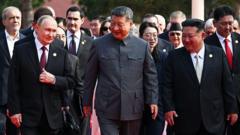
Stop looking for signs of a deep ideological alliance in the state media photographs of shaking hands. Those smiles are transactional, guarded, and laced with profound mutual distrust.
Beijing is stuck with a liability it cannot sell, cannot fix, and cannot abandon. It will keep paying the minimum maintenance fees to keep the structure standing, not out of friendship, but out of absolute dread of what happens if the building falls.