Modern military operations live and die by electricity. If a small squad loses power in a remote valley, their radios go dark, their drone feeds cut out, and their situational awareness vanishes. For decades, the Pentagon has grappled with a frustrating reality on the frontline. Troops carry highly sophisticated digital gear but rely on primitive, heavy combustion engines to keep it running. When a high-draw device like an electronic jammer or a cooling pump suddenly kicks on, it demands a massive spike in current. Traditional generators cannot handle the shock. They bog down, choke on the load, and stall completely.
An Arizona firm recently secured a patent that changes this dynamic entirely. Gilbert-based Nishati Power Technologies won approval for US Patent No. 12,671,257 B1, which outlines a smarter hybrid electrical power generator and battery charging system. The invention targets the exact point where field power systems usually fail: sudden current surges. Instead of forcing troops to lug around massive, oversized generators just to handle occasional spikes, this new battlefield power system uses a clever voltage modulation technique to keep the engine humming through the worst of the load. It is a practical, elegant fix to a problem that has plagued infantry units for a generation.
The Brutal Reality of Small Unit Power
Walk into any forward operating base or temporary observation post and you will hear a constant, deafening roar. It is the sound of heavy diesel generators burning through thousands of gallons of fuel. Military logistics are shockingly burdened by this reliance. In fact, historically, over half of the gross tonnage transported during major military deployments consists of fuel alone. A massive chunk of that fuel does not go to tanks or armored vehicles. It goes to keeping command tents, radios, and laptop displays alive.
When you are out at the tactical edge, you do not have the luxury of a massive power grid. You rely on small, portable units. The U.S. Marine Corps has spent years trying to field lighter equipment through initiatives like the Small Unit Power program. They want things that two Marines can carry over rough terrain without throwing out their backs.
The problem is that small generators are inherently fragile when it comes to electrical transients. Imagine a small 2kW generator running quietly, powering a couple of laptops and some radio chargers. Suddenly, an operator plugs in a high-powered satellite terminal or a thermal imaging system. The immediate draw spikes way past the generator's baseline capacity, sometimes hitting 3kW or more. The sudden magnetic resistance inside the alternator acts like a sudden brake on the small diesel engine. The RPMs plunge, the system chokes, and the lights go out. To prevent this, the military has historically done something incredibly wasteful. They deploy 5kW or 10kW generators to do a 2kW job, simply because they need the extra headroom to survive those brief surges. This leads to massive fuel waste, heavy logistics, and units that are easily spotted by enemy thermal sensors.
Inside the Mechanics of Patent 12671257
The invention designed by Robert J. Charette, Richard A. Schilke, and Travis P. Kelley throws out the old philosophy of over-engineering the engine size. Instead, it uses smart electrical management to handle the load.
The patent details a control system wired directly to a variable voltage regulator. This setup constantly watches the electrical demand coming from the field equipment. When a massive piece of gear spins up and the current draw jumps past a critical upper threshold, the system does not let the engine choke. Instead, the control system instructs the variable voltage regulator to dynamically modulate the voltage output from the alternator.
The generator temporarily and rapidly cycles its voltage output between a lower voltage range and an upper voltage range. By intentionally dropping the voltage during a high-amperage surge, the system temporarily reduces the torque load on the engine crankshaft. It essentially gives the diesel engine a split second to breathe and spin up its RPMs to meet the new demand. The system keeps cycling the voltage rapidly until the amperage draw stabilizes. Once the electrical surge passes or the engine catches up, the generator returns to its steady, standard Mil-Std 28V DC output.
It is an incredibly simple concept that requires precise software execution. Think of it like a driver pumping the brakes on an icy road or a smart transmission downshifting before a steep hill. The hardware does not need to be twice as big because the software handles the physics of the spike. Nishati's unit can comfortably handle surges exceeding 3kW on a generator rated for a 2kW continuous load without stalling out or overloading the internal circuits.
Why the Old Solutions Missed the Mark
Many engineers in the defense sector tried to solve this with massive battery banks. The theory was simple. Run the generator at a constant, efficient speed to charge a battery, and let the battery absorb the shock of any sudden spikes. It sounds great on paper, but the reality of combat deployment ruins it.
Batteries add immense weight. Lead-acid blocks are too heavy to carry, and large lithium-ion packs present a severe fire hazard if they take shrapnel or small-arms fire. Furthermore, large battery banks require complex thermal management systems to keep them cool in places like the deserts of Arizona or the Middle East. If the cooling fan fails, the whole system shuts down to prevent a thermal runaway.
Another failed approach was relying entirely on commercial off-the-shelf inverter generators. These are the quiet generators you see at campsites. They work fine for a tailgate party, but they are notoriously delicate. They cannot handle the dirty, variable-quality JP-8 jet fuel that the military standardizes on to simplify supply lines. They also fall apart when exposed to fine desert dust, torrential rain, and the vibration of being bounced around in the back of an unarmored truck.
Nishati took a different path. They kept the rugged, air-cooled, single-cylinder diesel engine that grunts already know how to fix. They did not build a fragile computer that happens to produce power. They built a tough, mechanical engine and gave it a smarter brain.
The Grueling Road Through Aberdeen Testing
You cannot just invent something, show it to a general, and expect it on the battlefield next week. The military demands proof. Nishati put their technology through the ringer at the U.S. Army's Aberdeen Test Center, completing extensive Mil-Std-810H and Mil-Std-705D environmental and reliability trials.
Aberdeen is where equipment goes to die. They bake gear in extreme heat chambers, freeze it in sub-zero simulations, blast it with corrosive salt fog, and shake it on vibration tables that mimic thousands of miles of rough driving. The hybrid generator configuration did not just scrape by. It blew past the government's objective operating hours requirement by three times, and outperformed the absolute minimum operating requirement by a factor of nine.
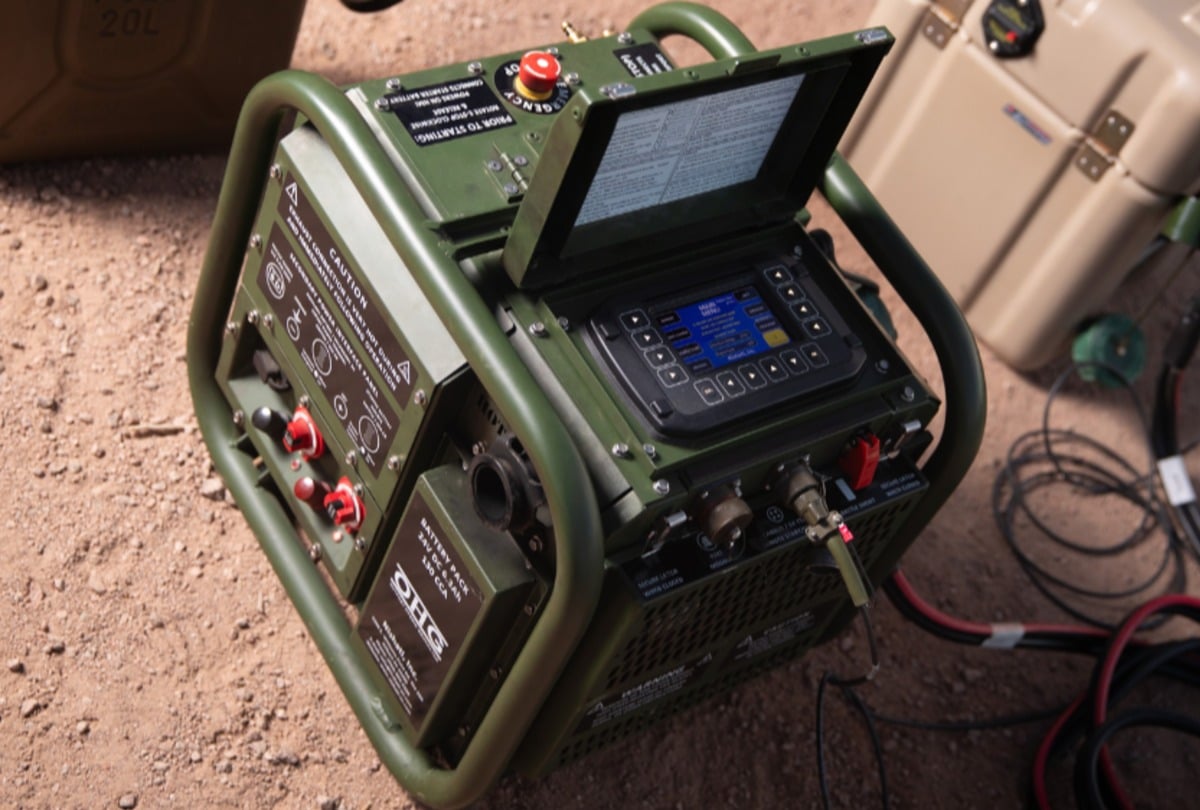
This testing cleared the way for real-world deployment. The U.S. Marine Corps selected the firm to deliver their next-generation 2kW Outpost Hybrid Generators under the Lightweight DC Generator program. With hundreds of units scheduled for delivery, this technology is moving out of the lab and into the dirt.
The Logistics Shift for Future Operators
So, what does this actually look like for a unit deployed in a forward area? It means a radical downsizing of their physical footprint.
Because the generator can handle surges through voltage cycling rather than raw engine displacement, a two-person team can physically carry the power source. You do not need a forklift or a trailer to move your power grid. If an enemy drone spots your position, you can kill the power, pack the generator into the back of a light vehicle, and relocate in minutes.
The DC-native output also simplifies how units build out their local grids. Traditional military generators produce alternating current (AC), which then requires heavy rectification boxes to convert into the direct current (DC) needed by modern communications gear, drone stations, and laptop banks. Nishati's system outputs utility-grade 28V DC right out of the box. This makes it simple to plug directly into NATO vehicle platforms, tactical battery charging trays, or portable solar blankets without losing energy through multiple stages of inversion.
Actionable Steps for Tactical Procurement Officers
If you are a defense program manager, an operations officer, or a logistics planner looking to modernize your unit's power layout, you cannot keep buying legacy tactical quiet generators. The old acquisition framework is broken. Here is how you should evaluate your next power procurement cycle.
First, demand transient load profiles from your vendors. Do not just look at the continuous kilowatt rating on the spec sheet. Ask exactly what happens when the system takes a 150 percent load surge in less than 50 milliseconds. If the vendor tells you that you need to size up to a larger engine class to handle that spike, walk away.
Second, prioritize multi-fuel compliance. A battlefield power system must run on whatever is available in the theater of operations. Look for systems designed around single-cylinder diesel engines that are certified to run on JP-8, F-24, standard commercial diesel, and kerosene without requiring mechanical timing adjustments in the field.
Third, eliminate unnecessary conversion steps. Count the number of inverters and rectifiers between your power source and your primary mission equipment. If your unit is primarily running digital communication gear, satellite dishes, and drone controllers, your primary power generation should be DC-native. Stop wasting fuel and generating excess heat by converting AC to DC and back again.
The patent issued to this Arizona firm proves that the solution to military energy issues is not bigger engines or heavier trucks. The solution is smarter power distribution that works with the laws of physics instead of fighting them with brute force.