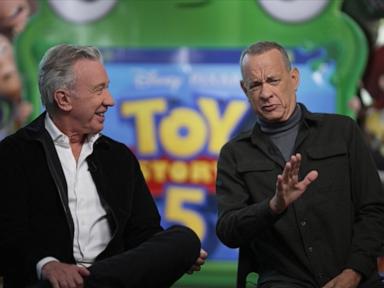
The air inside the sound booth is always cold, but the microphone is unforgivingly warm. Tom Hanks stands there, adjusting his glasses, looking at a digital sketch of a pull-string cowboy he first met more than thirty years ago. He is seventy years old now. Across the country, or perhaps just down the hall, Tim Allen is staring down the barrel of the same existential barrel. They do not have to be here. They have the money. They have the Oscars and the legacies.
Yet, here they are, trying to summon the specific, breathless panic of plastic toys realizing they are about to become completely irrelevant.
When Pixar first approached the duo about returning for a fifth outing, the reaction was not an immediate celebration. It was a confrontation.
"We don't want them to be lesser than what the others have been," Hanks admitted recently, recalling the uneasy phone calls between himself and Allen. The fourth film had felt like an ending. The characters had been given their grand goodbyes. To open that box again required something more than a studio's desire to print money. It required an enemy worth fighting.
They found that enemy in a small, glowing rectangle.
Consider the premise of the new story: Bonnie, the little girl who inherited the beloved collection of playthings, gets a tablet. Her attention vanishes into the screen. The toys are left on the shelf, static and frozen, watching a blue light reflect off her blank face.
It sounds like a simple, modern conflict for an animated feature. But if you listen to the way Hanks and Allen talk about it, you realize they aren't just acting out a script. They are terrified. They are witnessing a quiet, massive shift in human development, and they are using an old cowboy and a plastic space ranger to fight a rearguard action against the modern world.
"Being on a tablet is not playing with a toy," Tim Allen said bluntly during the press run. "It's playing with dopamine."
The comedian is known for his love of tools, of gears, of things you can physically drop on your foot. He tells a story about a kid across the street to whom he gave a small, metal front-end loader. The boy immediately began moving real rocks, building a narrative in the dirt, sweating under the sun. That is active engagement. The screen, Allen argues, is something entirely different. It is a passive delivery mechanism for artificial highs. He looks at his own phone and watches the algorithm feed him fabricated videos of plane crashes that never happened. If a grown man can get sucked into the digital quicksand, what chance does a seven-year-old child have?
This is where the narrative shifts from a movie promotion to a public intervention.
The new character in the franchise, a sleek tablet interface named Lilypad, is voiced by Greta Lee. She represents the seductive ease of the digital age. In the film, a moment occurs where Bonnie is interacting with the device, trying to find a sense of community, only to have her feelings deeply hurt by a text message.
Hanks points to that specific scene as the emotional anchor of the entire project. "No toy hurts your feelings if you are playing with it," he observes.
The contrast is stark. A physical toy requires a child to project their own soul into it. If Woody walks across the carpet, it is because the child willed it. The child creates the dialogue, solves the conflict, and processes their own reality through the medium of plastic and plush. The toy is a mirror of the child's inner world.
A tablet does the opposite. It projects its own world into the child. It dictates the sounds, the colors, the narrative pacing, and the rewards. It demands nothing but consumption.
We are currently living through a massive, uncontrolled psychological experiment. Parents around the world are exhausted. It is incredibly easy to hand a screaming toddler an iPad so you can cook dinner, answer an email, or just have ten minutes of silence. Greta Lee admits to this struggle with her own children, describing the daily warfare of setting boundaries, forcing them outside into nature, and trying to teach them to tolerate the ancient art of being bored.
Joan Cusack, returning as the energetic cowgirl Jessie, notes how hard that parenting choice is. It takes immense energy to say no to the screen. It is exhausting to build fortresses out of couch cushions and hide under the coffee table when your knees hurt and your day was long. The tablet is the ultimate path of least resistance.
But the cost of that path is the slow death of tactile imagination.
The creators at Pixar are not subtle about the stakes. They are using one of the most powerful media operations on earth to critique the very technology that made their industry possible. Thirty-one years ago, Jeffrey Katzenberg convinced Tom Hanks to sign on to the original film by showing him a crude, computer-generated Woody moving against a flat blue background to a voice line ripped from Turner and Hooch. It was a technological marvel—the first fully computer-animated movie in history.
Now, that same animation powerhouse is waving a red flag, warning that the technology has gotten too good, too sticky, and too isolated.
Will a single animated movie change the trajectory of childhood development? It is highly unlikely. Human behavior does not turn on a dime because of a movie ticket. Hanks himself is cynical about whether a piece of cinema can alter the course of a society currently debating whether to ban social media for anyone under sixteen.
But Allen holds onto a strange, mathematical hope. He cites an old friend from his past who ran large wellness seminars. Out of ten thousand people who attended an event, maybe twelve percent would actually leave and change their lives.
"There's a weird part of me that really believes that there's going to be a bunch of kids that see our film and go: I do want to play with my toys," Allen says.
That is the true target audience for this film. Not the critics, not the box office analysts, and not the adults looking for a hit of nineties nostalgia. The target is the kid who looks up from the screen during the credits, sees their old, discarded action figures lying in the corner of the bedroom, and reaches down to pick them up.
The magic of the series has never been about the animation quality or the clever pop-culture jokes. It has always been about the profound vulnerability of loving something that cannot love you back, and the immense responsibility of being the custodian of a child's fleeting youth.
When Hanks and Allen step into that recording booth, they are looking at two old friends who have aged much better than they have. Woody's paint doesn't wrinkle. Buzz's wings still pop out with the same crisp click. But the voices behind them are deeper now, carrying the weight of decades lived and a world changed beyond recognition.
They are two old men shouting into a microphone, trying to remind a generation of distracted children that the most powerful processor on earth isn't sitting inside a silicon chip.
It is already inside their heads, waiting for someone to pick up a toy and turn it on.