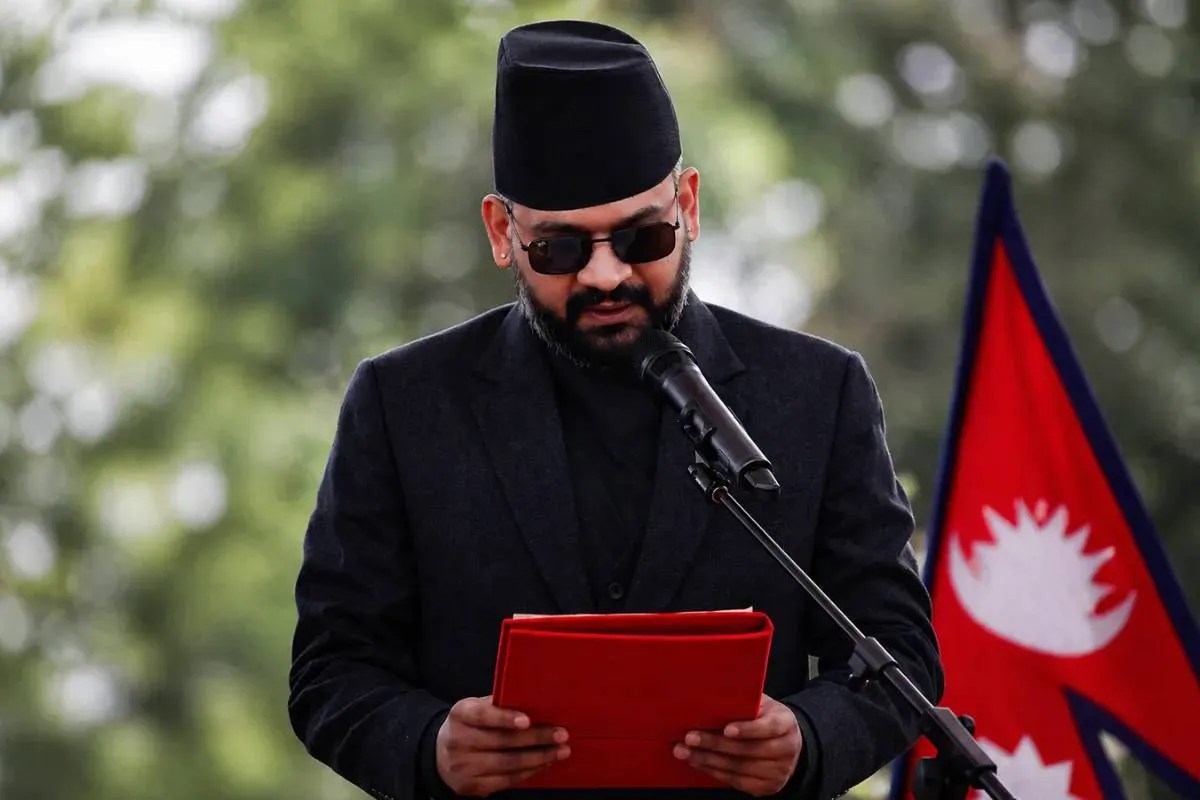
You can always count on Balen Shah to stir the pot, but nobody expected his latest stunt to rock the foundations of Nepali diplomacy quite like this. During a heated legislative session, the firebrand leader dropped a geopolitical bombshell that left opposition lawmakers hyperventilating. He admitted on the floor that Nepal has encroached upon and occupied Indian territory in multiple places along the border.
It's a jaw-dropping reversal of the usual political script in Kathmandu. For decades, Nepali politicians built their careers by pointing fingers at New Delhi over border encroachments. Now, the guy at the top is saying the exact opposite. Predictably, all hell broke loose.
Opposition MPs immediately erupted in protest, shouting down the leader and demanding his resignation. They didn't just want him to retract the statement. They wanted it completely erased from the official parliamentary archives. To understand why this caused such massive panic, you have to realize how fragile the bilateral dynamic truly is right now.
The Statement That Shook Kathmandu
The drama unfolded when lawmakers questioned the administration about ongoing territorial disputes with India, specifically focusing on flashlight points like Kalapani, Limpiyadhura, and Lipulekh. Instead of sticking to the usual state-approved talking points, Balen Shah went completely rogue.
"It might sound strange to you, but after becoming Prime Minister, even I realized that it isn't just India. Nepal has also encroached upon Indian land in several places."
The reaction was instantaneous. The opposition benches turned into a wall of noise. Experts on border management and former diplomats quickly jumped on television networks to denounce the claims, calling them irresponsible and damaging to national interests.
The political calculus here is obvious. By claiming that Nepal is also an aggressor in border disputes, Shah effectively diluted the country's historical leverage. For a nation that recently updated its political map to include disputed territories, acknowledging counter-encroachments is seen by many locals as political suicide.
Untangling The Real Border Disputes
So, what is he actually talking about? Is there any truth to the claim that Nepal holds Indian land? The reality is much messier than a simple land grab.
Most of these disputes boil down to shifting rivers, particularly the Gandak River, which flows along the border near Susta. Known as the Narayani River in Nepal, this body of water has changed its course drastically over the last few decades.
When a river shifts, the land around it changes hands practically overnight. Take a look at the core flashpoints driving this friction:
- Susta: This region sits on the eastern bank of the Gandak River. Nepal claims the area belongs to the Susta Rural Municipality, arguing that India has encroached on over 14,000 hectares of land. India, on the other hand, administers it as part of the West Champaran district of Bihar. Over the years, the changing river path has pushed large chunks of what was historically Indian agricultural land over to the Nepali side.
- The Kalapani Tri-junction: A high-altitude zone where the borders of India, Nepal, and China meet. The core issue is the origin of the Kali River. Nepal relies on the 1816 Sugauli Treaty to claim everything east of the river, while India maintains that the river's source lies further inland, keeping the territory under New Delhi's control.
Historically, locals living along these borders didn't care about formal lines drawn in far-off capitals. They crossed back and forth to cultivate ancestral farmlands. However, the recent deployment of Nepal's Armed Police Force (APF) to these sectors has transformed casual farming communities into militarized zones.
The Greater Nepal Ideology Meets National Politics
To understand why Balen Shah is so comfortable playing with diplomatic fire, you have to look at his political brand. He didn't rise to power through the traditional party machine. He built his reputation as a populist outsider who taps directly into Gen-Z nationalism.
Years ago, while serving as the Mayor of Kathmandu, Shah famously hung a massive historical map of "Greater Nepal" in his municipal office.
This map dates back to the pre-Sugauli Treaty era of 1816, showing Nepali territory extending far past its current limits, reaching the Sutlej River in the west and the Teesta River in the east. It essentially swallowed modern Indian regions like Darjeeling, parts of Uttarakhand, and chunks of Uttar Pradesh and Bihar.
That move was a direct, symbolic retaliation against New Delhi displaying an "Akhand Bharat" cultural mural in its new parliament building, which included Lumbini—the birthplace of Gautama Buddha. Shah knows exactly how to play the nationalist card when it suits him. But his latest admission in parliament shows he's willing to pivot when trying to project a realistic, no-nonsense governing style.
Diplomatic Fallout And Next Steps
The diplomatic damage control has already begun. Shah tried to soften the blow by telling parliament that his government is actively working on diplomatic channels. He confirmed that formal notes have been dispatched to both India and China regarding the Lipulekh dispute.
More surprisingly, he suggested bringing the United Kingdom into the conversation, arguing that because the original border demarcations were drawn during the British Raj, London bears some responsibility for clearing up the confusion.
Whether that strategy works is highly doubtful. International border disputes aren't solved by adding more cooks to the kitchen. For now, the political reality inside Nepal is highly volatile. The opposition will continue to weaponize this speech to paint Shah as a liability who can't be trusted with national sovereignty.
If you're tracking this geopolitical standoff, expect the focus to shift back to the joint boundary field surveys. Resolving the shifting river boundaries in Susta is the only practical way forward. Until both nations sit down to finalize the technical ground realities rather than trading barbs in parliament, these border areas will remain highly unstable.