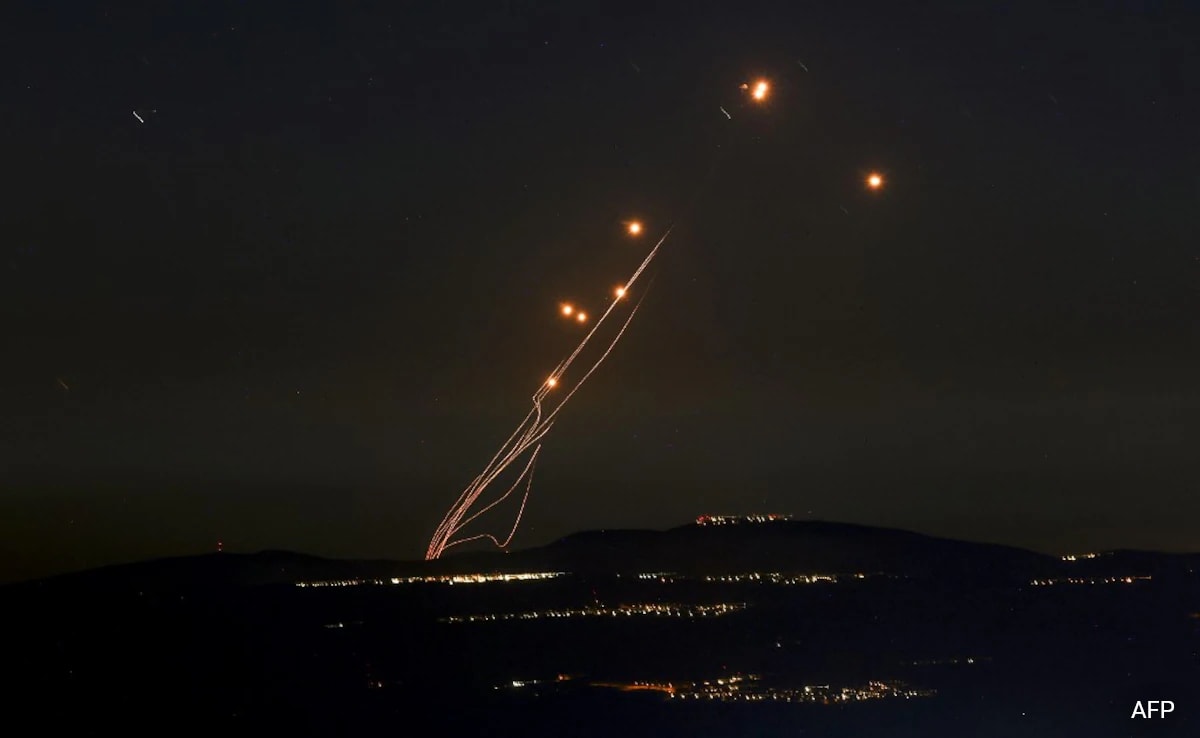
The deployment of Israeli missile defense assets to the United Arab Emirates (UAE) represents more than a transactional arms sale; it is the physical manifestation of a structural shift in Middle Eastern security architecture. While surface-level reporting focuses on the geopolitical "thaw" between former adversaries, a rigorous analysis reveals a deep-tier integration of sensor-to-shooter loops designed to counter asymmetric threats from non-state actors and Iranian-backed proxies. The operational utility of the Iron Dome and its associated systems in the UAE rests on three pillars: kinetic interception efficiency, regional radar synchronization, and the psychological devaluation of low-cost saturation attacks.
The Kinetic Calculus of Point Defense
The decision to deploy the Iron Dome (Kippat Barzel) to the UAE serves a specific mission profile: the protection of high-value economic assets and urban population centers against short-range rocket, mortar, and Unmanned Aerial Vehicle (UAV) threats. Unlike high-altitude systems like the Terminal High Altitude Area Defense (THAAD), which manage ballistic trajectories in the terminal phase, Iron Dome operates within the lower atmosphere to intercept threats with a high degree of discrimination.
The system's efficacy is defined by its Battle Management & Control (BMC) unit. This unit calculates the trajectory of an incoming projectile in milliseconds. If the projected impact point falls within an unpopulated or low-value zone, the system does not fire. This selective engagement is the primary driver of the system’s economic sustainability. In a saturation attack, where an adversary launches hundreds of low-cost munitions, the defender faces a cost-asymmetry crisis. By ignoring "non-threatening" projectiles, Iron Dome optimizes the interceptor-to-threat ratio, ensuring that the limited inventory of Tamir interceptors is reserved for genuine risks.
Sensor Fusion and the Middle East Air Defense Alliance
The UAE’s acquisition of Israeli defense technology functions as a node in a broader, albeit informal, regional network often referred to as MEAD (Middle East Air Defense). The geography of the Arabian Peninsula creates a significant "early warning" deficit for localized threats. A cruise missile or a swarm of loitering munitions launched from southern Iran or maritime platforms has a short flight time to UAE targets.
The integration of Israeli ELM-2084 Multi-Mission Radar (MMR) systems into the Emirati defense grid provides a qualitative leap in situational awareness. These radars are AESA (Active Electronically Scanned Array) systems capable of tracking high-speed ballistic targets and low-speed, low-RCS (Radar Cross Section) drones simultaneously.
- Detection Horizon: By linking Emirati sensors with Israeli data processing and potentially US-monitored regional feeds, the reaction window increases from seconds to minutes.
- Triangulation: Multiple radar nodes allow for more precise tracking of "low and slow" threats that attempt to use terrain masking or complex flight paths to evade detection.
- Data Sovereignty: While the hardware is Israeli, the integration into the UAE’s existing Western-made command and control structures requires a high degree of software interoperability, effectively creating a hybrid defense ecosystem.
The Cost Function of Modern Attrition
The strategic logic of Iranian-aligned proxy attacks—such as those executed by Houthi forces using Quds-series cruise missiles and Samad-3 UAVs—is centered on economic exhaustion. A single drone may cost $20,000 to produce, while a traditional surface-to-air missile (SAM) like the Patriot PAC-3 can cost nearly $3 million per interceptor.
Iron Dome shifts this cost function. While a Tamir interceptor remains more expensive than a basic drone (estimated at $40,000 to $50,000 per unit), the delta is narrow enough to make defense viable over a prolonged campaign of attrition. The UAE's reliance on THAAD and Patriot systems for all tiers of defense was a structural vulnerability; using a multi-million dollar missile to down a "suicide drone" is a losing economic strategy. The introduction of Israeli point defense allows the UAE to reserve its heavy batteries for high-tier ballistic threats while using Iron Dome for the "low-tier" volume.
Structural Limitations and Failure Modes
No defense system is hermetic. The deployment in the UAE faces specific operational headwinds that differ from the Israeli domestic context.
- Saturation Thresholds: Every interceptor battery has a finite number of firing cells. If an adversary calculates the maximum engagement capacity of a battery and launches $N+1$ projectiles, the system is mathematically guaranteed to fail for the final projectile.
- Clutter and Urban Density: In high-density environments like Dubai or Abu Dhabi, the radar must distinguish between civilian air traffic, maritime activity, and incoming threats. This increases the computational load on the BMC and necessitates strict "no-fire zones" to avoid fratricide or civilian aviation accidents.
- Geopolitical Friction: The presence of Israeli technology on Emirati soil creates a target-rich environment for intelligence gathering. Adversaries will likely deploy electronic warfare (EW) assets to map the ELM-2084 radar frequencies and test for vulnerabilities in the data links.
The Shift from Passive to Proactive Defense
The Emirati-Israeli defense nexus signals a move away from passive reliance on Western security guarantees toward a proactive, localized hardware-based alliance. This transition is driven by the perception of a declining US kinetic footprint in the Gulf. By adopting Israeli battle-tested systems, the UAE gains immediate access to "combat-refined" software—code that has been updated in real-time based on actual interceptions in Gaza and Lebanon.
This iterative loop of technology development is the "hidden" value of the Israeli partnership. Unlike many defense systems that are tested in controlled ranges, Iron Dome undergoes constant evolutionary pressure. For the UAE, the acquisition is as much about the data and the algorithm as it is about the physical launchers.
Tactical Recommendations for Regional Stability
The transition to an integrated defense posture requires the UAE to move beyond hardware procurement and focus on three strategic vectors:
- Standardization of Interoperability: The UAE must ensure that the Israeli BMC can communicate with the US-made IBCS (Integrated Battle Command System) to create a unified air picture. Failure to do so will result in "siloed" defense, where different batteries operate blindly of one another.
- Deepening Domestic Maintenance: To mitigate supply chain risks during a regional conflict, the UAE must secure localized production of Tamir interceptor components or, at a minimum, massive localized stockpiles to prevent "magazine exhaustion."
- The Drone-Laser Pivot: As loitering munitions become cheaper, even the Iron Dome will eventually hit an economic ceiling. The UAE should accelerate its interest in "Iron Beam" or similar directed-energy (laser) systems. A laser-based interceptor reduces the cost-per-kill to the price of electricity, effectively neutralizing the economic advantage of drone swarms.
The deployment of Israeli defense assets is not a final state but an interim solution in a rapidly evolving arms race. The ability to deny an adversary "cheap wins" through missile and drone strikes forces that adversary back to the diplomatic table or toward more expensive, riskier forms of escalation. By hardening its "soft targets" with Israeli precision, the UAE is effectively raising the entry price for regional aggression.