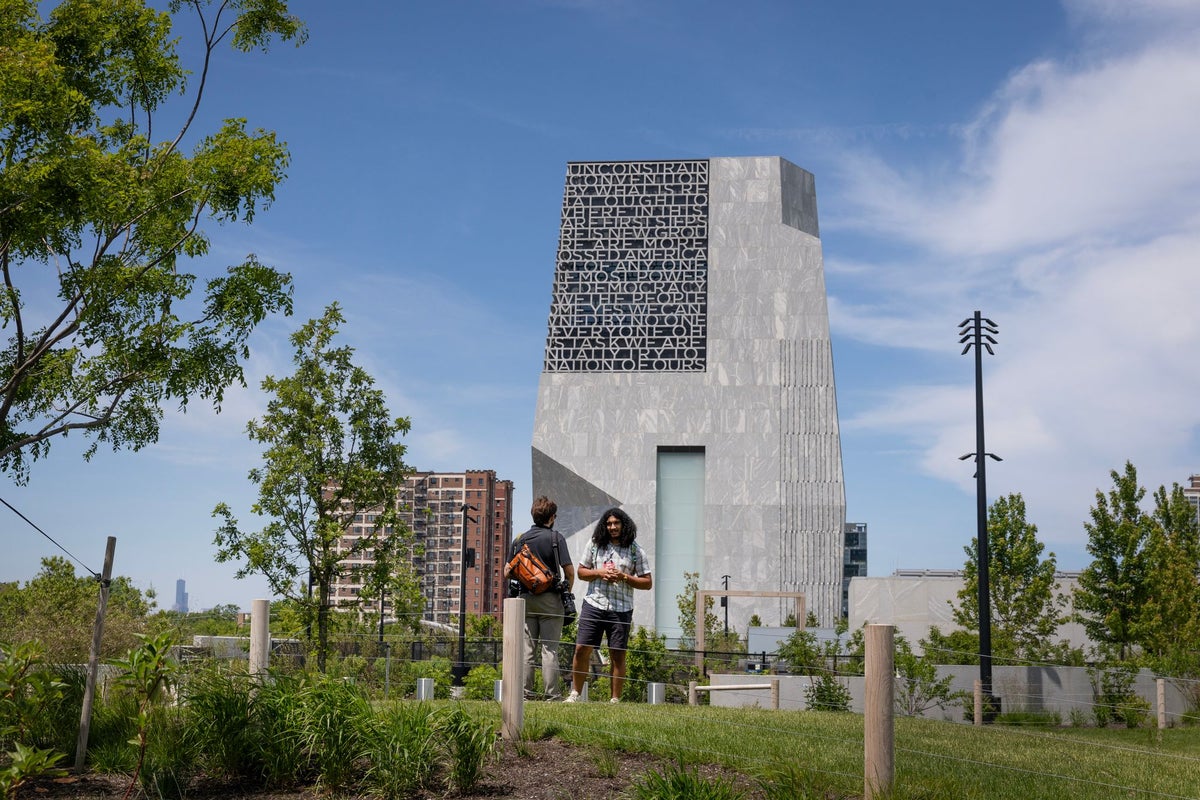
The modern presidential library operates under a fundamental contradiction: it must serve as a solemn civic monument while simultaneously performing as a high-throughput commercial enterprise. The opening of the $850 million Obama Presidential Center in Chicago's Jackson Park crystallizes this tension. By decoupling from the traditional National Archives and Records Administration (NARA) framework, the project represents a deliberate pivot from historical preservation to an active civic engine designed to generate localized economic value.
Evaluating this institution requires bypassing conventional museum narratives. Instead, the facility must be analyzed through its architectural geometry, spatial yield optimization, and the financial trade-offs inherent in building the most expensive presidential campus in American history.
Spatial Mechanics and Tower Geometry
The centerpiece of the 19.3-acre campus is a 225-foot-foot tall museum tower designed by Tod Williams Billie Tsien Architects. To evaluate its design is to understand its programmatic constraints. Museum environments demand rigorous environmental control to optimize internal lighting conditions for digital multimedia projections and artifact preservation. The building's monolithic envelope, wrapped in New Hampshire granite, intentionally limits natural apertures to minimize solar heat gain and UV degradation.
The structural form mimics a vertical progression, described by the architects as four hands converging in an embrace. This geometry creates a shifting profile on each face, preventing the mass from reading as a static block. The verticality serves an explicit urban-planning function: it acts as a visual anchor on the South Side skyline, contrasting with the horizontal landscape of Frederick Law Olmsted’s historic park.
The primary structural layout divides the campus into a distinct binary framework:
- The Revenue Tower: A vertical, controlled-environment stack requiring paid admission to access the primary exhibition floors.
- The Civic Horizon: A series of low-slung, single-story pavilions—the Forum, the Chicago Public Library branch, and the Home Court athletic facility—integrated directly into the landscape via green roofs and open plazas.
By pushing all vehicular parking below-grade and reclaiming a former roadway, the master plan maximizes contiguous surface acreage for civic use. The landscape design uses winding paths, a restored historic Women’s Garden, and a specialized wetland park engineered for high-capacity stormwater retention. This layout functions as an environmental buffer, capturing surface runoff before it impacts the adjacent Jackson Park lagoon.
The Digital Substitution Framework
The core operational divergence of this facility is the complete absence of physical presidential papers on display. Traditional presidential libraries function as research repositories under NARA jurisdiction, where structural design is dictated by the archival storage parameters of paper documents and physical records. This center operates outside that paradigm, choosing a fully digital archival model.
This structural pivot shifts the museum’s core asset from physical conservation to experience design. The exhibition spaces, developed by Ralph Appelbaum Associates, rely on a digital substitution framework.
[Traditional Library: Physical Archival Vaults] ──> High Square-Foot Allocations + Strict Climate Controls
                                                               │
                                                       (Strategic Shift)
                                                               ▼
[Modern Center: Digital Exhibition Framework]     ──> Dynamic Spatial Yield + High-Throughput Foot Traffic
Physical artifacts are deployed strategically rather than exhaustively. Instead of rows of archival text, key historical moments—such as the passage of the Affordable Care Act or the 2015 Charleston eulogy—are mediated through large-scale video installations and soundscapes. The physical items that do appear are highly curated for tactile or emotional resonance: a collection of Michelle Obama's evening gowns behind glass paired with touchable fabric swatches, or Barack Obama's personal BlackBerry phone resting inside a desk drawer.
The structural risk of this digital approach is the potential loss of historical authority. When an institution trades primary source documents for digital reproductions, it assumes the burden of maintaining historical weight without the self-evident authenticity of physical paper. The design counters this liability through architectural permanence—using raw concrete, end-grain wood flooring, and patinated metals inside the atrium to ground the high-tech interior in a heavy, physical material reality.
The Oval Office and Spatial Yield Optimization
The primary driver of visitor throughput sits on the fourth level of the tower: a full-scale replica of the White House Oval Office. Presidential museums regularly deploy replicas, but the deployment here follows a distinct operational logic. Rather than isolating the room behind a security barrier, the installation allows visitors to sit behind the desk and interact with the space.
This interactive design solves an explicit throughput and engagement problem:
Spatial Access
The traditional museum layout forces a linear, look-but-don't-touch flow, creating structural bottlenecks around key exhibits. The open replica design transforms the room into a multi-directional space capable of handling continuous streams of visitors, including large school groups.
Behavioral Feedback
By permitting visitors to handle replica objects—such as a copy of the handwritten letter left by President George W. Bush—the exhibit converts a passive viewing experience into an active, high-engagement touchpoint. This shifts the value proposition from standard viewing to personal immersion.
Social Propagation
Allowing photography behind the desk leverages visitor behavior to organic marketing ends. Each participant acts as an independent node distributing the museum’s core visual asset across digital networks, lowering the institution's long-term customer acquisition costs.
Financial Engineering and the $30 Threshold
Operating outside the NARA network grants the Obama Foundation complete operational flexibility, but it eliminates federal operational subsidies. The center must be entirely self-sustaining. This financial reality explains its aggressive pricing structure. At $30 per ticket, the museum sets the highest baseline admission fee of any presidential site in the United States, positioning it just above the Richard Nixon Presidential Library ($29) and double the price of the Abraham Lincoln Presidential Library ($15).
To balance this premium pricing with its stated mission of local community empowerment, the foundation relies on a clear cross-subsidization model.
[Paid Museum Tower Access ($30 Ticket Base)]
                     │
                     ▼ (Generates Surplus Revenue)
                     │
         ┌───────────┴───────────┐
         ▼                       ▼
[Free Civic Infrastructure]   [Localized Access Programs]
- 8th-Floor Sky Room           - Illinois Resident Discounts
- Public Plaza & Library       - Neighborhood Free Days
- Wetland Park & Athletics     - Educational Exemptions
The revenue generated by the four floors of the paid museum tower offsets the operational liabilities of the free public spaces. The eighth-floor Sky Room, which provides panoramic views of Chicago and Lake Michigan, remains open to the public without a ticket, acting as a goodwill anchor for the local South Side population.
The success of this financial model relies on an estimated annual draw of 1 million visitors. This target requires a delicate balance between national tourism and local community utility. If the premium pricing discourages repeat visits from regional demographics, the center risks becoming an isolated tourist enclave rather than an integrated civic hub.
Capital Deployment and Regional Value Generation
The deployment of $850 million in capital into Jackson Park represents a significant economic bet on the South Side of Chicago. By combining a digital-first museum with an open, multi-building public campus, the project attempts to establish a new blueprint for the post-presidential institution.
The long-term viability of the center will not be measured by the praise of its architecture or the novelty of its digital installations. Instead, its performance must be evaluated by its ongoing capacity to convert high tourist traffic into sustained local economic energy, all while managing the operational costs of a sprawling, 20-acre urban infrastructure.