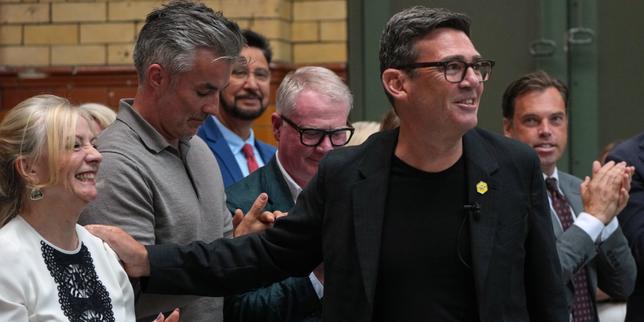
The British political commentary class has found its new fixation. They are swooning over Andy Burnham’s latest programmatic speech, painting the Mayor of Greater Manchester as the true heir to the center-left throne, a visionary leader-in-waiting who has cracked the code of regional governance.
They are entirely wrong.
The lazy consensus across mainstream media treats Burnham’s "King of the North" persona as a blueprint for national revival. They point to his localized bus system, his fiery rhetoric against Westminster, and his soft-left populist appeal as proof that he offers a viable alternative to the sterile technocracy of the current Downing Street regime.
But if you strip away the flat cap aesthetics and the carefully curated regional grievances, you do not find a radical alternative. You find the exact same management framework that has stagnated the British economy for decades. Burnham is not a disruptor. He is a highly skilled administrator of a broken status quo, using devolution as a shield to deflect from structural economic failures.
To understand why the Burnham hype train is headed for a dead end, you have to look past the optics and examine the hard mechanics of regional political economy.
The Devolution Delusion: Managing Scarcity Is Not Leadership
The core premise of the pro-Burnham argument rests on the success of devolution. The narrative claims that moving power away from London allows regional leaders to spark localized economic growth.
This is a structural misunderstanding of how capital and power operate in the United Kingdom.
I have watched local governments across Europe and the UK burn through hundreds of millions of pounds trying to "regenerate" regions through prestige infrastructure projects and localized public transport branding. The results are almost always the same: temporary construction spikes followed by a return to the baseline of low-productivity, service-based economies.
True economic power in the UK remains fiercely centralized not just geographically in London, but structurally within the Treasury. Regional mayors do not possess macro-fiscal levers. They cannot alter monetary policy, they cannot change national tax structures, and they cannot borrow capital at the scale required to shift macroeconomic realities.
When Burnham boasts about taking control of Manchester’s buses—the Bee Network—he is celebrating the management of a utility, not the creation of wealth. Fixing bus routes is useful for municipal efficiency, but it does not fix a productivity crisis. It is a textbook example of confusing administrative competence with economic transformation. Burnham has masterfully shifted the goalposts: he has convinced the public that a well-run bus schedule is equivalent to a radical economic program.
The High-Tax, Low-Productivity Trap
The programmatic vision pitched by the Burnham camp relies heavily on the classic center-left triad: public investment, regional assembly consensus, and social safety nets. While these concepts sound comforting in a conference hall, they ignore the brutal reality of the UK’s fiscal position.
Consider the trade-offs that Burnham’s defenders conveniently omit. To fund expanded regional bureaucracies and localized welfare initiatives, capital must be extracted from the local economy. In a high-productivity environment, this might be sustainable. But Greater Manchester’s productivity—measured by Gross Value Added (GVA) per hour worked—consistently lags behind the UK national average, which itself is underperforming compared to peer economies like Germany or the United States.
When you implement interventionist regional policies in a low-productivity zone, you create a feedback loop of economic drag:
- Capital Crowding Out: Public sector interventions artificialize the local job market, absorbing talent into administrative and compliance roles rather than wealth-generating industries.
- Regulatory Friction: Localized employment charters and regional standards, while well-intentioned, increase the cost of doing business relative to neighboring regions, discouraging external direct investment.
- The Subsidy Trap: Industries become reliant on regional development grants and public contracts rather than market competitiveness, stifling genuine innovation.
The downside of this contrarian reality is stark: challenging this model means admitting that regional equality cannot be achieved by simply spending public money more compassionately. It requires deregulatory agility, targeted tax incentives, and a willingness to let certain legacy industries die to make way for high-value technology and advanced manufacturing clusters. Burnham’s political brand, built on defending the existing social fabric at all costs, is fundamentally incapable of executing that kind of creative destruction.
Dismantling the Devo-Max Questions
The political class keeps asking the same flawed questions about Burnham’s trajectory. Let us dismantle the most common ones with blunt reality.
Can the "Manchester Model" be scaled nationally?
The question assumes the Manchester Model is an engine of independent growth. It isn't. Manchester’s recent boom in city-center property development and nightlife is not driven by Burnham's policies; it is driven by asset-price inflation and the overflow of capital from an oversaturated London market. You cannot scale an overflow mechanism to a national economy. If you apply Manchester's high-intervention, service-heavy framework to the entire country without London’s financial engine to tax, the system collapses under its own weight.
Doesn't Burnham's high public approval prove his platform works?
Approval ratings measure communication skills, not economic metrics. It is easy to remain popular when your entire political strategy relies on blaming an external entity—Westminster—for every systemic failure while taking credit for every localized success. This is standard populist regionalism, mirrored by politicians worldwide. It is excellent PR, but it is terrible diagnostics.
Isn't regional devolution the only way to fix the North-South divide?
No. The North-South divide is a product of structural under-investment in national energy grid infrastructure, highly restrictive planning laws that prevent industrial expansion, and an immigration policy that has historically favored low-wage service labor over capital-intensive automation. None of these issues can be resolved by a metro mayor, no matter how many speeches they give. Fixing the divide requires a ruthless, centralized overhaul of planning and energy laws, not more layers of regional governance.
The Technocratic Trap in a Flat Cap
The ultimate irony of Andy Burnham’s positioning is that he presents himself as the antidote to the slick, focus-grouped politics of London. Yet, his programmatic agenda is entirely technocratic. It replaces Westminster’s spreadsheet managers with regional spreadsheet managers.
Imagine a scenario where a region successfully cuts its unemployment rate by expanding municipal code enforcement, local transit administration, and publicly subsidized community trusts. On paper, the employment data looks healthier. In reality, the tax base has not expanded; it has merely redistributed existing national subsidies. The region remains entirely dependent on the fiscal goodwill of the central state.
This is the hidden flaw of the entire Burnham project. It does not create regional self-reliance. It perfects the art of regional dependency. It turns the North of England into a permanent client state of the Treasury, wrapped in the banner of local pride.
True economic disruption does not look like a regional mayor negotiating a slightly larger block grant from the Chancellor. It looks like a region demanding the power to slash corporate taxes to zero for advanced manufacturing, tearing up greenbelt planning restrictions to build massive data centers, and establishing independent special economic zones that bypass national union agreements to spark rapid industrialization.
Burnham will never propose this. His coalition of public sector unions, academic institutions, and traditional center-left voters would vanish overnight if he did. Instead, he will continue to deliver speeches that sound urgent but change nothing, promising a soft landing for a nation in structural decline.
Stop looking to Manchester for a national savior. The regional model being praised today is not the birth of a new economic paradigm; it is merely the final, polished version of the old one.