Large-scale public events present a distinct security paradox: the structural open-access design required to maximize community engagement directly undermines traditional access-control and threat-mitigation protocols. The fatal discharge of firearms on July 11, 2026, at Toronto’s Salsa on St. Clair street festival—resulting in two fatalities and four injuries—highlights the severe operational challenges inherent in securing soft targets within high-density municipal corridors. Resolving the vulnerabilities exposed by this incident requires a rigorous examination of the underlying ballistics environment, crowd dynamics under acute stress, and the operational limitations of municipal response frameworks.
The Kinematics of the Incident and Ballistic Contagion
The shooting occurred at approximately 8:12 p.m. near the intersection of St. Clair Avenue West and Arlington Avenue, a zone packed with pedestrians, vendors, and structural bottlenecks. Initial tactical telemetry led to an active-shooter designation by municipal dispatch. However, preliminary investigation by the Toronto Police Service established a different behavioral mechanism: a direct, reciprocal exchange of gunfire between two targeted individuals.
This distinction changes how the incident must be analyzed from a threat-mitigation standpoint. A classic active shooter operates on an asymmetric optimization model, maximizing casualties within a set timeframe. In contrast, a reciprocal exchange introduces a bilateral ballistic threat vector, transforming a public space into a crossfire zone.
The mechanism of injury for the bystanders is dictated by the principles of urban ballistic containment. When two combatants exchange fire within a high-density crowd, the probability of secondary casualties increases sharply due to two primary factors:
- Line-of-Sight Occlusion: High human density reduces the clear trajectory window for shooters, meaning projectiles that miss the intended target are highly likely to strike bystanders.
- Vector Dispersion: In a mobile, unscripted gunfight, the angles of fire shift rapidly, expanding the danger zone from a single trajectory line into a multi-directional kill web.
Investigators recovered two firearms at the scene, confirming the presence of multiple weapons, while both deceased individuals were identified as adult males. The outstanding suspects fled the perimeter immediately after the exchange, exploiting the chaotic crowd movement to evade immediate apprehension.
The Crowdsourcing of Panic: Mass Evacuation Dynamics
The transition from a localized violent dispute to a macro-level public safety emergency is accelerated by the physics of crowd panic. Witness accounts from restaurant patrons and street vendors described a sudden wave of frantic flight. This behavior matches established models of collective survival mechanics.
When a kinetic threat occurs in an open environment, the target population experiences an immediate cognitive processing bottleneck. The auditory signature of gunfire triggers a rapid assessment period. Because open-air festivals lack clear, centralized communication networks, individuals rely on visual cues from those nearest to the source of danger.
[Kinetic Threat / Gunfire]
       ↓
[Localized Sensory Input]
       ↓
[Visual Cue Transmission (First Wave Flees)]
       ↓
[Macro-Level Crowd Surge (Secondary Stampede Risk)]
This transmission creates a secondary hazard: the stampede risk. In narrow urban thoroughfares bounded by buildings and temporary vending stalls, a rapid surge of bodies generates significant physical force. The risk of crush injuries or trampling often rivals the direct ballistic threat. The halt of commercial operations by festival vendors reflects an immediate adaptation to this physical reality, shifting from service delivery to personal survival as space became highly compressed.
Operational Challenges in Command, Control, and Communication
The initial operational response faced immediate friction regarding situational awareness. The deployment of an active-shooter warning via social media and tactical channels reflected an abundance of caution, but it also illustrated the difficulties of identifying threats in real-time during chaotic public events.
The first limitation involves the Information Asymmetry Gap. During the opening minutes of an incident, emergency services depend on conflicting eyewitness calls. In a dense environment, the echoing of gunshots off building facades frequently distorts the perceived number of shooters and their positions, artificially inflating the apparent scale of the threat.
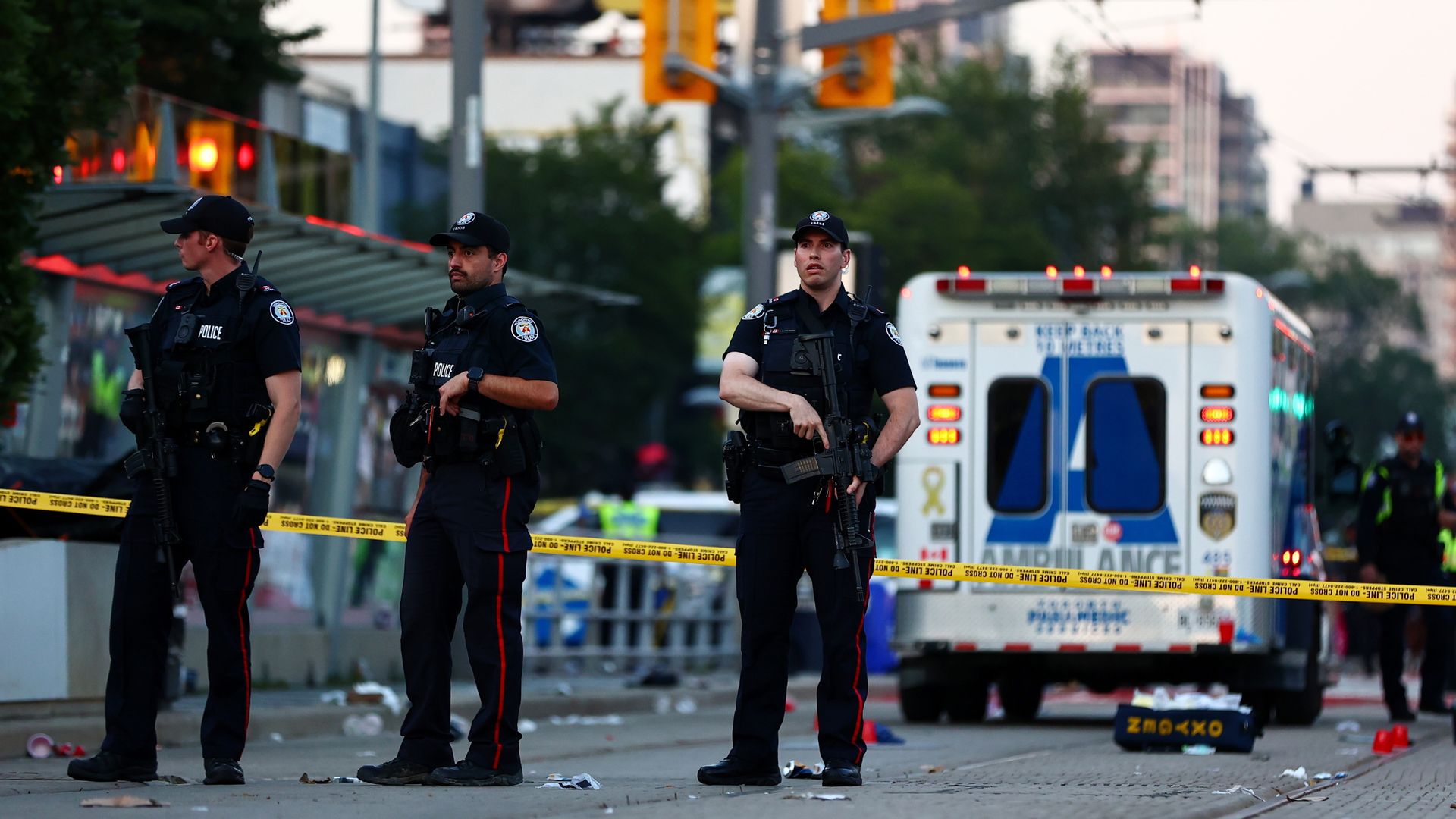
The second limitation centers on Tactical Mobility Constraints. A heavy police presence was quickly established at St. Clair Avenue West, but entering a crowded, high-stress zone presents logistical hurdles. Standard response times are slowed by the physical resistance of a fleeing crowd moving against incoming emergency vehicles and personnel.
While Deputy Chief Frank Barredo later confirmed that the situation was a targeted gunfight rather than a systematic active shooter, the initial confusion temporarily altered how personnel were deployed, forcing a defensive perimeter strategy before transition to a localized forensic investigation could occur.
Regional Safety Metrics and Policy Implications
To properly evaluate this event, it must be viewed against broader municipal and national safety data. Toronto has historically maintained a low rate of violent crime relative to major metropolitan areas in North America. Public mass casualty events remain statistical anomalies rather than systemic patterns.
+------------------------------------+-----------------------------------+
| Metric                             | Operational Reality               |
+------------------------------------+-----------------------------------+
| Baseline Urban Safety Profile      | Low per-capita firearm violence   |
| Public Space Vulnerability         | High risk during soft-target events|
| Response Strategy Requirement      | Flexible, decentralized staging   |
+------------------------------------+-----------------------------------+
| Note: Data reflects historic baseline trends versus acute incidents.   |
+------------------------------------+-----------------------------------+
Despite political statements from figures like Ontario Premier Doug Ford and Prime Minister Mark Carney focusing on criminal justice outcomes, the operational reality points toward an ongoing systemic issue: the difficulty of managing weapons access and monitoring open public spaces. The presence of illicit firearms in a crowded civic space demonstrates that standard deterrents lose effectiveness when individuals accept high levels of personal risk.
The strategic response cannot rely solely on increasing police numbers after an event occurs. True mitigation requires shifting toward a predictive, structural security model. This involves altering the physical layout of street festivals to include staggered barricades that disrupt direct lines of sight, establishing pre-planned emergency evacuation channels, and deploying specialized, plainclothes tactical spotters capable of identifying early signs of interpersonal conflict before weapons are drawn.
The final strategic move for municipal planners is clear: street festivals must no longer be treated as simple pedestrian zones. They require the same rigorous, zoned security architecture as enclosed stadiums, adapted intelligently for open urban environments.