International football tournaments are governed by an unforgiving math: the compression of tactical adaptation into a fixed 270-minute window. On Day 14 of the 2026 World Cup, Groups A, B, and C concluded their initial stages, providing a definitive case study in how systemic clarity outperforms reactive containment under extreme stakes. The group stage finale did not just separate qualifiers from those eliminated; it exposed the structural flaws of passive strategies and highlighted the tactical mechanisms required to navigate the expanded tournament format.
The Tactical Rebound of South Africa: Structural Prose vs. Reactive Systems
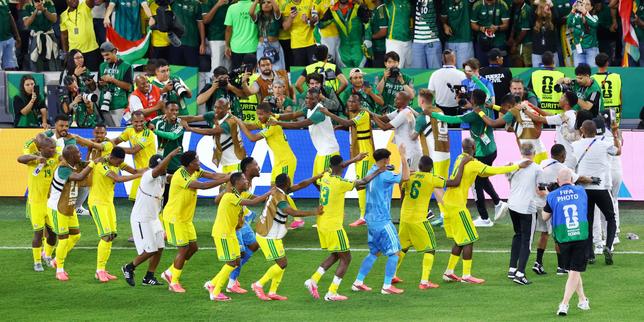
South Africa’s historic advancement to the knockout stage via a 1-0 victory over South Korea serves as a clear demonstration of structural optimization overriding personnel deficits. Following an opening 2-0 defeat to Mexico where manager Hugo Broos deployed a defensive five-at-the-back formation, the subsequent shift back to a proactive 4-3-3 framework altered the team's spatial dynamics.
The structural transition can be broken down into three core mechanisms:
- The Defensive Shield Pivot: Operating without the suspended Teboho Mokoena, Yaya Sithole acted as a lone anchor, absorbing vertical passes from the Korean midfield. This allowed Thalente Mbatha and Relebohile Mofokeng to occupy half-spaces and disrupt transition lines before South Korea could isolate Son Heung-min.
- Asymmetric Winger Roles: While Oswin Appollis maintained width on the left flank to stretch the Korean low block, Thapelo Maseko was deployed on the right. This inverted positioning allowed Maseko to cut inside on his preferred left foot, manipulating the defensive horizontal line.
- Proactive Field Tilting: South Africa registered seven shots to South Korea’s four in the opening half despite holding only 36% of possession. This indicates highly efficient transitional attacking rather than passive possession accumulation.
[South Africa Midfield Triangle]
       Mofokeng      Mbatha
              \      /
              Sithole (Shield)
                 |
         [Back Four Line]
The game's single goal in the 63rd minute emerged from this exact structural design. Tshepang Moremi exploited space on the left flank to deliver a cross to Maseko, who controlled and directed a low strike into the bottom corner. South Korea’s passivity—relying on a draw that would guarantee progression—created a tactical bottleneck. By withholding Son Heung-min from aggressive transitions until the final ten minutes, the Korean side surrendered central zone control, failing to create high-probability scoring chances against Ronwen Williams.
High-Gravity Superstars and the Brazilian Analytical Model
Brazil's 3-0 victory over Scotland in Miami provides a quantitative lesson in "superstar gravity" and defensive exploit utilization. While earlier group stage matches exposed a lack of collective fluid movement, the structural solution has been to lean heavily into the tactical overload created by Vinícius Júnior on the left flank.
The efficiency of this model relies on the concept of defensive inflation. When a single player attracts two or three defensive covers, space opens up on the weak side or inside the penalty area. Vinícius Júnior's individual metric breakdown on Day 14 highlights this reality:
- Expected Goals (xG): 3.06 (The highest individual score of the tournament so far).
- Dribbling Efficiency: 5 successful take-ons out of 8 attempts.
- Scoring Consistency: Becoming the first Brazilian player since Ronaldo and Rivaldo in 2002 to score in all three opening matches.
The opening goal in the seventh minute occurred due to a forced error under high pressing lines, capitalizating on a defensive mistake by Scott McKenna. The second goal, a header from Vinícius Júnior in first-half stoppage time, resulted directly from Scotland shifting their defensive block too heavily to counter underlapping runs. This left the back post undefended. Matheus Cunha’s 60th-minute strike consolidated a system that functions because of individual gravity rather than complex team passing schemes. The inclusion of Neymar in the second half served as a secondary spatial anchor, forcing Scotland to abandon their mid-block completely.
The limitation of the Brazilian model lies in its extreme dependency on individual fitness and execution profiles. If a knockout opponent possesses the defensive personnel to neutralize Vinícius Júnior in isolated 1v1 scenarios without shifting secondary cover, Brazil’s secondary attacking avenues remain largely unproven.
Group C Efficiency Scales and Morocco’s Second-Half Inversion
Morocco’s 4-2 victory over Haiti in Atlanta showcased a stark contrast between first-half defensive vulnerability and second-half offensive volume. Entering the interval at a 2-2 deadlock, Morocco's qualification was secure, but their structural shape required reconfiguration to maximize chance creation.
The structural variance between the two halves is visible through shot distribution and fullback positioning. Achraf Hakimi operated not as a traditional wingback, but as an auxiliary attacking midfielder in possession phase. Hakimi completed the match with five total shots, one goal, and an assist.
Morocco Possession Phase:
[CB] ---- [CB] ---- [LB]
       \       /
        [Midfield]
       /        \
[Hakimi]        [Winger]
   |
[Attacking Zone]
By pushing Hakimi high into the final third, Morocco generated 22 total shots, with 11 hitting the target. This volume overwhelmed Haiti's low block, which had found success early on by exploiting space left behind Morocco's advancing lines. Gessime Yassine's late goal validated a tactical strategy focused on high-pressing intensity designed to exhaust opponents late in tournament matches.
The Cost Function of Perfect Group Records: Mexico and Switzerland
Mexico's 3-0 victory over Czechia at the Estadio Azteca confirmed El Tri's perfect record of nine points across three matches. Julian Quiñones and Álvaro Fidalgo capitalised on a fatigued Czech team that struggled to manage both the high altitude of Mexico City and Mexico's quick transitions.
Statistically, Mexico’s success is built on defensive stability in the first half of matches. The team has not conceded a first-half goal in their last 14 World Cup appearances, a run tracing back to 2014. This defensive baseline allows the team to play patiently, wearing down opponents before introducing attacking reinforcements in the final half-hour.
Concurrently, Switzerland's 2-1 victory over Canada secured the top spot in Group B, sending Canada through in second place to face South Africa. This dynamic presents an interesting analytical problem regarding knockout round preparation. Teams like Mexico and Switzerland that have maintained structural consistency throughout the group stage face lower immediate risks but must now deal with the physiological toll of intense group play.
Tactical Playbook for the Round of 32
The upcoming knockout matchup between South Africa and Canada in Los Angeles presents a distinct tactical puzzle. South Africa must resist the urge to revert to the low-block, five-man defensive line that failed against Mexico. Canada’s vertical pace in wide areas will punish passive containment systems. South Africa's path forward requires maintaining the proactive 4-3-3 shape used against South Korea, keeping the midfield trio tight to deny Canada clean transitional looks, and continuing to use Maseko's inverted runs to test Canada's central defenders.