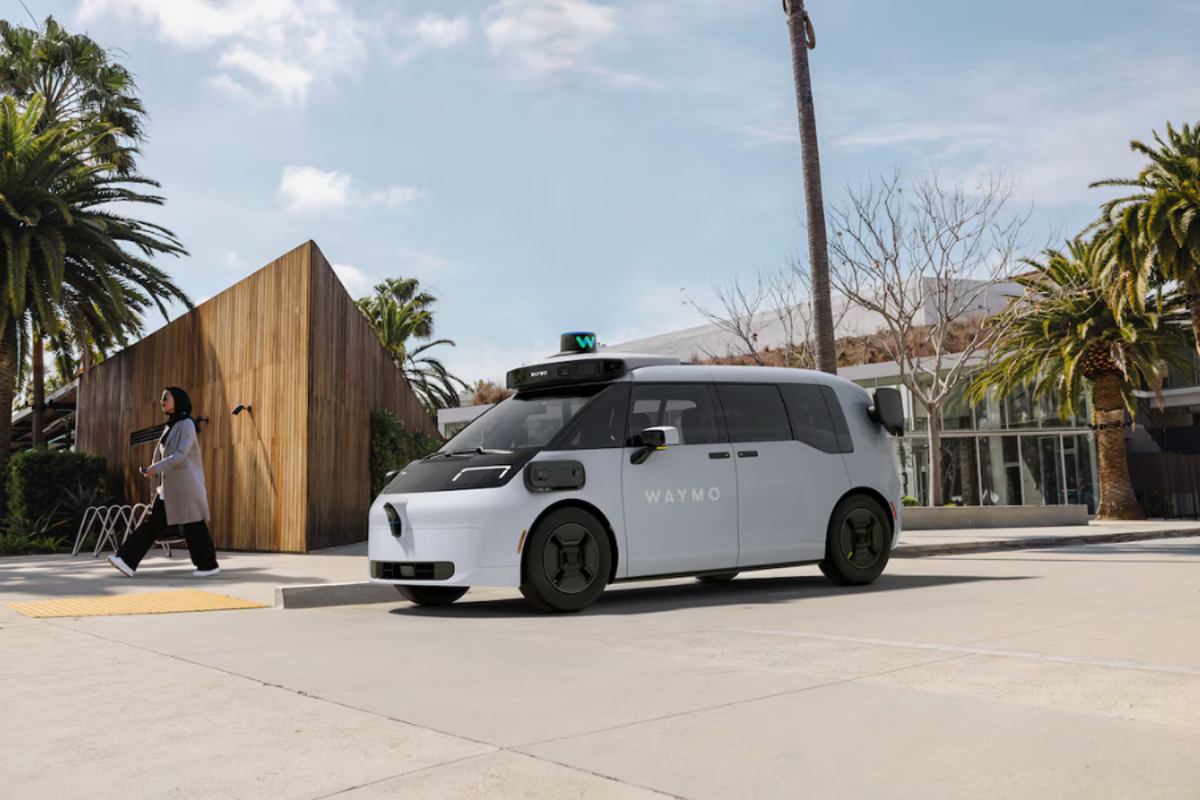
Alphabet’s Waymo has activated fully driverless operations in Las Vegas, with Denver, San Diego, and Tampa designated as the immediate subsequent markets. This development transitions these metropolitan areas from localized testing zones utilizing human safety operators to autonomous commercial environments. The expansion brings Waymo’s footprint to 14 metropolitan regions, positioning the firm to chase an operational target of 1 million paid rides per week by the end of 2026.
Beneath the consumer-facing narrative of rider-only convenience lies a calculated corporate maneuver to solve the dual structural constraints that have historically throttled the autonomous vehicle industry: unit economics and geographic operating boundaries. By pairing this geographic expansion with the deployment of its sixth-generation computing and sensor architecture, integrated into purpose-built platforms like the Geely-manufactured Zeekr "Ojai" minivan, Waymo is attempting to shift autonomous driving from a capital-intensive engineering experiment to a sustainable, high-margin transport utility.
The Unit Economics of Autonomy: The Sensor Reduction Equation
The fundamental critique of autonomous vehicle deployment via high-fidelity sensing has always focused on capital expenditure per vehicle. The previous generation hardware suite, deployed on the Jaguar I-PACE fleet, relied on a hyper-redundant sensor architecture that inflated vehicle manufacturing costs well beyond commercial viability for mass scale.
The sixth-generation architecture directly addresses this capital expenditure bottleneck through structural sensor consolidation. By optimizing data processing and sensor localization, the engineering team altered the hardware cost function through a 42% net reduction in total sensor components.
- Optical Perception Consolidations: Camera count has been reduced from 29 sensors to 13. This efficiency is driven by transitioning to high-resolution 17-megapixel imagers. The increased spatial resolution allows a single sensor to capture overlapping fields of view up to 500 meters away, executing tasks that previously required multiple narrow-field 5- or 8-megapixel cameras.
- Active Sensing Reductions: Lidar arrays have been cut from five units to four, capitalizing on market efficiencies and enhanced range fidelity from internal optical designs. Radar units are capped at six, relying on updated in-house machine-learning algorithms to isolate signals within noise.
- The Hardware Cost Threshold: This architectural optimization lowers the auxiliary hardware stack cost to a target below $20,000 per unit, a contraction of greater than 50% relative to the fifth-generation suite.
[5th-Gen Fleet Stack]  -->  Sensor Consolidation (17MP Imagers)  -->  [6th-Gen Fleet Stack]
- 29 Cameras                - 13 Cameras (-55%)                      - Sub-$20,000 Hardware Cost
- 5 Lidars                  - 4 Lidars   (-20%)                      - 42% Net Sensor Reduction
- 6 Radars                  - 6 Radars   (0%)                        - Weather-Cleaning Integration
By decoupling spatial awareness from sheer sensor volume, the unit economic model shifts. The reduction in physical parts decreases the vehicle's assembly complexity, reduces raw computational hardware overhead, and drops the mean time between failures for the entire vehicle assembly.
Geographic Asymmetry and Structural Volatility
The selection of Las Vegas, Denver, San Diego, and Tampa as expansion targets illustrates a dual-pronged validation strategy designed to stress-test the software’s adaptability across vastly different operational matrices.
Extreme Climate Resistance
The previous iteration of the fleet was functionally restricted to warm-weather climates due to sensor vulnerabilities to precipitation and freezing temperatures. Denver presents an environment defined by severe winter weather, high altitudes, and rapid temperature fluctuations. To operate without safety drivers in these conditions, the latest hardware suite integrates active sensor-clearing mechanisms, hydrophobic coatings, and modular thermal management units designed to prevent ice buildup and lens obscuration.
Operational Domain Complexity
Las Vegas presents a radically different edge-case profile. The city’s core infrastructure is defined by massive pedestrian density, erratic tourist behavior, complex multi-lane drop-off zones, and dense electromagnetic interference from localized lighting. Success in Las Vegas demands localized spatial mapping capable of parsing high-density human traffic and erratic vehicle movements that deviate from standard traffic flow models.
By launching simultaneously in a high-density, high-turnover tourist hub (Las Vegas) and a cold-weather metro area (Denver), Waymo is running a parallel processing stress test. The goal is to prove that its core software engine can generalize across disparate environmental boundaries without requiring bespoke software builds for every zip code.
The Operational Bottleneck: Human-in-the-Loop Latency
A common industry misconception is that "fully driverless" equates to total operational isolation from human infrastructure. Even with the removal of the physical safety driver, the operational architecture relies on remote technical assistance centers to resolve complex edge cases.
This introduces an architectural cost factor: the remote-operator-to-vehicle allocation ratio. If an autonomous system requires a remote human handler to intervene via cloud-based path validation every time a vehicle encounters an undocumented construction zone or an illegal drop-off vector, the labor cost structure scales linearly with the fleet size.
This creates an inherent scaling bottleneck. As fleets deploy into complex markets like Las Vegas, localized anomalies—such as severe traffic disruptions during large-scale conventions or dense holiday congestion—can trigger simultaneous remote assistance requests. If these requests exceed the processing capacity of the remote assistance centers, systemic fleet latency occurs. Cars halt in active lanes, creating localized bottlenecks.
Waymo’s path to a sustainable operating margin requires its software to progressively decrease the frequency of these remote interventions. The software must achieve a mean time between interventions that allows a single remote specialist to oversee dozens of vehicles simultaneously.
Supply Chain Diversification as a Defensive Moat
Scaling a fleet toward tens of thousands of units introduces significant macroeconomic risks, particularly regarding vehicle procurement and regulatory tariffs. The architecture of the platform addresses this by separating the self-driving stack from the underlying automotive frame.
The platform is designed to adapt to multiple vehicle shapes. Production is currently split across two core platforms: the purpose-built Zeekr Ojai minivan—featuring a flat floor, low step-in profile, and optimized passenger access—and the Hyundai Ioniq 5 crossover.
This multi-platform deployment serves as a defensive hedge against macroeconomic headwinds. Because the Zeekr platform is manufactured in Ningbo, China, it faces steep regulatory import tariffs within the United States. By concurrently validating and deploying the hardware suite on South Korean-manufactured Hyundai platforms, Waymo maintains a flexible supply chain. It can shift fleet procurement based on geopolitical realignments, manufacturing bottlenecks, or sudden localized regulatory changes.
The Scaling Vector to Year-End 2026
The trajectory toward 1 million weekly paid rides relies on a highly synchronized deployment pipeline. The expansion follows a structured, multi-phase scaling sequence that prioritizes risk mitigation before unlocking public commercial access.
- Employee-Only Operational Phase: Initial driverless deployments in Denver, San Diego, and Tampa are restricted to internal employees. This serves as an unpublicized testing phase to validate localized routing behavior, sensor-clearing efficiency under real-world conditions, and remote-assistance response times without exposing the brand to public liability.
- Public Commercial Access Unlocked: Following internal validation metrics, the service transitions to a public commercial model via the proprietary app infrastructure, converting idle fleet capacity into active revenue generation.
- Third-Party Network Integration: To maximize utilization rates outside of standalone applications, Waymo continues to deploy its fleet through existing ride-hailing networks, including its operational partnerships with Uber in markets like Atlanta and Austin. This dual-channel distribution model stabilizes demand curves throughout off-peak hours.
The competitive divide in the autonomous vehicle sector is no longer determined by showcase demonstrations or theoretical updates; it is dictated by capital deployment velocity and physical manufacturing capacity. Backed by a $16 billion investment round secured in early 2026, which valued the entity at $126 billion, Waymo’s expansion into these four distinct markets represents a shift into capital-intensive industrialization. The core challenge moving forward is no longer proving that a machine can drive, but proving that an enterprise can operate thousands of machines simultaneously across a continent without experiencing operational or financial collapse.