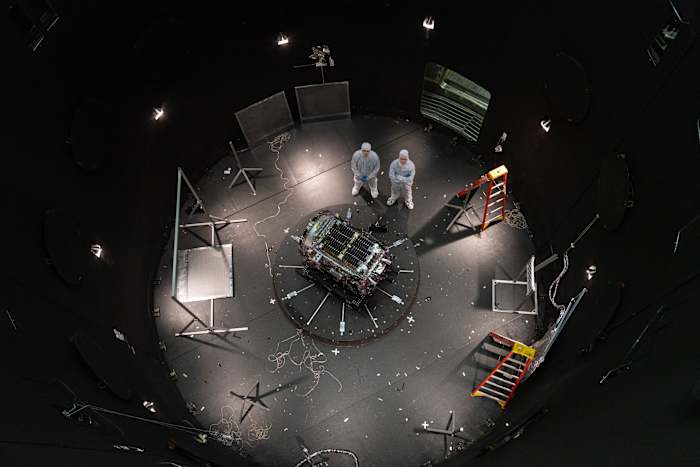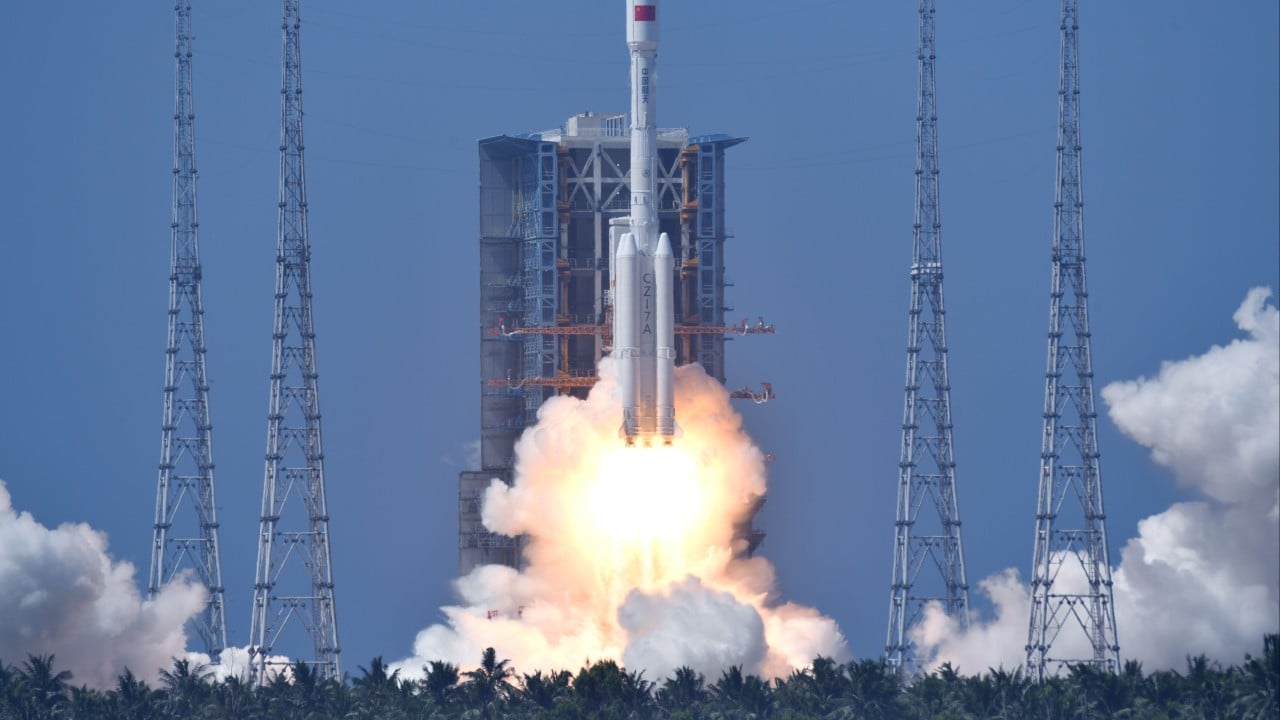
A Chinese aerospace team recently validated a 750-newton satellite propulsion system via 14 hours of continuous in-space operation, sparking assertions that Western orbital propulsion technology has been decisively eclipsed. This claim conflates a single engineering milestone with a systemic industrial victory. Evaluating the strategic balance between the Chinese and American space ecosystems requires moving past headlines and isolating the fundamental engineering limits, mass-efficiency variables, and economic trade-offs dictating orbital maneuverability.
The core battleground is not the maximum duration of a single engine firing, but the optimization of the orbital transport cost function. Satellite deployment, station-keeping, and constellation management rely on a strict trade-off between thrust and specific impulse ($I_{sp}$). High-thrust systems, such as the newly validated Chinese 750-newton liquid-bipropellant engine, move mass rapidly but at a high propellant cost. Conversely, low-thrust, high-efficiency systems, such as the Hall-effect electric propulsion networks used by American commercial megaconstellations, trade time for extreme propellant mass savings. Deconstructing this development reveals the architectural divergence between state-driven industrial platforms and commercial execution models.
The Triad of Spacecraft Propulsion Performance
Evaluating the capability of an in-space propulsion system requires balancing three independent engineering variables. Maximizing one parameter invariably creates bottlenecks across the others.
- Thrust Magnitude ($F$): The raw force delivered by the engine, measured in newtons. High thrust is necessary for rapid orbital transitions, prompt collision avoidance, and overcoming gravity wells efficiently.
- Specific Impulse ($I_{sp}$): The metric of propellant efficiency, measured in seconds. It defines how much thrust is produced per unit mass of propellant consumed. Chemical engines deliver high thrust but low efficiency ($250\text{ s} - 330\text{ s}$), whereas electric engines offer low thrust but high efficiency ($1500\text{ s} - 3000\text{ s}$).
- Thermal and Structural Endurance ($t_{operational}$): The continuous or cumulative burn time an engine can withstand before material degradation—specifically throat erosion in chemical thrusters or grid erosion in electrostatic systems—causes catastrophic failure.
The 14-hour continuous burn of a 750-newton engine indicates progress in thermal management. In liquid chemical propulsion, maintaining structural integrity over extended burn durations requires complex regenerative cooling or film-cooling techniques. High combustion temperatures degrade engine nozzles rapidly if thermal dissipation paths are inefficient.
By executing a prolonged continuous firing in space, the Chinese mission proved that its thermal control loops can maintain steady-state equilibrium under a high thermal load. This removes a significant constraint for large-scale orbital adjustments, such as moving a heavy payload directly from a low Earth orbit (LEO) insertion injection to a geostationary orbit (GEO).
The Strategic Trade-Off: Chemical Velocity vs. Electric Efficiency
The assertion that this development leaves American alternatives behind overlooks a foundational architectural divergence between the two nations' space sectors. The United States and China are optimizing for entirely different mission profiles and economic frameworks.
       [Orbital Transport Optimization]
                      |
       +--------------+--------------+
       |                             |
[High Chemical Thrust]       [High Electric Efficiency]
 - 750N Bipropellant          - Hall-Effect / Ion
 - Rapid Orbit Changing       - Slow, Mass-Efficient
 - Optimized for Direct-       - Optimized for Mass-
   to-GEO / Heavy Assets        Produced LEO Megaconstellations
The prevailing American orbital architecture, dominated by massive commercial operations like SpaceX's Starlink, relies on highly automated, mass-produced electric propulsion. These commercial assets utilize krypton or argon Hall-effect thrusters. The operational logic here minimizes launch mass by maximizing $I_{sp}$. Because electric thrusters require far less propellant mass to achieve the identical total change in velocity ($\Delta v$), more individual satellites can be packed into a single rocket fairing. The tradeoff is time; raising an orbit via electric propulsion takes weeks or months rather than hours.
The Chinese development focuses on a high-thrust chemical asset. A 750-newton liquid engine is built for heavy lifting and rapid transit. It is optimized for direct orbital injection profiles, large-scale military or reconnaissance satellite maneuvering, and complex orbital transfer vehicles (space tugs).
This approach addresses a distinct structural vulnerability: launch cadence limitations. While American space infrastructure uses rapid reusability to lower the cost per kilogram to LEO, the Chinese space ecosystem utilizes heavy chemical propulsion stages on satellites to bypass the need for incremental orbit-raising, aiming for immediate operational deployment upon launch.
Supply Chain Realities and Material Underpinnings
An engine is only as viable as the raw materials and manufacturing stack required to produce it reliably. The primary constraint on high-performance chemical engines is the availability of advanced refractory metals and high-temperature alloys capable of enduring corrosive propellants and extreme thermal gradients.
China holds a commanding position in the extraction and processing of critical materials like tungsten, molybdenum, and rare earth elements used in high-temperature aerospace coatings. This geographic concentration provides domestic research teams with low input costs and priority access to specialized materials during the prototyping and scaling phases.
The secondary limitation, however, rests in the scalability of high-precision component manufacturing. Building a single record-breaking engine in a controlled laboratory or executing a bespoke military-backed mission does not immediately translate into industrial-scale output. The true test of orbital propulsion superiority is the yield rate: the percentage of manufactured engines that pass rigorous hot-fire testing without requiring manual remanufacturing.
American commercial manufacturers have industrialised the production of space components, treating engine assembly with the repeatability of automotive manufacturing. The Chinese aerospace sector is still transitioning its manufacturing stack from a state-subvented research model to a high-rate commercial assembly line.
Strategic Forecast for the Orbital Marketplace
The introduction of a reliable, high-thrust 750-newton engine will accelerate the deployment of sovereign Chinese megaconstellations, such as the SpaceSail (Thousand Sails) and Guowang initiatives. By utilizing higher-thrust propulsion on the upper deployment blocks, state-backed operators can reduce the time between launch and commercial revenue generation.
Furthermore, this engine technology strengthens China’s position in the global defense and commercial export sectors. Developing nations seeking standalone communications networks prefer turnkey satellite platforms that do not require complex, long-duration orbital drift management. Offering a high-thrust, long-endurance platform provides an appealing alternative for buyers looking to avoid Western regulatory frameworks and technology export restrictions.
The immediate imperative for Western aerospace defense primes and commercial operators is to decouple propulsion design from legacy frameworks. Relying entirely on electric propulsion leaves a critical vulnerability in rapid deployment and defensive maneuvering scenarios. To maintain strategic equilibrium, capital must be allocated toward hybrid-propulsion architectures that pair the high efficiency of electric station-keeping with the high impulse and rapid response of advanced chemical engines. The future of orbital dominance belongs to the architecture that manages the total cost of mass delivery while retaining the tactical flexibility to alter orbital geometry on demand.