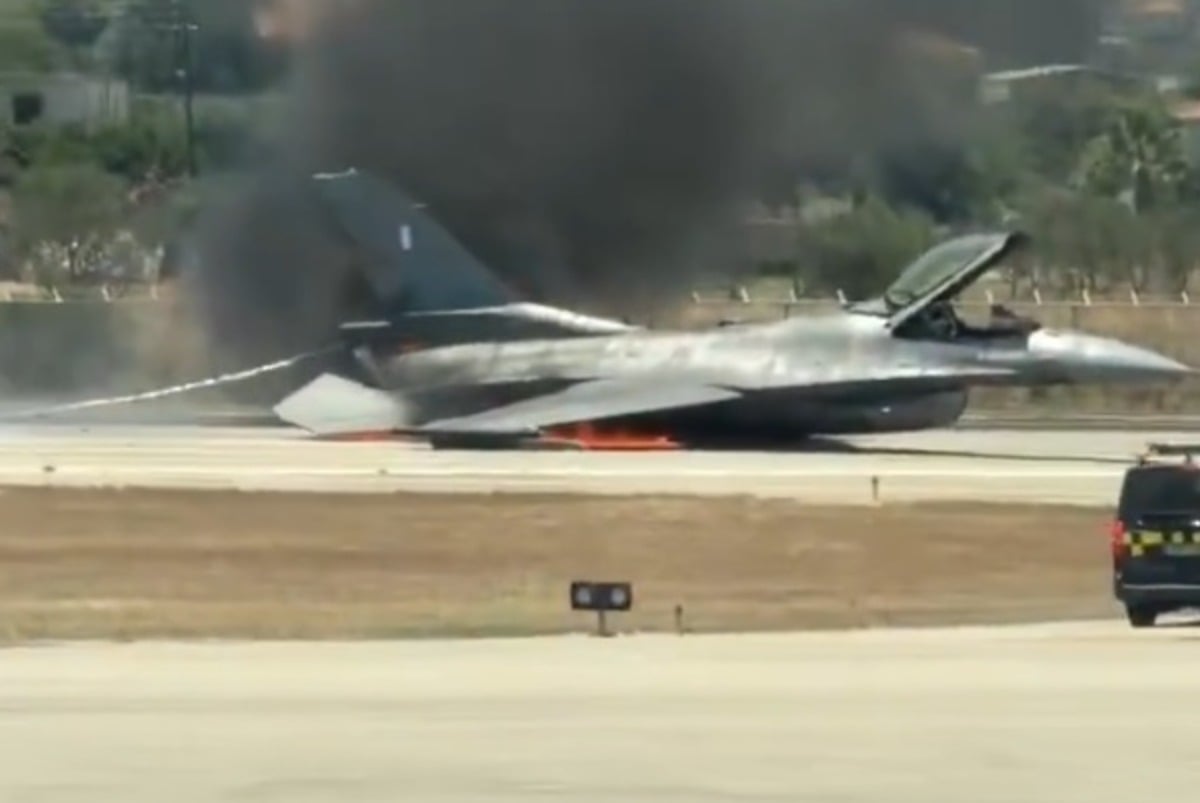
The successful emergency belly landing of a Hellenic Air Force (HAF) F-16C Block 52+ Advanced at Zakynthos International Airport on July 9, 2026, exposes the rigid trade-offs between military asset preservation, pilot survivability, and civilian infrastructure disruption. When an aircraft belonging to the 335th Squadron of the 116th Combat Wing experienced a catastrophic mid-air malfunction during a routine training exercise, the pilot was forced to execute a high-risk wheels-up landing on a civilian runway. Navigating this emergency required a real-time risk assessment governed by mechanical failure protocols, aerodynamic management, and emergency response synchronization.
Evaluating this incident through an operational lens reveals how military emergency systems interface with civilian aviation infrastructure under acute time constraints.
The Triple Crisis Framework of the In-Flight Emergency
Military pilots navigate complex failures by categorizing risks into three distinct operational vectors: propulsion integrity, structural control, and landing configuration. Preliminary data indicates the HAF F-16 encountered an interconnected compounding failure involving an in-flight engine fire—likely exacerbated by a fuel leak—and a subsequent failure of the primary hydraulic system governing the landing gear extension.
1. Propulsion Compromise and Thermal Runaway
The initial point of failure manifested as an onboard fire indication while the aircraft was operating over the Ionian Sea, approximately 100 kilometers south of its home installation at Araxos Air Base. In single-engine fighters like the F-16, an engine fire forces immediate throttle management to minimize the introduction of pressurized fuel into the thermal zone. A fuel leak operating under high pressure ($3,000\text{ psi}$ within typical aircraft hydraulic and fuel distribution systems) acts as a continuous accelerant. The pilot's decision to manage engine output while maintaining sufficient energy to reach a runway illustrates the tight margin between controlled gliding and catastrophic structural breakup.
2. Hydraulic Depletion and Gear Asymmetry
The failure of the landing gear to deploy indicates a loss of hydraulic pressure or a mechanical freeze within the actuation lines. The F-16 utilizes independent hydraulic systems (System A and System B) driven by the engine accessory gearbox. A severe engine fire or structural breach can sever these lines or deplete fluid reserves, rendering the primary landing gear extension mechanisms inoperable. While the F-16 features an Emergency Alternate Gear Extension system that relies on a combination of free-fall gravity and pneumatic pressure to lock the gear into place, the complete absence of deployment suggests either a pneumatic system failure or a conscious decision by the pilot to avoid asymmetric gear deployment. Landing with one wheel locked down and two retracted guarantees a catastrophic roll upon touchdown; a clean belly landing provides a predictable, directional skid.
3. Divert Vector Selection
Araxos Air Base sat 100 kilometers away, a distance that introduced an unacceptable time-to-impact metric given the progression of the onboard fire. Zakynthos International Airport presented the nearest viable runway. However, utilizing a single-runway commercial airport during the peak summer tourist season introduces a steep external cost function: the immediate freezing of regional civilian airspace.
The Physics and Friction of the Wheels-Up Skid
Executing a belly landing requires precise energy management. The pilot must strip the aircraft of excess mass to lower the kinetic energy ($E_k = \frac{1}{2}mv^2$) that must be dissipated via friction upon friction-induced touchdown.
The first tactical step involves jettisoning external fuel tanks. Dropping these tanks removes highly volatile fuel mass and eliminates structural protrusions that would catch on the runway surface, preventing the aircraft from pivoting violently.
When the underbelly of the fuselage makes direct contact with the runway asphalt, the kinetic energy transforms into extreme thermal energy and mechanical deformation.
- Friction-Induced Thermal Generation: Without the rolling friction of rubber tires, the aircraft relies on sliding friction between the runway and the aluminum/titanium structure of the lower fuselage. The friction coefficient rises sharply, generating surface temperatures that instantly ignite any pooling fluids or hydraulic vapors leaking from the engine compartment.
- Directional Stability Challenges: A standard landing relies on differential braking and nose-wheel steering to maintain the runway centerline. In a belly landing, the pilot loses all steering authority. Stability depends entirely on aerodynamic rudder control during the initial high-speed phase of the skid, followed by the uniform distribution of friction across the underside of the fuselage. Any uneven surface deformation can cause the jet to hook or depart the runway surface.
Systemic Friction: The Military-Civilian Interface
The operational friction generated by this incident extends past the physical runway damage. Diverting a crippled military asset into a high-density civilian transportation hub forces a rapid realignment of emergency priorities.
| Operational Phase | Military Metric | Civilian Infrastructure Impact |
|---|---|---|
| Approach | Prioritize minimum flight time; maximize glide slope efficiency. | Immediate grounding of all scheduled arrivals and departures; holding patterns established for airborne commercial traffic. |
| Touchdown | Rapid deceleration; pilot extraction; containment of toxic materials (e.g., hydrazine if the Emergency Power Unit activates). | Physical damage to the runway surface (gouging and scraping of asphalt); deployment of airport firefighting assets. |
| Post-Incident | Preservation of airframe for mishap investigation; forensic collection of telemetry data. | Complete terminal closure; diversion of inbound international flights to contingency hubs (Athens and Corfu). |
The immediate response by the Zakynthos airfield fire services prevented the airframe from suffering a total thermal loss. Deploying specialized firefighting foam suppresses oxygen access to the friction-ignited underbelly fire. However, because Zakynthos operates as a single-runway facility, the presence of a disabled, structurally compromised fighter jet lines blocks all commercial movements.
The recovery process for a belly-landed F-16 is inherently slow. Unlike a standard recovery where an aircraft can be towed on its own wheels, a wheels-up recovery requires specialized pneumatic lifting bags, heavy-duty cranes, and structural transport flatbeds to lift and clear the vehicle without causing secondary structural collapses.
Tactical Implementation
The primary objective following an emergency belly landing is the rapid restoration of regional airspace capacity while securing the integrity of the accident investigation. Air force command and civilian port authorities must execute a synchronized recovery framework.
First, emergency teams must neutralize the airframe's hazardous systems. This requires verifying that the F-16's Emergency Power Unit (EPU)—which utilizes highly toxic hydrazine to provide emergency electrical and hydraulic power—has either not fired or has been thoroughly neutralized by hazardous materials teams. Entering the crash zone without verifying hydrazine containment exposes ground crews to severe chemical risks.
Second, logistics units must deploy heavy-lift recovery cranes and flatbed trailers from the nearest military installation rather than relying on standard commercial towing equipment. The lower fuselage must be stabilized using specialized slings attached to verified structural hardpoints (such as the wing roots and main gear wells) to prevent the airframe from snapping during the lift.
Third, civil engineering teams must conduct an immediate structural evaluation of the runway surface. The intense heat and mechanical scraping from an F-16 belly skid can delaminate asphalt layers, leaving debris that poses a Foreign Object Damage (FOD) hazard to commercial jet engines. A comprehensive sweep and core inspection of the impact path must occur before reopening the runway to commercial traffic.



