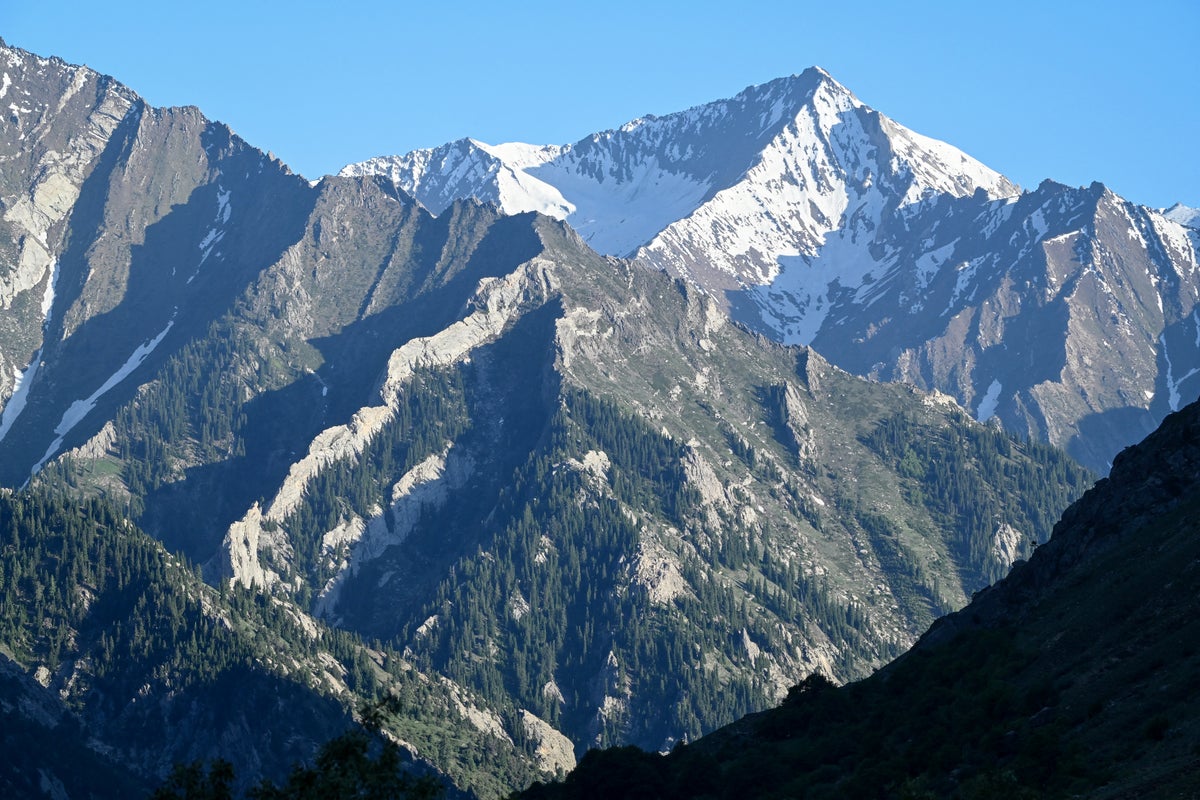
The convergence of the Indian and Eurasian tectonic plates releases approximately 15% of the global annual seismic energy, transforming the Hindu Kush mountain range into one of the most volatile seismic zones on Earth. When a magnitude 6.0 earthquake struck the region on June 27, 2026, standard media coverage relied on familiar narratives: descriptions of panicking residents fleeing their homes in northern Pakistan's Swat district, statements from provincial disaster management authorities, and vague tracking of tremors across international borders. This surface-level reporting fails to analyze the fundamental structural mechanisms that drive these events.
The primary driver of this event was not shallow crustal shifting, but rather intermediate-depth deformation occurring 100 kilometers below the surface within a subducted, sinking fragment of continental mantle lithosphere. Understanding the risks posed by this seismic zone requires moving past raw magnitude numbers to analyze the structural dynamics, stress fields, and regional energy attenuation that determine the impact of these deep-seated failures.
The Structural Mechanics of Intermediate Depth Ruptures
The June 27 event occurred within an unusual geological environment: an active intracontinental subduction zone. While the majority of the world's subduction zones involve dense oceanic crust plunging beneath lighter continental plates, the Hindu Kush features a cold, dense remnant of continental mantle lithosphere sinking into the warmer, less viscous asthenosphere.
+-----------------------------------------------------------+
|                      EURASIAN PLATE                       |
|                                                           |
|     +-----------------------------------------------+     |
|     |     Hindu Kush Intermediate Seismic Zone      |     |
|     |     (70 km - 300 km Depth)                     |     |
|     |                                               |     |
|     |  [70-150 km]: Scattered, mixed focal regimes   |     |
|     |                                               |     |
|     |  --- 150 km Aseismic Structural Discontinuity ---   |
|     |                                               |     |
|     |  [150-300 km]: Concentrated down-dip strain,  |     |
|     |                dominant reverse faulting      |     |
|     +-----------------------------------------------+     |
|                            |                              |
|                            v                              |
|             Sinking Lithospheric Blob/Slab                |
|             (Velocity: ~40 mm to 100 mm/year)             |
+-----------------------------------------------------------+
This sinking mechanism subjects the subducted slab to severe internal stress fields, which vary systematically by depth:
- The Upper Zone (70 to 150 kilometers): This segment exhibits scattered, lower-frequency seismicity. Focal mechanisms here are structurally inconsistent, presenting a complex mix of reverse, strike-slip, and normal faulting as the upper portion of the slab deforms under multi-directional regional forces.
- The Structural Discontinuity (approximately 150 kilometers): A narrow, nearly aseismic gap separates the upper and lower sections of the slab. At this specific depth threshold, strike and dip directions alter sharply, marking a major structural boundary.
- The Lower Zone (150 to 300 kilometers): Seismicity is highly concentrated within a tight geometric volume. Earthquakes in this deep zone are characterized by a systematic pattern of reverse faulting with vertical tension axes (T-axes).
The 100-kilometer depth of the 2026 earthquake places it firmly in the upper zone of this sinking slab. At these high-pressure, high-temperature depths, rock typically deforms through ductile flow, much like a viscous fluid, rather than fracturing brittlely. Two leading mechanical hypotheses explain how sudden ruptures happen under these conditions:
- Dehydration Melting and Fluid Lubrication: As the subducted lithosphere descends, hydrous minerals undergo polymorphic phase transitions to denser molecular structures. This process expels trapped pore water into localized fault planes. The released fluid counters overriding lithostatic pressure, lowering effective normal stress and allowing rapid, brittle slippage along pre-existing weaknesses.
- Thermal Runaway and Shear Localization: Under immense tectonic pressure, minor initial displacement along a shear zone generates localized frictional heat. Because the surrounding rock has low thermal conductivity, this heat cannot easily dissipate. The temperature spike lowers the rock's local viscosity, accelerating deformation and generating more heat. This self-reinforcing loop weakens the fault plane and triggers a rapid slip event.
Attenuation Vectors and Spatial Shaking Profiles
The physical depth of an intermediate earthquake changes how seismic energy moves through the ground, altering the surface impact compared to a shallow crustal event.
Intermediate Depth Event (100 km)     Shallow Crustal Event (<150 km)

         [ Surface Shaking ]                 [ Surface Shaking ]
          /       |       \                        /   |   \
         /        |        \                      /    |    \
        /         |         \                    /     |     \
       /          |          \                  /______|______\
      /           |           \                 [Rupture Zone]
     /            |            \                 (Concentrated)
    /             |             \
   /              |              \
  /               |               \
 /                |                \
-------------------------------------
          [Rupture Zone]
        (Deep / Dispersed)
The geometric relationship between the deep energy source and surface shaking can be broken down into three key principles:
Geometric Spreading Matrix
Because the energy source is deep, seismic wavefronts travel a longer distance before hitting the surface. This expanded path spreads energy over a much wider geographic footprint. Consequently, while the maximum intensity felt directly above the epicenter is lower than that of an equivalent shallow crustal event, the total area experiencing moderate ground motion expands significantly. This explains why a magnitude 6.0 event at a 100-kilometer depth can vibrate cities hundreds of kilometers away in both Afghanistan and Pakistan.
High-Velocity Propagation Corridors
The body waves (P-waves and S-waves) from deep events travel vertically through the cold, dense, low-attenuation core of the subducting lithospheric slab. This high-density material acts as an efficient conduit, preserving wave energy with minimal dampening. When these waves cross into the warmer, lower-velocity crust beneath major population centers, they can cause unexpected resonance and prolonged shaking.
Surface Wave Minimization
Shallow earthquakes transfer a large portion of their energy into low-frequency surface waves (Rayleigh and Love waves), which cause destructive horizontal rolling motions. In contrast, intermediate-depth events generate weak surface waves because their deep source location does not interact efficiently with the earth-air boundary. As a result, the surface damage is driven primarily by high-frequency body waves, which cause vertical shaking that dissipates faster as it moves away from the epicenter.
Operational Risk Analysis for Regional Infrastructure
Evaluating risk from these deep events requires analyzing how high-frequency body waves interact with local building styles. In northern Pakistan and eastern Afghanistan, structural vulnerability follows a clear pattern based on construction types:
- Non-Engineered Adobe and Unreinforced Masonry: These buildings have low tensile strength and lack ductile structural ties. High-frequency vertical and horizontal shaking easily unseats unreinforced timber roofs and cracks bearing walls, leading to sudden structural collapse even under moderate acceleration.
- Mid-Rise Reinforced Concrete Frames: These structures face unique risks from regional soil amplification. When high-frequency body waves pass through deep alluvial river valleys—such as those in Peshawar or Kabul—the soft topsoil can amplify ground motion, inducing structural resonance that tests the shear capacity of beam-column joints.
- Critical Infrastructure Lifelines: Linear infrastructure like highways, irrigation canals, and hydroelectric pens face severe secondary risks. The steep, fractured terrain of the Hindu Kush is highly susceptible to co-seismic landslides. These slides can block roads, isolate remote valleys, and disrupt relief operations, turning a manageable structural crisis into a prolonged logistics bottleneck.
Strategic Disaster Mitigation Imperatives
Managing the persistent seismic risk in the Hindu Kush requires moving away from reactive emergency responses and adopting a proactive engineering framework.
First, regional seismic hazard maps must be updated to account for depth-dependent attenuation formulas. Standard hazard models often assume a shallow source, which overestimates peak ground acceleration near the epicenter while underestimating the broad reach of intermediate-depth events. Updating these formulas will allow engineers to establish more accurate design requirements for infrastructure in outlying zones.
Second, building code enforcement must focus on low-cost structural upgrades for residential areas. Since large-scale reconstruction is economically unfeasible, regional authorities should subsidize retrofitting programs. Simple techniques, such as installing wire mesh reinforcement on adobe walls or securing floor-to-ceiling connections with steel brackets, can prevent catastrophic collapses and save lives during prolonged shaking.
Finally, expanding cross-border seismic monitoring networks is essential. Geopolitical friction between Pakistan and Afghanistan currently limits real-time data sharing between the National Seismic Monitoring Centre in Islamabad and stations across the border. Establishing an automated, open-access data exchange for raw wave data would improve the speed and accuracy of focal mechanism assessments, helping emergency teams identify high-risk impact zones within minutes of an event.