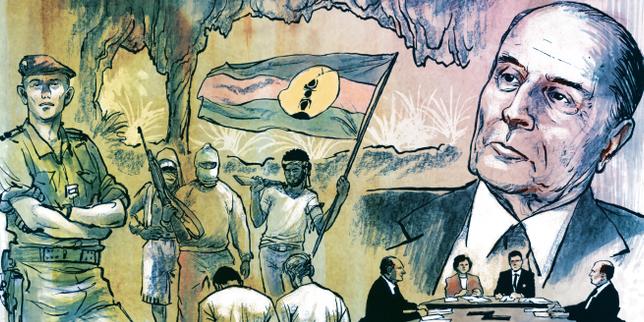
The 1988 Ouvéa cave crisis represents a tragic intersection of local anti-colonial resistance and high-stakes national political strategy. While traditional narratives frame the event through personal rivalries or ethical lapses, a rigorous operational analysis reveals a structural breakdown driven by conflicting command structures, skewed political incentives, and a complete failure of tactical risk mitigation.
By analyzing the crisis through quantitative realities and decision-making frameworks, we can isolate the core operational vectors that led to the catastrophic outcome on Ouvéa Island. Meanwhile, you can read similar developments here: Why Blaming the Monsoon for Bangladesh Transit Failures is a Lie.
The Cohabitation Command Conflict
The primary structural bottleneck of the Ouvéa crisis was the executive dynamic of the French "cohabitation" framework. In the spring of 1988, President François Mitterrand and Prime Minister Jacques Chirac were simultaneously running the state apparatus and competing against each other in a presidential election. This created a dual-headed command structure with opposing strategic objectives.
                  [ EXECUTIVE COHABITATION ]
                  /                        \
 [President François Mitterrand]    [Prime Minister Jacques Chirac]
       (Strategic Oversight)              (Operational Execution)
                 |                                  |
    [Constitutional Authority]          [Ministry of Overseas/Defense]
                 \                                  /
                  v                                v
               [ TACTICAL IMPASSE ON OUVÉA ISLAND ]
This structural division broke down standard operational protocols across three core areas: To explore the full picture, check out the excellent report by BBC News.
- Asymmetric Incentive Structures: For Chirac, the Prime Minister executing daily operations, the primary metric of success was perceived strength. A swift, decisive military resolution offered high political capital before the second round of voting. Conversely, Mitterrand’s incentive structure favored structural patience, positioning himself as a wise arbiter above the political fray.
- The Communication Chokepoint: Rather than a unified command loop, tactical intelligence from New Caledonia was routed through parallel, competing channels. The Ministry of Overseas Territories, led by Bernard Pons, acted as an operational arm for the Prime Minister's office, frequently bypassing the Presidency’s preferred civilian mediators.
- Command Dilution: When elite units—including the GIGN, Commando Hubert, and the 11e Choc—deployed to the island, they faced conflicting mandates. One line of authority prioritized Captain Philippe Legorjus’s hostage-negotiation framework, while another pushed for an immediate, high-impact tactical resolution.
Tactical Asymmetry and the Geography of the Cave
The operational landscape of the Gossanah cave system introduced friction that drastically reduced the probability of a low-casualty resolution. When Kanak militants belonging to the FLNKS retreated to the multi-tiered limestone complex with their remaining hostages, they radically shifted the tactical balance.
The Defensive Multiplier
A subterranean limestone network creates a massive defensive advantage. The narrow entrance to the Gossanah cave restricted the entry point of any assault team to a single file line. This bottleneck completely nullified the technological superiority and numerical advantage of the French forces. The interior geometry offered natural ballistic cover and deep interior chambers where hostages and captors could shelter from external detonations.
Operational Friction Points
Operation Victor, launched on May 5, 1988, suffered from significant execution errors due to the complex terrain and coordination issues:
- Topographical Barriers: The dense jungle and jagged terrain surrounding the cave caused the assault teams to deviate from their planned approach routes, delaying their final positioning.
- Timing Disruptions: A Puma helicopter tasked with providing a loud audio distraction arrived minutes late and off-target. This loss of tactical surprise allowed the militants to retreat deeper into their defensive positions.
- Weaponry Realities: The presence of an AA-52 7.5mm machine gun at the cave entrance forced tactical teams to use extreme measures, including flamethrowers, to clear defensive positions, dramatically increasing the risk of collateral damage.
While Operation Victor successfully extracted all remaining hostages, the tactical cost function was severe: 19 Kanak militants and two military operators were killed during the operation.
The Matignon Accords as an Institutional Pivot
The tragic outcome of the Ouvéa crisis exposed the limits of treating deeply rooted political crises purely as tactical security operations. The heavy loss of life forced both the French state and the independence movement to completely re-evaluate their strategic approach, leading directly to the Matignon Accords in June 1988.
| Operational Element | Pre-Ouvéa Framework | Post-Matignon Framework |
|---|---|---|
| Primary Mechanism | Military containment and regional policing. | Institutional rebalancing and economic decentralization. |
| Legal Strategy | Judicial prosecution and emergency decrees. | Mutual amnesty to restore basic political trust. |
| Sovereignty Roadmap | Centralized administration from Paris. | Gradual devolution of powers via multi-decade referendums. |
The Matignon Accords shifted the conflict from an unstable environment of asymmetric guerrilla actions and military responses to a structured legal framework. This transition highlights an essential institutional lesson: when a political conflict is driven by fundamental issues of self-determination, tactical interventions can only manage immediate security crises; they cannot replace a sustainable, structural settlement.
The ultimate strategic takeaway of the 1988 crisis is that split command structures and politically driven operational timelines inherently lead to high friction and increased casualties. Organizations and states facing complex crises must protect operational timelines from external political windows, establish a single, clear line of command, and match tactical interventions with realistic long-term structural strategies.
For a comprehensive historical look at the timeline and local impact of these events, check out this detailed retrospective on the Ouvéa crisis, which provides important archival context on the political environment of 1988.