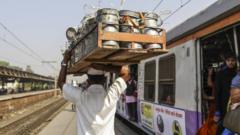
The operational decline of Mumbai’s Tiffin Box Suppliers Association—popularly known as the Dabbawalas—is routinely framed as a tragic cultural erosion driven by structural shifts in white-collar employment. This narrative misdiagnoses the mechanism. The contraction of this century-old logistical marvel, which saw active delivery volumes drop from 200,000 to approximately 90,000 units daily, is not an issue of cultural irrelevance. It is a structural failure triggered by a shift in macroeconomic cost functions, the entry of capital-subsidized platform monopolies, and the unbundling of the core value proposition of the decentralized supply chain.
For over 130 years, the Dabbawala network sustained a near-flawless operational cadence, famously evaluated at a Six Sigma error rate (fewer than 3.4 defects per million transactions). This performance was achieved using zero digital technology, a flat cooperative ownership model, and an absolute reliance on the public transit infrastructure of the Mumbai Suburban Railway. To understand why this system is contracting, we must deconstruct its logistics engine and analyze the precise structural bottlenecks that prevent it from competing in the modern platform economy. In other developments, take a look at: The $64 Billion Standoff Behind the Universal Music Rejection.
The Tri-Hub Supply Chain Model and Cost Minimization
The traditional Dabbawala system operates as a zero-inventory, synchronized cross-docking network. The architecture relies on strict time-windows and a decentralized, three-stage sorting mechanism.
- Local Aggregation (Milk Run Route): Between 09:00 and 10:30, individual field agents execute a high-density, hyper-local collection of tiffin boxes (dabbas) from residential units within a designated geographic zone. Transportation at this stage relies exclusively on low-capital, zero-fuel assets: bicycles or wooden handcarts.
- Synchronized Cross-Docking (Hub-to-Hub): Collected units are transported to the nearest suburban railway station. This station acts as the primary sorting hub. Dabbas are aggregated and categorized based on their final destination zones using an alphanumeric, color-coded visual marking system. The sorted batches are loaded into dedicated luggage compartments of local commuter trains during a precise 30-minute operational window.
- Last-Mile Disaggregation (Spoke Distribution): The train acts as the long-haul transit link, moving cargo toward central business districts (such as Nariman Point, Fort, or Bandra-Kurla Complex). At the destination station, a secondary sorting process occurs. Units are transferred to last-mile delivery teams who execute point-to-point delivery to specific corporate offices before 13:00.
The mathematical beauty of this model lies in its cost function. By leveraging existing public railway networks, the variable cost of long-haul transportation was kept near zero. The model converted capital expenditures (fleet management, routing software, warehousing) into pure labor utility. Investopedia has also covered this fascinating subject in extensive detail.
The Alphanumeric Coding Protocol
The system operates without a centralized digital database. Information management is completely distributed, encoded directly onto the lid of the container using a highly standardized visual rubric.
       [   B  ]  -> Destination Hub/Railway Station (e.g., Borivali)
       [ 3-12 ]  -> Residential Sorting Code / Originating Line
       [  KMC ]  -> Target Corporate Building/Complex Identifier
       [   E  ]  -> Local Delivery Agent Alpha-Designation
       [  14  ]  -> Specific Floor Number
This structural coding protocol ensures that any literate or semi-literate operator can instantly identify the next routing node by executing simple visual pattern matching. The absence of digital scanning interfaces eliminated the technical latency and hardware capital required by western hub-and-spoke models (such as FedEx or DHL). This structural design presents a major limitation: the system cannot handle dynamic routing. The code assumes static origins and destinations. If a customer changes offices or alters their schedule, the manual routing logic breaks down completely.
The Unit Economics of Deflationary Labor
The financial viability of the cooperative depends on a rigid correlation between labor density and geographic proximity. Because the network operates as a decentralized profit-sharing cooperative across roughly 200 autonomous units, each group of 25 to 30 workers operates as an independent cost-and-revenue center.
Monthly Subscription Price per Customer:  ~INR 1,500 - 2,000
Average Allocation per Dabbawala:          30 Customers
Gross Revenue Generated per Agent:         INR 45,000 - 60,000
Less: Association Levies, Rail Passes:    -INR 10,000 - 15,000
Net Dividend per Worker:                  ~INR 35,000 - 45,000
This economic equation held for decades because of the high density of residential sources and corporate destinations along the linear geography of Mumbai’s railway lines. The post-pandemic shift toward hybrid white-collar employment frameworks structurally altered this density. When corporate personnel transition to working from home even two days a week, the demand for a monthly subscription-based daily lunch delivery drops.
Because the Dabbawala pricing architecture is fixed on a monthly retainer rather than a per-use model, customers facing hybrid work schedules experience an immediate inflation in the per-meal cost of delivery. The inability of the cooperative to offer variable, on-demand pricing pricing led to immediate customer attrition.
The Dual-Front Disruption: Platform Capitalism and Corporate Catering
The operational footprint of the Dabbawalas is being compressed by two distinct competitive forces, each targeting a different side of their value proposition.
+------------------------------------------------------------------------+
|                      COMPETITIVE DISRUPTION MATRIX                    |
+------------------------------------------------------------------------+
|   TRADITIONAL MODEL   |        HYPERLOCAL PLATFORMS      | INSTUCTIONAL |
|     (Dabbawalas)      |         (Swiggy / Zomato)        | CATERING     |
+-----------------------+----------------------------------+--------------+
| • Fixed subscription  | • Dynamic on-demand ordering     | • In-house   |
| • Static home-source  | • Algorithmically optimized routes|   cafeterias |
| • Zero-fuel logistics | • Capital-subsidized gig labor   | • B2B contract|
| • Single window (13:00)| • 24/7 delivery capability       |   supplies   |
+-----------------------+----------------------------------+--------------+
Hyperlocal delivery applications disrupted the market by separating the meal from the residential kitchen. The traditional Dabbawala model requires an asset-heavy domestic infrastructure: someone must prepare a fresh meal in a suburban household by 08:30. Urban demographic shifts, characterized by smaller nuclear families and longer individual commute times, have degraded this domestic foundation.
On-demand delivery applications utilize venture-backed capital subsidies to lower the cost of single-point restaurant delivery. They compete directly on convenience, offering real-time tracking and an endless menu selection. These software networks use dynamic algorithmic routing to dispatch contract gig workers based on real-time demand. The Dabbawalas, bound by their static railway schedules and manual sorting processes, cannot offer this level of flexibility.
Concurrently, modern corporate infrastructure has shifted toward centralized internal services. Grade-A commercial developments across suburban business parks (such as Nesco or international tech hubs) now require corporate tenants to utilize internal, managed cafeterias or centralized B2B food service vendors. These corporate campuses implement strict security perimeters that restrict entry for external field workers. This security posture adds significant friction to the last-mile distribution phase, disrupting the precise time-windows needed to maintain delivery velocity.
Structural Bottlenecks to Digital Modernization
When confronted with market share losses, external observers frequently advocate for digital transformation—specifically, the integration of smartphone applications, GPS routing, and digital payment gateways. This recommendation overlooks the architectural realities of the Dabbawala operational engine.
The first barrier is structural. The Six Sigma accuracy of the network relies on the standardized physical format of the tiffin container and the specialized skill set of the workers. This tacit operational knowledge is passed down through generations within specific socio-cultural groups from rural Maharashtra. Introducing an app-based dispatch interface would add administrative overhead to a workforce whose primary advantage is rapid, muscle-memory-based visual sorting. A digital platform requires scanning barcodes or updating delivery statuses at every node, which introduces seconds of latency per unit. Across a volume of 200,000 deliveries, adding five seconds of friction per transaction adds hundreds of collective hours to the system, causing the time-bound railway windows to collapse.
The second limitation is the capital expense requirement of a digital platform. Aggregators operate on sophisticated cloud computing frameworks that process millions of location updates per second. The Tiffin Box Association operates on a thin margin with zero retained capital reserves. It cannot invest in or maintain proprietary algorithmic routing engines without raising subscription fees, which would destroy its remaining cost advantage over corporate catering options.
The Strategic Path Forward
The Dabbawala network cannot compete with platform aggregators on speed, menu diversity, or convenience. To survive, the association must reposition its logistics network to capture value in specialized supply chain niches where its structural advantages remain defensible.
The organization must pivot from a purely B2C subscription model to a specialized B2B hybrid delivery provider. Centralized cloud kitchens and corporate meal providers often struggle with high last-mile delivery costs during peak hours. The Dabbawalas can offer these businesses a highly efficient, bulk delivery solution. By picking up bulk shipments from central production facilities located near suburban rail hubs and utilizing their existing cross-docking network, they can deliver meals to commercial zones at a lower per-unit cost than an app-based gig worker.
Traditional Flow:
[Suburban Home] -> [Local Station] -> [Rail Transit] -> [CBD Hub] -> [Corporate Office]

B2B Pivot Flow:
[Cloud Kitchen] -> [Local Station] -> [Rail Transit] -> [CBD Hub] -> [Corporate Office]
This operational adjustment preserves the core elements of the traditional sorting system while eliminating the high-friction, low-density residential collection phase. It transforms the network from a fragmented consumer service into a high-capacity last-mile delivery engine for enterprise clients.
The organization can also monetize its legendary operational accuracy through corporate training and consultation. The association can establish a formal advisory arm focused on organizational design and supply chain management. This division can provide modern logistics companies with actionable strategies for building resilient supply chains, minimizing operational errors, and managing human capital without relying on expensive software infrastructure.
The survival of the Dabbawalas depends on their ability to specialize. Trying to compete directly with capital-subsidized tech platforms is a losing strategy. The association must focus on optimizing its high-density, rail-bound transit model to serve the changing enterprise needs of the modern corporate environment.