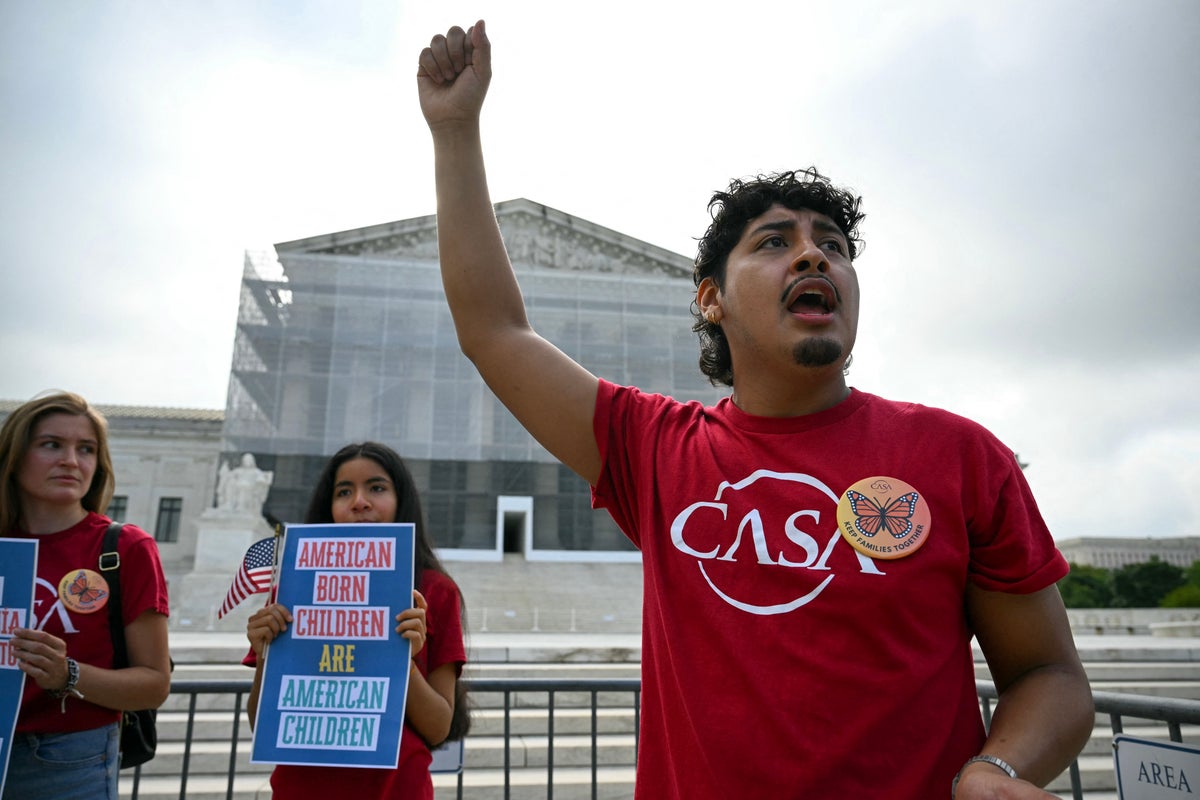
The Supreme Court ruling in Trump v. Barbara establishes a definitive baseline for the separation of powers regarding citizenship. By striking down the executive order that sought to deny birthright citizenship to children of undocumented immigrants and temporary visa holders, the Court highlighted a fundamental constraint on unilateral executive authority. The administration's subsequent pivot to a legislative strategy via Congress shifts the constitutional battleground from Article II enforcement power to Article I statutory authority. Evaluating the viability of this pivot requires an objective breakdown of the jurisdictional frameworks, judicial voting alignments, and the distinct statutory mechanics governing the modern immigration state.
The Dual Track Jurisdictional Framework
The core of the legal dispute rests on the structural tension between two distinct layers of authority: constitutional text and federal statutory design. The executive branch attempted to bypass both by reinterpreting the Citizenship Clause of the Fourteenth Amendment through an administrative directive.
1. The Constitutional Layer
The foundational text states that all persons born or naturalized in the United States, and "subject to the jurisdiction thereof," are citizens. The administration's legal defense rested on a narrow definition of jurisdiction, arguing that individuals without permanent legal status do not owe full political allegiance to the United States.
The majority rejected this position, maintaining the historical precedent established in United States v. Wong Kim Ark (1898). The Court reaffirmed that "subject to the jurisdiction" functions as a territorial metric rather than a political contract. Under this framework, anyone physically present within U.S. borders—barring recognized exceptions like foreign diplomats or invading militaries—falls under the immediate regulatory and punitive jurisdiction of U.S. laws, thus qualifying their U.S.-born offspring for automatic citizenship.
2. The Statutory Layer
The secondary bottleneck for executive action is the Immigration and Nationality Act (INA), specifically 8 U.S.C. § 1401(a). This statute explicitly codifies that a person born in the United States, and subject to its jurisdiction, is a national and citizen at birth.
Because Congress explicitly mirrored the constitutional language within the statutory text, the executive branch possessed no delegated authority to narrow the scope of the statute via an executive order. The administrative rewrite conflicted directly with the plain reading of federal law, triggering an immediate statutory violation independently of the constitutional question.
Deconstructing the Judicial Coalition
The 6-3 ruling reveals a highly fragmented conservative bloc, yielding a 5-4 constitutional split alongside a broader 6-3 consensus on statutory limitations.
       [ 6-3 Statutory / Statutory & Constitutional Alignment ]
      /                                                       \
 [ 5-4 Constitutional Majority ]                 [ 3-3-3 Distinct Splinters ]
 - Roberts, Sotomayor, Kagan,                    - Kavanaugh: Concurs on statutory ground,
   Barrett, Jackson                                suggests legislative path viable.
                                                 - Thomas, Gorsuch, Alito: Dissent,
                                                   favoring originalist re-evaluation.
Chief Justice John Roberts, writing for a five-justice majority that included Justices Sonia Sotomayor, Elena Kagan, Amy Coney Barrett, and Ketanji Brown Jackson, anchored the decision in text and historical continuity. This alignment indicates that originalist interpretations among certain conservative justices do not automatically yield to executive policy goals when long-standing judicial precedent dictates otherwise.
Justice Brett Kavanaugh provided the decisive sixth vote against the executive order but split from the majority's constitutional rationale. By concurring strictly on statutory grounds, Kavanaugh argued that the executive order violated the INA, while intentionally leaving open the question of whether Congress holds the power to alter birthright metrics. This structural distinction creates the precise legal vulnerability the administration intends to exploit through Congress.
The dissenting trio—Justices Clarence Thomas, Neil Gorsuch, and Samuel Alito—adopted a historical originalist framework. Their position argued that the Fourteenth Amendment's primary intent was to secure the status of formerly enslaved people, asserting that the Reconstruction Congress never intended to extend automatic citizenship to children of foreign nationals temporarily or unlawfully present.
The Viability of the Congressional Pivot
The administration's assertion that Congress can end birthright citizenship through standard legislation is a high-risk strategy facing immediate structural bottlenecks. The legislative path splits into two distinct operational mechanisms, each carrying varying degrees of legal durability.
Statutory Amendment of the INA
The first mechanism involves a direct legislative amendment to 8 U.S.C. § 1401(a). Congress could alter the statutory definitions to explicitly exclude children of parents without lawful permanent residence.
While this bypasses the statutory violation identified by Justice Kavanaugh, it faces an immediate constitutional challenge under the Roberts majority's logic. Because the five-justice majority declared that the Fourteenth Amendment itself mandates birthright citizenship for this demographic, a mere statutory change would be struck down as unconstitutional. A statutory amendment is only viable if the judicial alignment shifts or if a future court limits the Barbara ruling strictly to its facts.
The Constitutional Amendment Path
The second mechanism is a formal constitutional amendment under Article V. This path requires a two-thirds majority in both chambers of Congress, followed by ratification from three-fourths of the states.
Given current legislative polarization, achieving a supermajority in the House and Senate represents a near-insurmountable political obstacle. The administration's public downplaying of the necessity of an amendment represents a tactical choice to project momentum rather than a realistic assessment of constitutional arithmetic.
Quantifiable Implications of Policy Shift
The operational scale of ending birthright citizenship would fundamentally alter demographic and fiscal trajectories within the domestic economy. Demographic modeling from immigration research institutes projects the immediate structural outcomes of a policy shift.
- Annual Volume Impact: Approximately 250,000 children born in the United States annually would be denied citizenship documentation if birthright policies were successfully terminated.
- Generational Accumulation: Over a 20-year horizon, this would create an undocumented or non-citizen underclass of roughly 5 million individuals born domestically but lacking legal status.
- Fiscal and Administrative Friction: The operational burden of tracking, identifying, and managing the legal status of hundreds of thousands of non-citizen minors would require a massive expansion of the Department of Homeland Security's infrastructure, introducing significant transaction costs into the civil registry system.
Immediate Strategic Execution
The path forward for policymakers and analysts requires monitoring specific legal and legislative triggers rather than rhetorical announcements.
First, track the precise text of any introduced bills amending the INA. The legal viability of these bills depends entirely on whether they attempt to redefine "jurisdiction" or if they attempt to establish a new tier of statutory non-citizen nationals.
Second, monitor lower-court litigation involving ancillary citizenship documentation. The administration may attempt to use State Department passport issuance protocols or Social Security Administration numbering rules to slow-walk documentation for target demographics, testing the boundaries of the Supreme Court's mandate without explicitly violating the core ruling.
The ultimate operational reality is that until the composition of the Supreme Court changes or a formal Article V amendment is ratified, any legislative attempt to end birthright citizenship remains a tool for political mobilization rather than a executable legal strategy.


