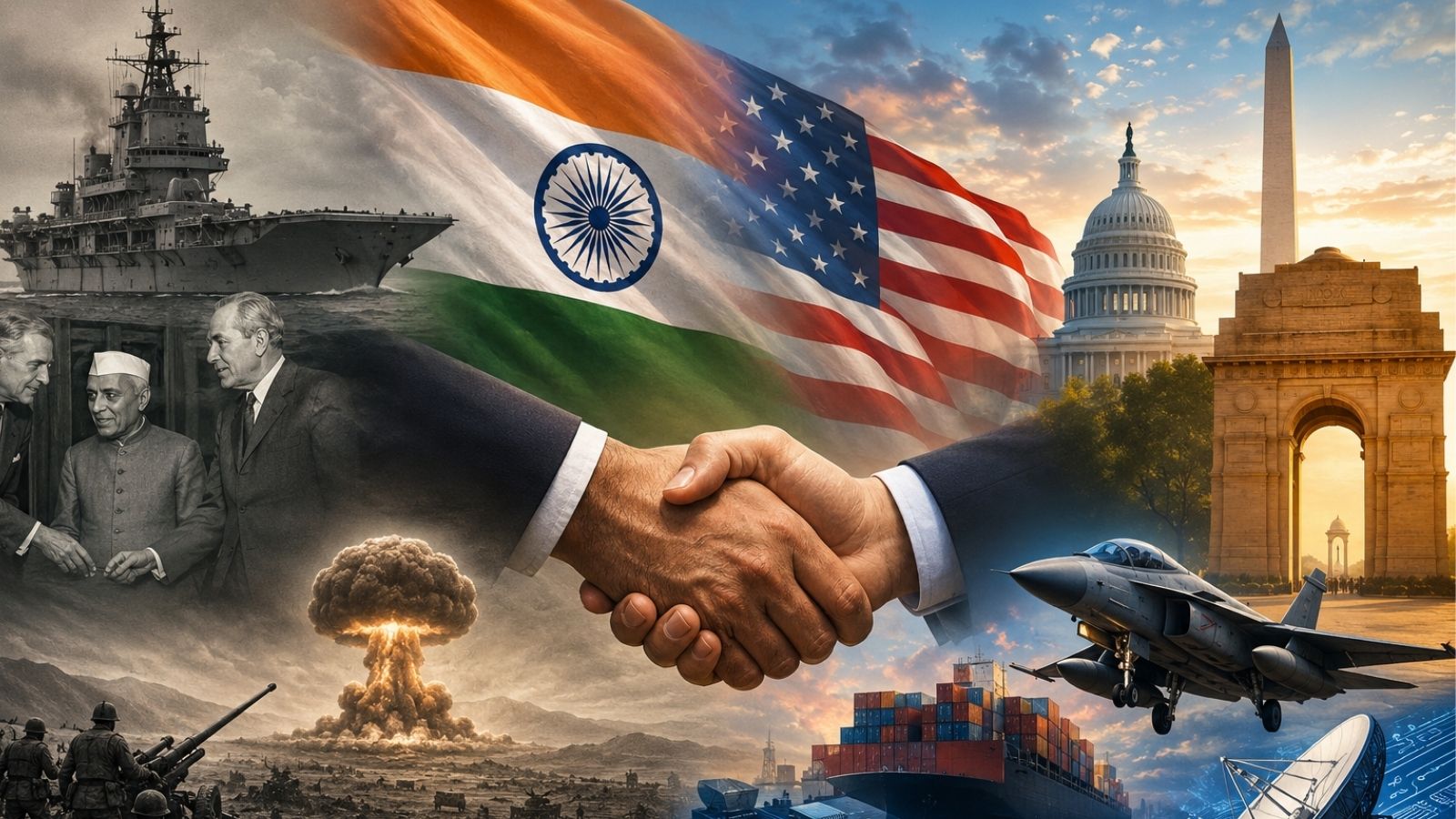
In the sweltering humidity of Washington D.C., July 1947, a young Indian diplomat sat at a mahogany desk, dipping a fountain pen into a glass inkwell. His country was weeks away from birth. Behind him, a map of the world was being aggressively redrawn in shades of American capitalist blue and Soviet communist red. The diplomat, representing a nation bruised by centuries of colonial plunder, wrote a simple directive back to New Delhi: we must breathe the air of freedom, not choose a master.
Halfway across the world, in the frantic, crowded streets of New Delhi, the response was already written in the collective psyche of a traumatized population. India wanted autonomy.
Washington, however, wanted allies.
This was the quiet, friction-filled origin of a relationship that everyone assumed would fail. For decades, it did. It was a story of missed connections, profound cultural misunderstandings, and a mutual stubbornness that kept two of the world’s greatest democracies at a chilly distance. Yet, as the United States celebrates its 250th year of independence, the geopolitical tectonic plates have shifted entirely.
What began as a cold shoulder in the shadow of the Cold War has transformed into something else. It is an alliance forged not out of romantic ideals, but out of absolute, cold-blooded necessity.
The Ghost in the Room
To understand how deep the divide once was, consider a hypothetical family living in Ohio in 1971, watching the evening news. The anchor speaks of a war in South Asia. To the average American viewer, India looked like an existential enigma—a socialist-leaning monolith aligned with the Soviet Union.
Now, change the lens. Consider a family in Kolkata during that exact same week. They looked to the sky, terrified not of Soviet tanks, but of the USS Enterprise, a nuclear-powered American aircraft carrier dispatched by the Nixon administration to the Bay of Bengal to intimidate India during its conflict with Pakistan.
Trust is easy to break. It takes generations to rebuild.
For nearly fifty years, the relationship was defined by these ghosts. The United States viewed India through the transactional prism of the Cold War. If you were not explicitly with Washington, you were against them. India, fiercely protective of its hard-won independence, pioneered the Non-Aligned Movement. They refused to be a pawn on a global chessboard.
When India conducted its peaceful nuclear tests in Rajasthan’s Pokhran desert in 1974, and later in 1998, the American response was swift and merciless. Sanctions. Isolation. Technological embargoes. The message from the West was clear: you are an outsider.
The Indian engineers who watched their computer screens go dark as American software companies pulled support did not forget that feeling. It bred a fierce, stubborn culture of self-reliance. If the West would not share its technology, India would build its own.
The Digital Bridge
Then, the world changed overnight.
The year 2000 arrived, bringing with it a terrifying digital boogeyman known as the Y2K bug. Companies across New York, Chicago, and Silicon Valley panicked. They realized millions of lines of legacy computer code would fail when the clock struck midnight, potentially crippling global banking, aviation, and infrastructure.
They needed an army of programmers. Fast.
They found that army in India. Hundreds of thousands of young Indian engineers, trained in the rigorous institutes that had been starved of Western hardware, stepped into the breach. They did not just fix the code. They proved that the distance between Silicon Valley and Bangalore was irrelevant.
This was the turning point. It was not a diplomatic breakthrough engineered by politicians in tailored suits. It was a organic economic bridge built by twenty-something coders working through the night on dial-up internet connections.
By the time the dust settled, the American corporate elite realized they could no longer view India merely as a impoverished, distant nation. It was a repository of human capital.
The Civilian Nuclear Deal
Political reality eventually caught up with economic truth. By the mid-2000s, both Washington and New Delhi faced a new, looming shadow on the horizon: the rapid, aggressive rise of an assertive China.
Suddenly, the old grudges felt incredibly small.
The ultimate exorcism of the Cold War ghosts happened in 2008 with the signing of the US-India Civil Nuclear Agreement. It was a bureaucratic masterpiece that defied diplomatic logic. The United States effectively recognized India as a de facto nuclear weapons state, bypassing global non-proliferation rules that had isolated New Delhi for decades.
It was an admission of a new reality. The United States needed an anchor in the Indo-Pacific. India needed the technological and military might of the West to balance its northern neighbor.
Consider the sheer scale of the shift. In the 1990s, defense trade between the two nations was virtually zero. Today, it sits at tens of billions of dollars. Indian fighter pilots fly American-made C-130J transport aircraft. American maritime patrol planes land on Indian naval bases to refuel. The two nations navigate the waters of the Indian Ocean together, their radar screens synced, watching the same targets.
The Shared Silicon
Step inside an office building in Seattle or Hyderabad today, and the boundaries of nationality blur completely. The highest echelons of American corporate power—from Microsoft to Alphabet—are led by Indian-born executives who immigrated to the United States in search of opportunity, only to reshape the American economic landscape.
This is no longer a relationship based on buying and selling goods. It is an ecosystem of shared survival.
When the global supply chain crumbled during the early 2020s, highlighting the dangerous vulnerability of relying on a single manufacturing superpower, the directive became urgent. Friend-shoring. The concept is simple: you build your critical technology only in countries you trust.
Now, American semiconductor giants are investing billions in Indian chip packaging facilities. Apple manufactures its latest iPhones in southern India. The critical technologies of the next century—artificial intelligence, quantum computing, and biotechnology—are being co-developed by researchers holding both blue and green passports.
The Weight of the Next Era
Yet, anyone who believes this partnership is a seamless romance is misreading the room. It remains a complex, often frustrating marriage of convenience.
India still buys Russian oil to keep its economy afloat and protect its poorest citizens from skyrocketing energy costs, much to the vocal irritation of lawmakers in Washington. The United States still critiques India’s domestic political landscape, causing sharp reactions from a proud New Delhi that refuses to be lectured on democracy by an external power.
But the friction is different now. It is the friction of partners, not adversaries.
The invisible stakes are staggering. If this partnership fractures, the balance of power in Asia shifts decisively toward authoritarianism. The sea lanes that carry half of the world's container traffic become vulnerable. The open internet risks being carved up into walled gardens governed by state surveillance.
The young diplomat from 1947 would scarcely recognize the world today. The inkwell is gone, replaced by secure fiber-optic lines connecting the White House directly to the Prime Minister’s Office in New Delhi. The United States enters its next quarter-millennium aware that its global preeminence is no longer guaranteed, and India navigates its path toward becoming a global superpower with the wind of American capital at its back.
They are bound together by an intricate web of algorithms, defense pacts, and millions of familial ties spanning two oceans. Two giant, messy, loud democracies, forever arguing, yet fundamentally realizing they cannot afford to let each other fail.