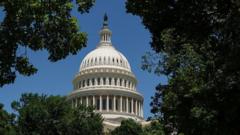
The United States House of Representatives approved a War Powers Resolution to halt military action against Iran, delivering a direct legislative rebuke to President Donald Trump. In a narrow 215-208 vote, a bipartisan majority defied the administration to demand an end to a three-month-old war that has radically disrupted global energy markets and blown a hole through the federal budget. The vote represents a significant crack in the executive branch’s unilateral grip on foreign policy. For the first time in this conflict, the legislative branch has successfully asserted its constitutional authority over an active, undeclared war.
While the White House dismissed the vote as symbolic political theater, the underlying reality points to a deeper crisis. The administration is struggling to maintain a fragile, uneasy ceasefire amid expanding regional hostilities. Capitol Hill is growing increasingly weary of a campaign that has already cost American taxpayers over $100 billion. You might also find this related coverage insightful: The Geopolitical Risk Function of Chokepoint Diplomacy Quantification of the Strait of Hormuz Memoranda.
The Anatomy of a Congressional Rebellion
The passage of the resolution, introduced by House Foreign Affairs Committee Ranking Member Gregory Meeks, succeeded after House Republican leaders spent weeks trying to suppress it. Speaker Mike Johnson previously pulled a scheduled vote before the Memorial Day recess, deploying procedural maneuvers to shield the administration from a public defection. The strategy failed. The extended break did not erode opposition; it solidified it.
When the roll was called, four Republicans broke ranks to vote with an entirely unified Democratic caucus. Representatives Thomas Massie of Kentucky, Brian Fitzpatrick of Pennsylvania, Tom Barrett of Michigan, and Warren Davidson of Ohio crossed the aisle. Representative Jared Golden, a Maine Democrat who had tanked three previous iterations of the resolution in search of a "cleaner" text, also voted in favor, yielding total Democratic unanimity. As highlighted in latest coverage by NBC News, the results are widespread.
This coalition did not form out of sudden pacifism. It formed because the conflict has breached the statutory deadlines of the 1973 War Powers Resolution. Under the law, a president has a 60-day window to secure explicit congressional authorization for military operations, with an optional 30-day extension for defensive withdrawals. The war against Iran passed that 90-day mark in late May.
The administration’s legal defense rests on a fragile premise. The White House argues that because a temporary ceasefire was brokered in April, active hostilities have technically ceased, resetting or halting the statutory clock. It is a highly creative reading of executive authority that many lawmakers find unacceptable. Military strikes between U.S. forces and Iranian targets continue to flare, and the conflict is increasingly entangled with broader clashes involving regional actors.
The $100 Billion Calculation and the Reopen Strategy
Beneath the constitutional debate lies a massive economic calculation. The war has put immense strain on the American economy. Rising fuel costs have hit domestic supply chains, and the open-ended nature of the deployment has drawn fierce criticism from deficit hawks.
"All we need are a handful of Republicans to join us and we can end this reckless and costly war of choice," lawmakers argued on the House floor, pointing directly to the ballooning $100 billion taxpayer bill.
The administration has pinned its hopes on what is known internally as the "reopen strategy." Speaker Johnson defended the military campaign by emphasizing the critical necessity of securing global trade routes. The White House maintains that the entire global economy has a vested interest in keeping the Strait of Hormuz open for commerce. In their view, the deployment is not an optional conflict, but an essential policing action to stabilize international markets.
Yet, the administration has been unable to articulated a clear exit strategy or a path toward a durable peace treaty. Secretary of State Marco Rubio warned that the House vote would severely undermine ongoing diplomatic efforts, suggesting that Iranian negotiators would view a divided American government as a sign of weakness. Rubio argued that if Tehran believes the president's hands are tied by domestic legislation, they will lose any incentive to negotiate a permanent settlement.
The Looming Senate Bottleneck and Veto Reality
The resolution now moves to the Senate, where its legislative journey becomes considerably more complex. Last month, Senate Democrats managed to advance a similar procedural measure with the help of a few Republican defectors. However, a final vote in the upper chamber has yet to be scheduled, and Republican leaders retain significant tools to delay or block a clean up-or-down vote.
Even if the resolution clears the Senate, it faces an insurmountable hurdle at the White House. President Trump will almost certainly exercise his veto power. Overriding a presidential veto requires a two-thirds majority in both chambers—a threshold that neither the House nor the Senate can currently reach given the deeply polarized landscape of Capitol Hill.
Furthermore, the legal authority of the War Powers Resolution itself remains a matter of intense dispute. The executive branch has historically viewed the 1973 law as an unconstitutional infringement on the president’s authority as commander-in-chief. If Congress were to successfully pass a binding resolution, the dispute would likely head to the federal courts. Historically, the judicial branch has gone to great lengths to avoid adjudicating turf wars over war powers between the executive and legislative branches, leaving the policy in a legal gray area.
The true significance of the vote is not found in its immediate legal mechanism, but in its political fallout. The bipartisan coalition in the House demonstrates that executive unilateralism in foreign affairs has clear operational limits when a conflict drags on without a definitive resolution. The administration can no longer assume passive compliance from its own party when the financial and strategic costs of an undeclared war begin to mount.


